

Europe has always been a dream destination for Indians — the history, the architecture, the food, the culture. And with a single Schengen visa, you can explore 29 stunning countries across the continent without changing your visa at every border. France one week, Italy the next, then a weekend in Amsterdam — all on the same visa stamp.
But the Schengen visa for Indians is also one of the most misunderstood and most feared application processes. The rejection rate for Indian applicants sits at approximately 15% — meaning roughly 1 in 7 applications gets refused, and every single rupee you paid is non-refundable. The embassy fee alone is €90 (≈ ₹8,300), and the total cost including VFS service fees, travel insurance, and document preparation typically runs ₹11,000–₹16,000 per person.
The good news: the majority of rejections are entirely preventable. The consulates are not looking for reasons to refuse you — they are looking for evidence that you will follow the rules, enjoy your trip, and return to India. Give them that evidence clearly, and your application will succeed.
This complete guide covers every single aspect of the Schengen visa process for Indians in 2026 — from choosing the right embassy to understanding the new EES border system, building the perfect financial proof, and the cascade rule that can earn you a free 5-year multiple-entry visa.
1.08M
Schengen visa applications from India in 2023 — 3rd highest globally
29
Countries accessible on a single Schengen visa
€90
Official visa fee — identical for all 29 Schengen countries (≈ ₹8,300)
15%
Average rejection rate for Indian applicants (European Commission 2024)
What Is a Schengen Visa — and What Can Indians Do with It?
A Schengen visa (Type C — short stay) is a travel permit issued by a member state of the Schengen Area that allows Indian passport holders to enter and freely travel across all 29 Schengen countries for tourism, business, family visits, or transit — for up to 90 days within any 180-day period.
The key phrase is "within any 180-day period" — this is a rolling window, not a calendar year. This means you must count backwards 180 days from any given date to ensure your combined days in Schengen do not exceed 90. Under the new EU Entry/Exit System (EES) — now live from April 2026 — this tracking is done automatically by digital border systems at every Schengen border. Read our complete guide to the EU EES for Indians for more on how this affects your border experience.
Types of Schengen Visas Available to Indians
Visa Type | Purpose | Who Applies | Max Stay |
|---|---|---|---|
Single Entry | One entry to Schengen Area for one trip | First-time applicants, specific trips | Up to 90 days |
Double Entry | Two separate entries within validity | Specific multi-leg itineraries | Up to 90 days per entry |
Multiple Entry | Unlimited entries within validity period | Repeat travellers, business visitors | 90 days per 180-day period |
2-Year Multiple Entry | Free upgrade for eligible repeat travellers | Indians who lawfully used 2 prior Schengen visas | 90/180 rule applies |
5-Year Multiple Entry | Cascade upgrade — free after 2-year MEV | Indians with clean 2-year MEV history | 90/180 rule applies |
✅ The Cascade Rule — How Indians Can Get a Free 5-Year Schengen Visa: Under the 2019 Schengen Visa Code (now fully active in 2026), Indian travellers who have lawfully used two previous short-stay Schengen visas within the past 3 years automatically qualify for a 2-year multiple-entry visa on their next application — at no extra cost. After lawfully using that 2-year visa, they then qualify for a 5-year multiple-entry visa on the following application — again at no extra cost. This cascade system rewards good travel history with progressively longer and more flexible visas. Keep your visa history clean and use every visa you receive.
The 29 Schengen Countries: Where Your Visa Lets You Go
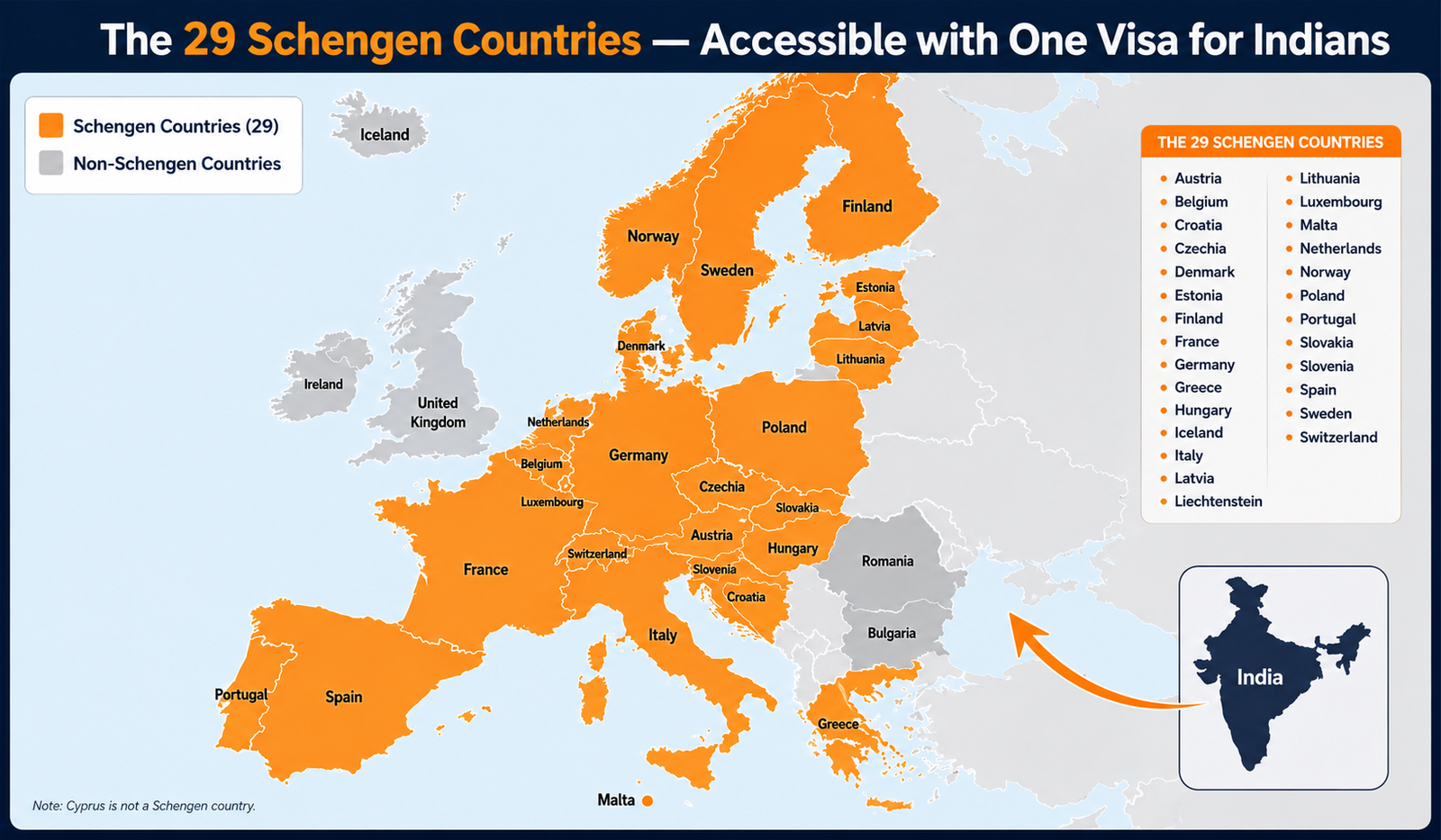
Region | Schengen Countries |
|---|---|
Western Europe | France, Germany, Belgium, Netherlands, Luxembourg, Austria, Switzerland, Liechtenstein |
Southern Europe | Spain, Portugal, Italy, Greece, Malta, Slovenia, Croatia |
Northern Europe | Sweden, Norway, Denmark, Finland, Iceland |
Eastern Europe | Poland, Czech Republic, Slovakia, Hungary, Estonia, Latvia, Lithuania |
⚠ Not Schengen — Do Not Be Confused: The UK, Ireland, Romania, Bulgaria, and Cyprus are EU members but are NOT in the Schengen Area. A Schengen visa does NOT allow you to enter these countries. You need a separate UK visa, Irish visa, or Bulgarian/Romanian/Cypriot visa. Similarly, Switzerland, Norway, Iceland, and Liechtenstein are Schengen members but NOT EU members — your Schengen visa works fine there.
Step 1: Choose the Right Embassy — This Is the Most Common Mistake
The single most common mistake Indian applicants make is applying to the wrong embassy. The rule is clear: you apply to the embassy of the country where you will spend the most days. If you spend equal days across countries — you apply to the embassy of your first point of entry into the Schengen Area.
How to Choose Your Embassy
If visiting one country: Apply to that country's embassy. Example — Paris trip only → French Embassy/Consulate.
If visiting multiple countries: Apply to the embassy of the country where you spend the most nights. Example — 5 nights Italy, 3 nights France, 2 nights Switzerland → Italian Embassy.
If equal days across countries: Apply to the embassy of the country you enter first. Example — 4 days Spain, 4 days Portugal, entering via Madrid → Spanish Embassy.
If only transiting: Apply for an Airport Transit Visa (ATV) from the transit country.
Which Embassies Are Fastest and Most Reliable for Indians?
Embassy | Known For | Avg Processing (2026) | Notes |
|---|---|---|---|
France | High volume but efficient — Paris is the most popular destination | 10–12 working days | Confirmed hotel bookings usually required |
Germany | Very structured — prefers flexible itineraries over rigid bookings | 10–15 working days | Online document upload now available in many cities |
Italy | Thorough — asks for detailed day-by-day itinerary | 12–15 working days | Cover letter is particularly important |
Switzerland | Efficient processing, strong approval rate | 10–12 working days | Good option for strong financial profiles |
Greece | Popular summer destination but higher VAC service fees | 10–15 working days | Higher VFS service charge than most |
Netherlands | Streamlined digital process, English-friendly | 8–12 working days | Strong for business and IT professionals |
Iceland | Very high approval rate, lower competition | 5–10 working days | Less popular so less backlog — good option |
Step 2: Know the Exact Documents Required
Missing even one document from the list below is enough to get your application rejected or returned without processing. Prepare every document in this checklist before booking your VFS appointment.
✅ Complete Schengen Visa Document Checklist for Indians (2026)
Passport: Original valid Indian passport — issued within last 10 years, at least 3 months validity beyond your planned return date, minimum 2 blank pages. Submit with photocopy of all pages including old expired passports (show travel history).
Visa application form: Fully completed and signed Schengen visa application form — available at the respective country's VFS centre or embassy website.
Biometric photographs: 2 recent colour photos — 35mm x 45mm, white background, taken within last 6 months, face covering 70-80% of frame, no glasses.
Travel insurance: Minimum €30,000 medical and repatriation coverage, valid for all 29 Schengen countries, covering the entire duration of your trip + 2 extra days.
Flight reservation: Confirmed or dummy round-trip flight reservation showing entry and exit dates from Schengen Area. Some embassies (France, Italy) want confirmed bookings; others (Germany) accept reservations.
Hotel / accommodation proof: Confirmed hotel bookings for every night of your stay OR invitation letter from host with address and contact details.
Travel itinerary: Day-by-day trip plan — cities you will visit, activities, hotels, travel between cities. Must be consistent with your booking history.
Cover letter: Personal letter explaining purpose of visit, your trip plan, your ties to India, and your commitment to return. One A4 page, clear and specific.
Bank statements: Last 6 months — showing consistent balance (not sudden large deposits), sufficient funds (≈ ₹5,000–9,000 per day of travel), and regular income/transactions.
Income Tax Returns (ITR): Last 2–3 years ITR acknowledgment. Not always mandatory but significantly strengthens financial credibility.
Employment proof: If employed — NOC from employer on letterhead, 3 months payslips, leave approval letter. If self-employed — business registration certificate, 6-month bank statements, ITR. If student — university ID, letter from institution, parent's financials.
Proof of ties to India: Anything showing you will return — property ownership documents, family ties (marriage certificate, children's birth certificates), business registration, employee contract, salary slip showing future salary.
Visa fee payment: €90 (≈ ₹8,300) for adults, €45 for children aged 6–12, free for children under 6. Paid at VFS centre — cash or card depending on embassy.
VFS service fee: Additional charge by VFS Global — varies by country (₹400 to ₹3,125 depending on embassy). Not refundable.
💡 The Cover Letter — Your Most Underestimated Document: Most Indians treat the cover letter as an afterthought. It is not. For a Schengen visa, your cover letter is the narrative that ties all your other documents together. It must explain: Why you are visiting (specific, genuine reasons), Where you are going (consistent with your hotel bookings), How you will fund the trip (consistent with your bank statements), Why you will return to India (job, family, property, business), and What your travel history is. Keep it to one page. Be specific — "I am visiting Paris to see the Musée d'Orsay and the Palace of Versailles, then travelling to Rome for the Colosseum and Vatican Museums" is far better than "I wish to travel to Europe for tourism."
Step 3: Book Your VFS Appointment
Most Schengen embassies in India process applications through VFS Global (or BLS International for some countries). You must book an appointment in advance — walk-ins are not accepted.
VFS Global Centres in India — Major Cities
City | VFS Centre Serving | Book At |
|---|---|---|
New Delhi | All major Schengen embassies | |
Mumbai | All major Schengen embassies | |
Bengaluru | Most major embassies | |
Chennai | Most major embassies | |
Hyderabad | Select embassies | |
Kolkata | Select embassies | |
Pune, Ahmedabad, Chandigarh | Select embassies only |
How to Book Your VFS Appointment
Go to visa.vfsglobal.com — select India as your country and the Schengen country you are applying to
Create an account — you will need a valid email address
Select your appointment location (city), type (tourist/business/family), and choose an available slot
Pay the VFS service fee online — amount varies by country (₹400 to ₹3,125)
Receive appointment confirmation by email — save and print this
⚠ Book Your Appointment Early — Very Early: During peak season (April–August and December), VFS appointments for popular destinations like France, Italy, and Spain can be booked out 6–8 weeks in advance. The official rule is you can apply no earlier than 6 months before your travel date. Apply as close to the 6-month mark as possible. Do not wait until 2–3 weeks before travel — this is the most common reason Indians miss their Europe trips.
Step 4–7: The Complete Application Process (Step by Step)
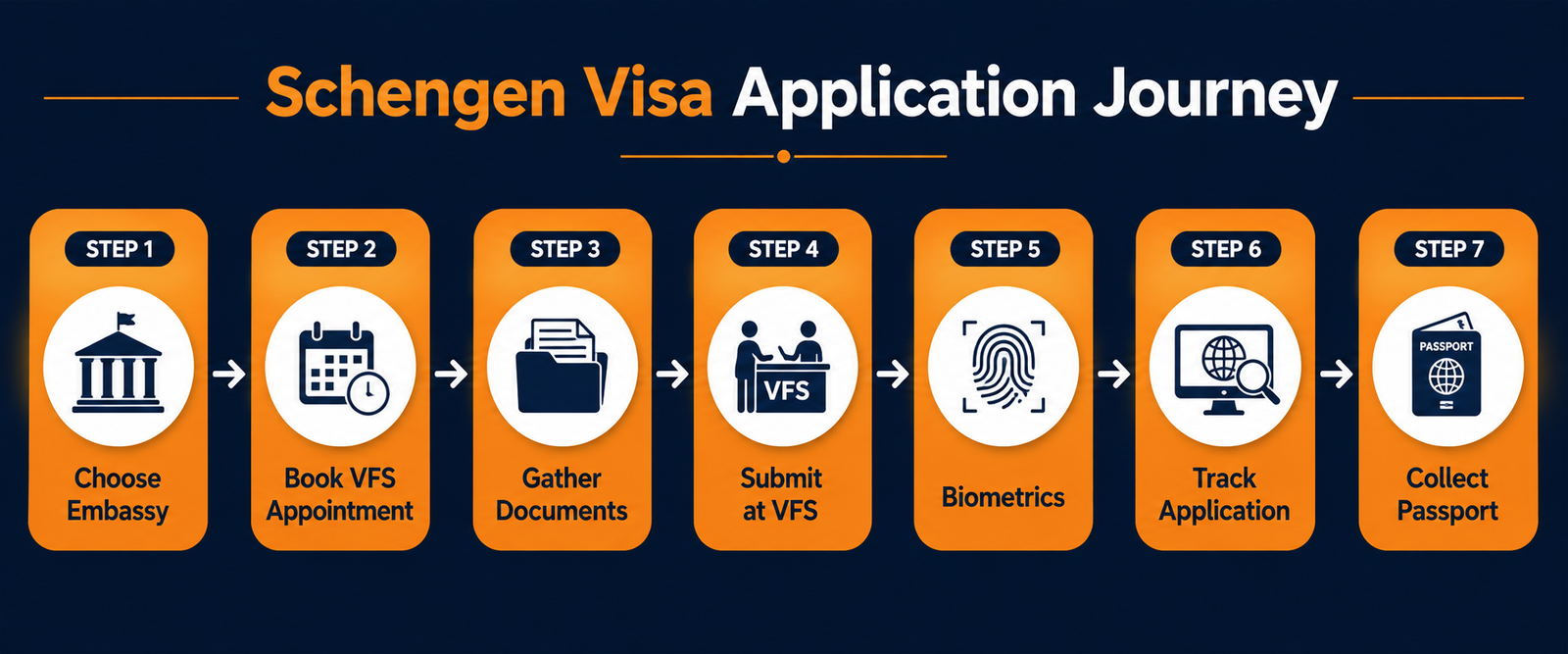
STEP 4
Gather and Organise All Documents
Print every document. Arrange in the exact order the embassy specifies (check the embassy's official VFS instruction page for your target country). Typically the order is: application form → photos → passport → insurance → flight booking → hotel booking → bank statements → employment proof → cover letter.
Use document separators or transparent folders. A well-organised file signals to the officer that you are a serious, prepared applicant. A messy pile of papers creates a poor first impression before they have read a word.
STEP 5
Attend Your VFS Appointment — What to Bring and Expect
Arrive 10–15 minutes before your appointment time. Bring:
Your appointment confirmation (printed or on phone)
Your original passport
All documents (originals where specified + photocopies of everything)
Cash and card for any fees not paid online
At the VFS centre, staff will:
Check your documents for completeness (not approve/reject — that is the embassy's job)
Collect your application and fee
Collect your biometrics — fingerprints (all 10 fingers) and a digital photograph
Issue you a receipt with an application reference number for tracking
Biometrics note: Once enrolled, your fingerprints are valid for 59 months (just under 5 years). If you applied for a Schengen visa within the last 59 months, you may not need to give biometrics again — just document submission.
STEP 6
Track Your Application and Wait for the Decision
After submission, you can track your application status using your reference number at the VFS tracking portal for your target country. Status messages you may see:
"Application received": VFS has sent your file to the embassy — normal
"Under process": Embassy is reviewing — normal
"Decision made": The embassy has decided — does NOT tell you yes or no. You find out only when you collect your passport.
"Passport dispatched": Your passport is on its way back to VFS — collect it in 1–2 working days
Official processing time: 15 calendar days. In practice: most Indian applicants receive a decision within 10–12 working days. During summer peak (June–August), it can extend to 30–45 days. Plan your travel date at least 30 days after your appointment to be safe.
STEP 7
Collect Your Passport — and Read Your Visa Carefully
Collect your passport from the VFS centre (or request courier delivery — paid service). When you receive it, check these details immediately:
Your name: Must match your passport exactly
Validity dates: Confirm the visa covers your entire travel period
Number of entries: Single / Double / Multiple — confirm this matches what you applied for
Duration of stay: How many days you are allowed within the validity period
Visa type: Should say "C" for short stay
If any detail is incorrect — report it to VFS immediately. Errors on the visa sticker are the embassy's mistake and can be corrected free of charge.
Complete Schengen Visa Fee Breakdown for Indians (2026)
Fee Type | Amount | In ₹ (approx) | Refundable? |
|---|---|---|---|
Embassy visa fee — Adult (18+) | €90 | ≈ ₹8,300 | ❌ No |
Embassy visa fee — Child (6–12 yrs) | €45 | ≈ ₹4,150 | ❌ No |
Embassy visa fee — Child under 6 | Free | ₹0 | N/A |
VFS service fee (varies by country) | ₹400–₹3,125 | ₹400–₹3,125 | ❌ No |
Travel insurance (10–15 day trip) | ₹500–₹1,500 | ₹500–₹1,500 | Partially |
Biometric photograph | ₹100–₹600 | ₹100–₹600 | ❌ No |
Document printing/photocopying | ₹200–₹500 | ₹200–₹500 | ❌ No |
Courier passport return (optional) | ₹300–₹600 | ₹300–₹600 | ❌ No |
TOTAL (typical adult application) | — | ₹11,000–₹16,000 | — |
Family of 4 cost estimate: For 2 adults + 2 children aged 6–11, total visa costs alone (before flights and hotels) typically run ₹40,000–₹50,000. This makes document preparation absolutely critical — a rejection means losing this entire amount and paying it again.
Financial Requirements — The Most Critical Section
Insufficient or unconvincing financial proof is the number one reason Schengen visas are rejected for Indian applicants. Here is exactly what the embassy wants to see:
How Much Money Must You Show?
General benchmark: ₹5,000–₹9,000 per day of travel as a maintained balance in your account
For a 10-day trip: maintain ₹50,000–₹90,000 in your account for at least 3 months before applying
For a 15-day trip: maintain ₹75,000–₹1,35,000 consistently
The balance must be existing savings — not money borrowed or suddenly deposited
What Your Bank Statements Must Show
Last 6 months: Submit the most recent 6 months of bank statements — all pages, bank-stamped and signed
Consistent balance: The average balance should comfortably cover your trip cost — not just the last day before your statement was taken
Regular income credits: Salary deposits, business income, rental income — showing a pattern of earning
No large unexplained deposits: A sudden large deposit of ₹5 lakh in the week before your appointment is a red flag. Embassies know this is borrowed money. They want to see the money was already yours.
No large unexplained withdrawals that bring the balance very low
What If Your Bank Balance Is Low?
Show Fixed Deposits — include FD receipts. A ₹5 lakh FD is strong proof even if your savings account balance is low
Show mutual fund portfolio statements
Show property ownership documents (proves you have assets in India to return to)
If a family member is sponsoring your trip — include a sponsorship letter from them with their bank statements and relationship proof
If your employer is sponsoring the trip — include a company sponsorship letter on letterhead
🚨 Never Do This — Instant Red Flag: Do not deposit a large sum of money into your account 1–2 weeks before your VFS appointment just to inflate your balance. Embassy officers see this pattern constantly and treat it as a deception attempt. If the deposit appears suspicious, it will not help your application — it will hurt it. Your financial proof must reflect your genuine, existing financial situation.
Travel Insurance: The Document Most Indians Get Wrong
Travel insurance for a Schengen visa is not just a formality — it is a mandatory requirement, and getting the wrong policy is one of the top rejection reasons. Your policy must specifically state all of the following:
Minimum coverage: €30,000 (not £30,000 or $30,000 — specifically euros)
"Valid for all Schengen states" — exact wording matters. A policy saying "valid for Europe" may not be accepted
Covers medical emergency AND repatriation — both must be mentioned
Covers your entire travel period — from your first entry date to your last exit date
Policy must be pre-paid and confirmed — not just a quote
Recommended Indian Insurance Providers Offering Schengen-Compliant Policies
Bajaj Allianz — Travel Insurance for Schengen (€30,000+ plans available)
HDFC ERGO — Travel Protect Gold (specifically mentions Schengen compliance)
Tata AIG — Travel Guard (available for individual and family Schengen plans)
ICICI Lombard — Travel Insurance (select Schengen-specific plan)
Star Health — Overseas travel plan with Schengen compliance
Cost: typically ₹500–₹1,500 for a 10–15 day trip for an adult. Always compare at least 3 providers before buying. The cheapest compliant option is perfectly acceptable.
Why Schengen Visas Are Rejected — And How to Avoid Each Reason
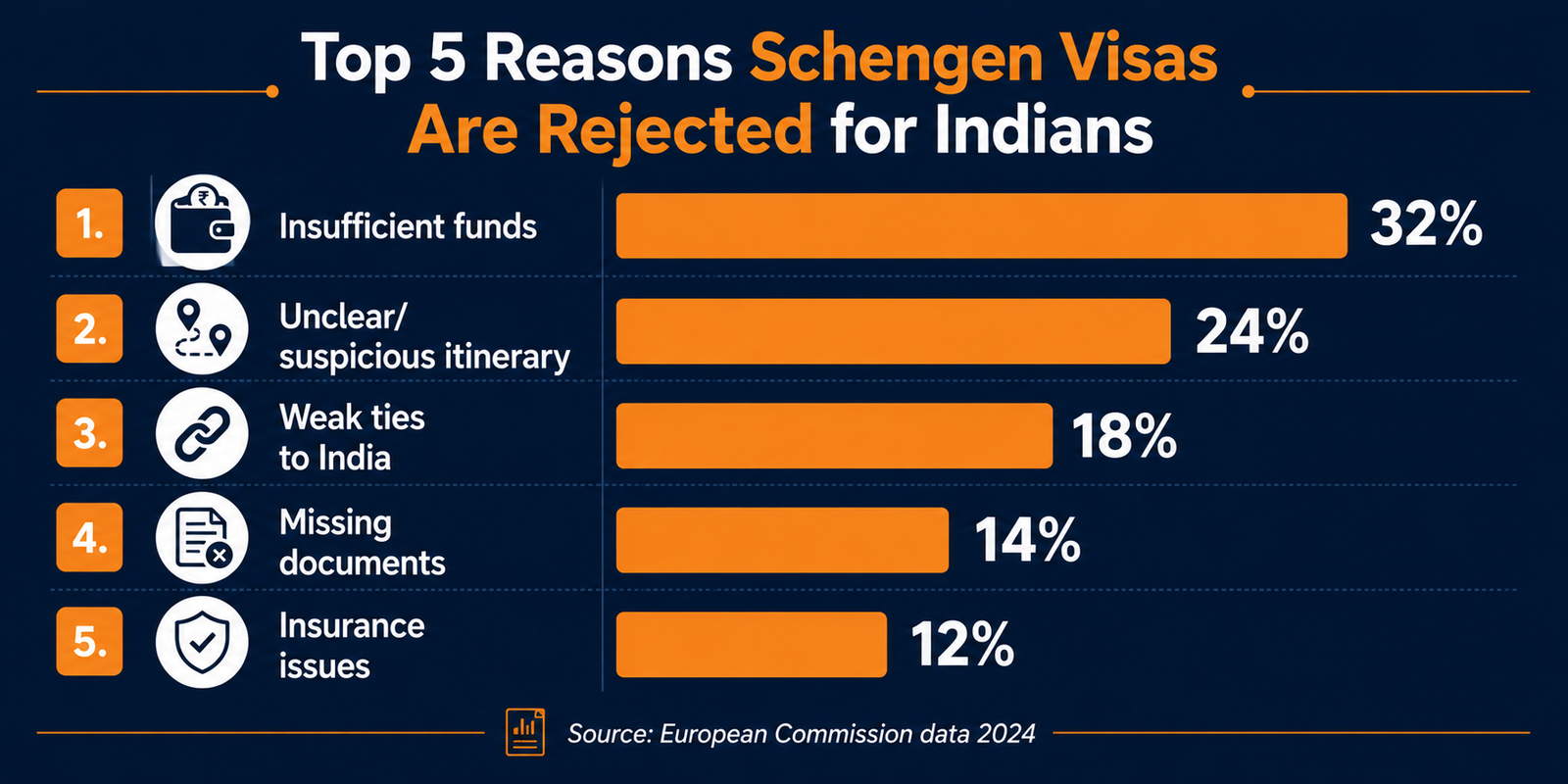
Rejection Reason | What Causes It | How to Avoid It |
|---|---|---|
Insufficient funds (32%) | Low bank balance, inconsistent statements, suspicious deposits | Maintain consistent balance 3+ months before applying. Show FDs and other assets if balance is low. |
Unclear or suspicious itinerary (24%) | Too vague ("travel across Europe"), inconsistent with bookings, unrealistic plans | Create a realistic, day-by-day itinerary that matches your hotel bookings exactly. |
Weak ties to India (18%) | No property, no family, no stable job — no clear reason to return | Include property documents, family tie proof, employer letter confirming your return, ongoing commitments in India. |
Missing documents (14%) | Incomplete checklist, missing translations, unsigned forms | Use embassy's official checklist. Cross-check every item. Sign every page that requires a signature. |
Non-compliant insurance (12%) | Policy doesn't say "all Schengen states", coverage under €30,000, wrong dates | Read insurance certificate carefully before submitting. Call the insurer if any wording is unclear. |
Applied to wrong embassy | Main destination was France but applied to Italian Embassy | Count your nights carefully. Apply to the embassy of your main destination. |
Previous visa violations | Overstayed a previous Schengen visa, entered on wrong port | Always comply with visa terms. Under EES, every overstay is now digitally recorded permanently. |
New in 2026: What Changed for Indian Schengen Applicants
1. EU Entry/Exit System (EES) — Now Live from April 2026
The EU's new digital border system records your biometrics (fingerprints + facial scan) and the exact date and place of every Schengen entry and exit. Your 90-day allowance is now tracked automatically — there is no longer any ambiguity about how many days you have used. Overstays are flagged immediately. Read the complete guide: EU EES — What Indians Visiting Schengen Must Know in 2026.
2. India-EU Mobility Pact — Signed January 2026
India and the European Union signed a significant Mobility and Migration Partnership in January 2026. While the implementing guidelines are still being drafted (expected mid-2026), the pact includes provisions for longer validity visas, streamlined processing, and a Talent Pool for STEM and healthcare professionals. For now, the current application process still applies — none of these changes are in force yet. The unified EU digital application portal is targeted for September 2026.
3. Biometric Fingerprint Validity Extended to 59 Months
Your Schengen fingerprint data collected at VFS is now valid for 59 months (just under 5 years). If you have applied for a Schengen visa within the past 59 months, you may not need to re-submit fingerprints at your next application — only document submission required. The embassy retains the right to request fresh biometrics if needed.
4. Digital Appointment Systems Rolling Out
France, Germany, and the Netherlands now allow online document uploads before your VFS appointment in several Indian cities. This reduces waiting time at the centre — you upload documents online, attend only to submit biometrics (if needed) and pay. Check your specific embassy's VFS page for availability in your city.
5. Cascade Visa System Fully Active
The 2-year and 5-year multiple-entry visa cascade (for Indians with clean prior Schengen history) is now fully operational and being actively applied. If you have lawfully used two Schengen visas in the past 3 years — ask for a multiple-entry visa and reference your clean history in your cover letter.
Pro Tips to Maximise Your Schengen Visa Approval Chances
💡 Tip 1 — Apply Well in Advance: Apply at least 30–45 days before your travel date — ideally more during peak season. The official window is 6 months to 15 days before travel. The earlier you apply, the more time there is to fix any issues, and you avoid the summer backlog. Never apply less than 15 days before travel.
💡 Tip 2 — Strong Travel History Matters: Prior travel to the USA, UK, Australia, Canada, Japan, or Singapore significantly strengthens your Schengen application — it shows you have traveled internationally and returned. Always include photocopies of visas and entry/exit stamps from all your previous international travel.
💡 Tip 3 — First-Timers: Start with an Easier Country: For your first Schengen visa, consider applying through France (high approval rate, clear process), Iceland (lower volume, faster processing, high approval), or Netherlands (efficient, digital-friendly). Once you have a clean Schengen history, future applications become easier everywhere.
💡 Tip 4 — Do Not Over-Book or Under-Book Your Itinerary: Booking 8 different hotels across 8 countries in 10 days raises suspicion — it looks physically impossible and rushed. Booking nothing and saying "I will decide when I arrive" raises suspicion of illegal work intentions. A realistic, well-paced itinerary that matches your budget and timeframe is what the embassy wants to see.
💡 Tip 5 — If Rejected, Learn Before Reapplying: The rejection letter must state the specific reason. Read it carefully. Address every reason mentioned before reapplying. You can reapply immediately after a rejection — but reapplying with the same weak application will result in the same rejection. Fix the problem first.
💡 Tip 6 — ITR Significantly Strengthens Applications: India's Income Tax Return filing is not technically mandatory for a Schengen visa — but it is strongly recommended. An ITR acknowledgment shows stable, declared income over multiple years and significantly increases credibility for financial proof. If you are ITR-eligible, file your returns before applying.
Special Cases: Students, Self-Employed, and Retired Indians
For Students
Submit: University/college admission letter or ID, NOC from institution, parents' bank statements (6 months), parents' employment proof, family sponsorship letter
Reduced visa fee (€35) may apply for students under exchange programs or research activities — check with specific embassy
Strong point: Student visas to study in Europe do not require the same financial proof as tourist visas — your institution's invitation carries weight
For Self-Employed / Business Owners
Business registration certificate (Udyam / GST registration / company incorporation documents)
Last 2 years of ITR with computation of income
6 months business bank account statements (current account)
Brief business introduction letter on your company letterhead explaining why you are traveling
Trade license, partnership deed, or company MoA as applicable
For Retired Individuals / Senior Citizens
Pension statement or retirement benefit documents
Bank statements showing consistent pension credits
Property ownership as proof of strong India ties
Travel insurance with specific coverage for pre-existing medical conditions — especially important for senior citizens
Doctor's letter confirming fitness for international travel (strongly recommended, not always mandatory)
Planning Your First Europe Trip? Get Expert Guidance.
IndiaWale Abroad connects you with verified Schengen visa consultants, Indians already living in Europe, and a growing community of experienced travelers who have successfully navigated the exact process you are planning. Get your application right on the first attempt — your ₹11,000+ is too important to risk on avoidable errors.
Connect with a Visa Expert on IndiaWale Abroad →
Related Guides for Indians Planning to Travel or Move Abroad
👉 EU Entry/Exit System (EES) 2026 — Complete guide for Indians visiting Schengen
👉 Countries Getting Easier for Indians in 2026 — Hidden alternatives to UK and Canada
👉 Germany Blue Card 2026 — Want to work in Schengen? Here's your complete guide
👉 India e-Arrival Card 2026 — Mandatory for OCI holders and foreign nationals returning to India
👉 How to Get a Job Abroad from India 2026 — Want to work in Europe after your trip?
Official External Resources
🔗 VFS Global India — Book Schengen visa appointments for all major embassies
🔗 Schengen Visa Calculator — Check your 90-day allowance before travel
🔗 EU Entry/Exit System (EES) — Official European Commission page
🔗 German Foreign Office — Visa information for Indian applicants
Frequently Asked Questions — Schengen Visa for Indians 2026
Can Indians get a Schengen visa on arrival in Europe?
No. Indian passport holders must obtain a Schengen visa in advance from the embassy or consulate of their main destination country in India — through VFS Global or BLS International. There is no visa-on-arrival and no e-visa option for Indian nationals visiting the Schengen Area for short stays. Apply at least 30–45 days before travel (ideally more during peak season).
How much does a Schengen visa cost for Indians in 2026?
The official embassy fee is €90 (≈ ₹8,300) for adults and €45 for children aged 6–12. Children under 6 are free. In addition, you pay a VFS service charge (₹400–₹3,125 depending on country), travel insurance (₹500–₹1,500), and document costs (₹500–₹1,000). The realistic all-in cost per adult is ₹11,000–₹16,000. For a family of 4, budget ₹40,000–₹50,000 in visa-related costs before flights and hotels. All embassy fees are non-refundable even if rejected.
How long does a Schengen visa take to process for Indians?
The official processing time is 15 calendar days from the date your application reaches the embassy. In practice, most Indian applicants receive a decision in 10–12 working days. During peak summer months (June–August) and December, it can extend to 30–45 days. Apply early — never less than 15 days before your travel date, and ideally 45–60 days before travel during peak periods.
How much bank balance is required for a Schengen visa from India?
There is no fixed minimum, but a practical benchmark is ₹5,000–₹9,000 per day of planned travel as a consistently maintained bank balance over the last 3–6 months. For a 10-day trip, having ₹50,000–₹90,000 maintained consistently is typically sufficient. The key word is "consistently" — the money must already be in your account, not deposited just before applying. You can also strengthen weak bank balances with Fixed Deposits, mutual fund statements, property ownership, or a sponsorship letter from family.
Which Schengen country is easiest for Indians to get a visa from in 2026?
No official "easiest" country exists, but experienced travelers consistently recommend France, Iceland, and the Netherlands for smooth first-time Schengen applications. France has high processing volume but an efficient, well-documented process. Iceland has lower application volumes, very fast processing, and consistently high approval rates. The Netherlands has a streamlined, digital-friendly system ideal for IT and business professionals. Switzerland and Germany are also reliable for well-prepared applications.
How many countries can I visit on a single Schengen visa?
All 29 Schengen countries — you can travel freely between them without additional border checks or separate visas. The 29 countries are: France, Germany, Italy, Spain, Portugal, Netherlands, Belgium, Luxembourg, Austria, Switzerland, Liechtenstein, Sweden, Norway, Denmark, Finland, Iceland, Greece, Malta, Slovenia, Croatia, Poland, Czech Republic, Slovakia, Hungary, Estonia, Latvia, and Lithuania. Note: UK, Ireland, and Romania are NOT Schengen — you need separate visas for those.
What is the Schengen 90-day rule and how does it work for Indians?
The 90/180-day rule means you can stay in the Schengen Area for a maximum of 90 days within any rolling 180-day period — not per calendar year. The 180-day period rolls backwards from any date you choose to count from. This is now tracked automatically by the EU's Entry/Exit System (EES) from April 2026 — every entry and exit is digitally recorded. Use the official Schengen visa calculator before every trip to verify your remaining days. Overstaying — even by one day — is recorded permanently and affects all future Schengen applications.
Can I get a multiple-entry or 5-year Schengen visa as an Indian?
Yes. The Schengen cascade system (fully active in 2026) means: after lawfully using two short-stay Schengen visas within 3 years, you automatically qualify for a 2-year multiple-entry visa on your next application at no extra cost. After lawfully using the 2-year MEV, you then qualify for a 5-year multiple-entry visa — again at no extra cost. The key is using every visa you receive, complying with all conditions, and not overstaying. Clean history is rewarded with progressively longer and more flexible visas.



Comments
No approved comments yet. Be the first to comment.