
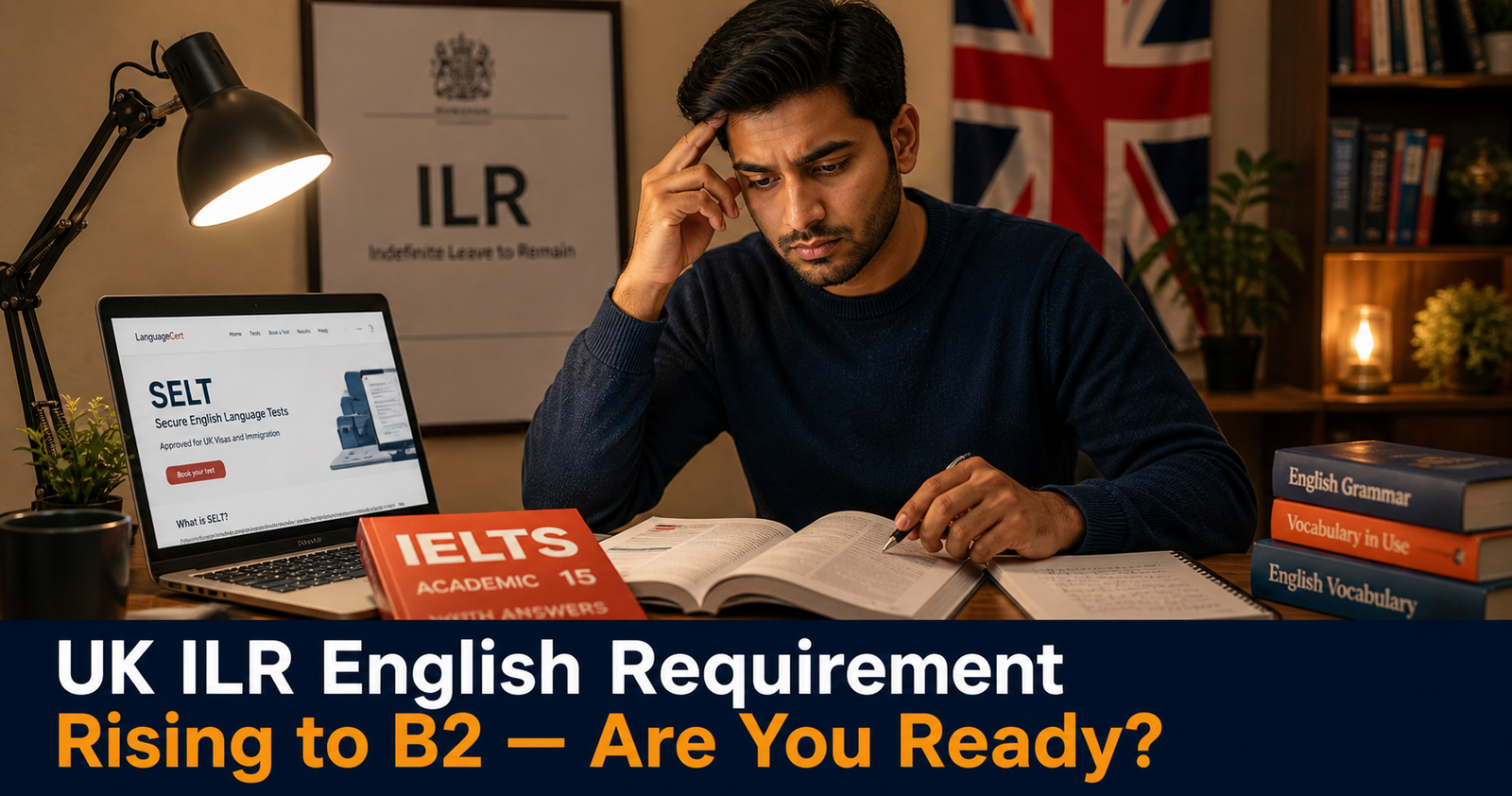
If you are an Indian professional living in the UK on a Skilled Worker visa, a family visa, or any other route that leads to Indefinite Leave to Remain (ILR) — the government has just raised the bar. And most people are not ready for it.
From 26 March 2027, the minimum English language level required to apply for ILR rises from B1 to B2 under the Common European Framework of Reference for Languages (CEFR). This was formally confirmed in the Statement of Changes in Immigration Rules HC 1691, published by the Home Office in March 2026.
B2 is not a small step up. It is described by immigration experts at OTS Solicitors as "equivalent to A-Level standard" — the level at which you can engage confidently in complex conversations, understand nuanced arguments, and express detailed opinions in English. Many Indians who passed B1 years ago for their Skilled Worker visa are nowhere near this level right now.
You have approximately 10 months from today to prepare. This guide tells you exactly what changed, who is affected, what B2 actually means in practice, which tests are accepted, and your precise action plan to be ready before March 2027.
26 Mar
2027: B2 English mandatory for ILR — confirmed in HC 1691
B1→B2
One CEFR level higher — equivalent jump from GCSE to A-Level standard
1.6M
ILR grants expected 2026–2030 — all affected by new B2 rule
10 Months
Time remaining to prepare from May 2026 to the deadline
🚨 URGENT — Check Your ILR Date Now: If your five-year qualifying period ends on or after 26 March 2027, you will need B2 English to apply for ILR. Your B1 certificate from your Skilled Worker visa application will NOT be sufficient. You need a new, higher-level approved English test result specifically for settlement purposes.
What Exactly Changed — And When Was It Decided?
The B2 English requirement for ILR did not come out of nowhere. It is part of the UK government's broader "Earned Settlement" reform agenda — the most significant overhaul of UK settlement rules in a generation.
12 May 2025 — Immigration White Paper Published
UK Government published the Immigration White Paper proposing a fundamental shift to "earned settlement" — where permanent residency must be demonstrated through contributions, integration, and character, not just time served.
20 November 2025 — Consultation Opens
"A Fairer Pathway to Settlement" consultation opens — the public and organisations had until 12 February 2026 to respond. Over 130,000 responses were received, making it one of the most responded-to immigration consultations ever.
8 January 2026 — B2 Already Required for New Skilled Worker Applicants
B2 English becomes mandatory for new applicants on Skilled Worker, Scale-Up, and High Potential Individual routes. This was the first wave — applying to new visa applicants. The ILR change is the second wave.
26 March 2026 — HC 1691 Published: ILR B2 Requirement Confirmed
Statement of Changes HC 1691 officially written into the Immigration Rules — confirming B2 English for ILR applications submitted on or after 26 March 2027. Published by the Home Office with 12 months' notice.
26 March 2027 — B2 ILR Requirement Goes Live
All ILR applications submitted from this date must demonstrate B2 English speaking and listening. Applications submitted before this date are assessed under the existing B1 requirement — no exceptions in either direction.
According to the UK House of Commons Library, the government is also "continuing to consider whether the B2 standard should be extended more widely" — meaning this is not the end of English requirement increases. B2 is the floor, not the ceiling.
B1 vs B2: What Is the Real Difference?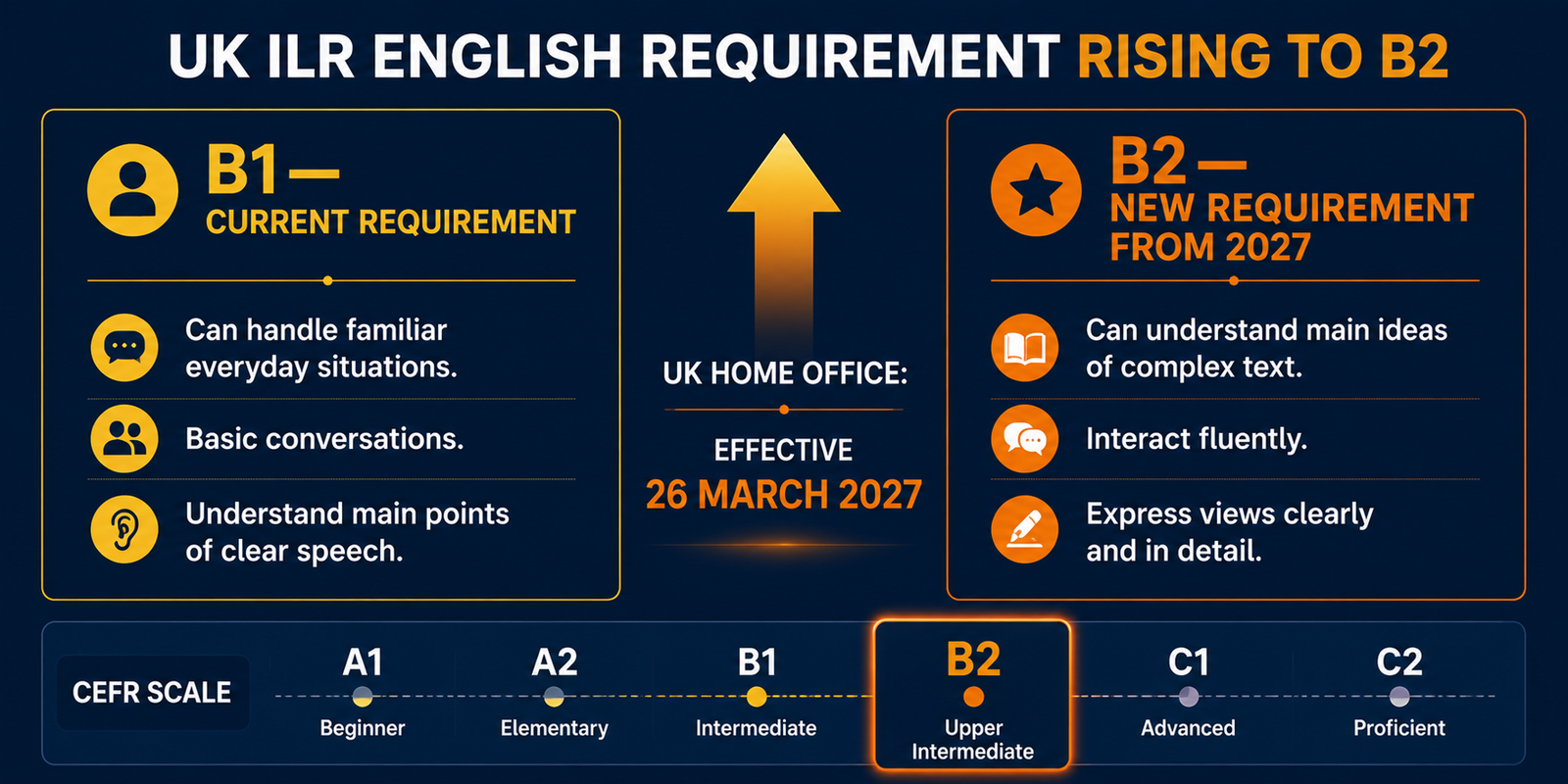
Many people underestimate how significant this jump is. B1 and B2 are not adjacent steps — they represent a meaningful shift in language competence. Here is what the CEFR framework actually says about each level:
Skill Area | B1 (Current — what you passed for your visa) | B2 (Required from March 2027 for ILR) |
|---|---|---|
Listening | Understand the main points of clear, standard speech on familiar topics in work, school, and leisure | Understand extended speech and lectures. Follow complex arguments even when not clearly structured |
Speaking | Deal with most situations likely to arise whilst travelling. Enter into conversations on familiar topics | Interact with a degree of fluency and spontaneity. Take an active part in discussions in familiar contexts, expressing and defending views |
Vocabulary | Sufficient vocabulary for routine, everyday communication | Good range of vocabulary on matters relating to your field and general topics. Can vary formulation to avoid frequent repetition |
Equivalent UK standard | Approximately GCSE grade C/4 level | Approximately A-Level standard (confirmed by OTS Solicitors and immigration experts) |
IELTS equivalent | Overall band 4.0–5.0 (B1 SELT) | Overall band 5.5–6.5 (B2 SELT) |
Real talk for Indians in the UK: Many Indian professionals in the UK are highly competent in written English and workplace communication — but the B2 speaking and listening requirement specifically tests spontaneous spoken English in complex scenarios. The formal SELT (Secure English Language Test) format — with proctored speaking and listening components — is very different from your everyday workplace use of English. You need to prepare specifically for the test format, not just "be good at English."
Who Does the B2 ILR Requirement Affect? (Specifically for Indians)
The B2 requirement does not affect everyone equally. Here is a precise breakdown by visa route and situation — particularly relevant for the Indian community in the UK.
Definitely Affected — Must Have B2 from 26 March 2027
Skilled Worker visa holders applying for ILR on or after 26 March 2027
Innovator Founder visa holders applying for settlement on or after that date
Scale-Up visa holders
High Potential Individual (HPI) visa holders applying for settlement
Family visa (Appendix FM) holders — spouses and partners applying for ILR on or after 26 March 2027
Adult dependants of Skilled Workers applying for their own settlement on or after March 2027
Anyone currently on a B1-qualified route whose 5-year qualifying period ends after 26 March 2027
Not Affected — Can Still Use B1 (or Exempt)
ILR applications submitted before 26 March 2027 — assessed under the current B1 requirement regardless of when the decision comes
People with existing ILR or British citizenship — no change
Applicants who qualify for an English language exemption — age over 65, certain disabilities, certain nationalities from majority English-speaking countries
Applicants whose English language requirement is met by a recognised UK degree — a degree taught in English from a UK institution still satisfies the requirement (the degree must be at or above the level being claimed — a UK bachelor's degree is generally considered B2 equivalent)
⚠ Critical: Adult Dependants Are Assessed Independently
Under the new earned settlement proposals, adult dependants of Skilled Worker visa holders will NOT automatically qualify for ILR at the same time as the main applicant. Each adult must meet the B2 requirement independently. This is a significant change from the current system. If your spouse or adult child is a dependant on your visa — they need their own B2 English certificate too. This is not widely known and is catching many Indian families off guard.
Your Situation | 5-Year End Date | English Requirement | Action Needed |
|---|---|---|---|
Skilled Worker — arrived Oct 2020 | Oct 2025 — Already eligible | B1 still applies | Apply NOW — before March 2027 |
Skilled Worker — arrived Mar 2022 | Mar 2027 | On the borderline — check exact date | Urgent — take legal advice immediately |
Skilled Worker — arrived Sep 2022 | Sep 2027 | B2 required | Start preparing B2 now |
Skilled Worker — arrived Jan 2023 | Jan 2028 | B2 required | Enrol in B2 preparation course |
Family visa — arrived 2023 | 2028 | B2 required | Start B2 preparation |
Already have ILR | N/A | No change | Nothing required |
Which Tests Are Accepted for B2 ILR?
This is where many people make an expensive mistake. Not every English test is accepted for UK ILR purposes. The Home Office requires a Secure English Language Test (SELT) from an approved provider. Your general IELTS certificate from years ago, your Cambridge First Certificate, or your university English qualification may NOT be sufficient.
Home Office Approved SELT Providers for ILR (B2 Level)
Test Provider | Test Name | B2 Equivalent Score | Available in India? | Approx Cost (UK) |
|---|---|---|---|---|
IELTS SELT Consortium | IELTS Life Skills B2 | Pass (speaking and listening only) | Yes (for pre-visa) | £195–£220 |
Trinity College London | ISE II (Integrated Skills in English) | Merit or higher | Selected centres | £195–£220 |
LanguageCert | LanguageCert International ESOL SELT B2 | Pass | No — UK only | £150–£180 |
Pearson | PTE Academic UKVI | 59+ overall | Yes | £195 |
PSI Services | Skills for English UKVI B2 | Pass | No — UK only | £150–£175 |
💡 Important: IELTS Life Skills B2 vs Standard IELTS
For ILR purposes, you need IELTS Life Skills B2 — NOT the standard IELTS Academic or General Training certificate. IELTS Life Skills B2 only tests speaking and listening (the components required for ILR). It is shorter, cheaper, and specifically designed for UK visa and settlement purposes. A standard IELTS overall band score certificate will NOT be accepted for ILR applications. Make sure you book the correct test format.
Can I Use My UK Degree Instead of a Test?
Yes — if you hold a degree from a UK institution taught in English, this can satisfy the English language requirement at B2 level (assuming the degree was at RQF Level 6 or above — typically a UK Bachelor's degree or higher). You do not need to take a separate language test. However, you must submit your degree certificate as evidence with your ILR application. Contact your university for an official letter confirming the language of instruction if your degree certificate does not explicitly state this.
What About Indian Degrees?
An Indian degree, even if taught entirely in English, does NOT automatically satisfy the UK Home Office's English language requirement for ILR. You still need an approved SELT result unless you qualify for a specific exemption. This catches many Indian professionals off guard — their excellent educational background in India does not substitute for a UK-approved English test result.
What If I Already Have a B1 Certificate — Can I Use It?
This is the question IndiaWale Abroad gets asked most frequently about this rule change — and the answer requires careful thought.
Scenario A: Your B1 Certificate Is Still Valid
Most approved SELT results are valid for 2 years from the date of the test. If your B1 certificate was issued within the past 2 years and you apply for ILR before 26 March 2027 — your B1 result may still be valid for your application. Check the date carefully.
Scenario B: Your B1 Certificate Has Expired
If your certificate expired, you need a new test anyway. Since you are taking a new test — take the B2 level test regardless of your ILR date, so you are covered for applications either side of the March 2027 threshold.
Scenario C: You Apply After 26 March 2027 (Most Indians in This Position)
Your B1 certificate — regardless of when it was issued or whether it is still valid — is not sufficient. The Immigration Rules require B2 from that date. You need a new B2 approved SELT result. No exceptions.
✅ The smart move if your ILR date is near March 2027: If your qualifying period ends within 3–6 months of 26 March 2027, speak to an immigration solicitor immediately. Depending on your exact dates, you may be able to apply just before the threshold and qualify under the current B1 rules — saving significant preparation time and cost. This timing decision could determine whether you need B1 or B2. Do not leave this to chance.
The Broader Picture: ILR Is Getting Harder Across the Board
The B2 English requirement is just one part of a fundamental reform of UK settlement rules. Understanding the full picture helps you plan your entire UK immigration journey, not just your English test.
The Earned Settlement Proposal (Not Yet Law — But Likely)
The UK government's Immigration White Paper proposes extending the standard ILR qualifying period from 5 years to 10 years for most migrants. According to the Morgan Smith Immigration review, implementation is targeted for autumn 2026 — though no final date is confirmed. Over 130,000 consultation responses were received, making this the most contested immigration reform in decades.
Under the proposed earned settlement model, your qualifying period can be reduced from 10 years based on:
Contribution Factor | Qualifying Period Reduction | Resulting ILR Timeline |
|---|---|---|
Earn over £50,270 per year | −5 years | 5 years (same as current) |
Earn over £125,140 per year | −7 years | 3 years (faster than current) |
Pass English at C1 level (above B2) | −1 year | 1 year shorter than baseline |
Work in public healthcare or teaching | Potentially −5 years | 5 years (proposed) |
No reductions apply | 0 | 10 years baseline |
What this means for Indians earning well: If you earn above £50,270 as a Skilled Worker — under the proposed earned settlement rules, you would still qualify for ILR in approximately 5 years. The 10-year baseline would not apply. For most senior Indian IT professionals, engineers, and healthcare workers — the practical impact of the timeline extension may be limited, if the salary thresholds are met. But the B2 English requirement applies to everyone, regardless of salary.
For more on the full ILR overhaul, read our complete guide to UK immigration changes for Indians in 2026 and our comparison of UK vs Canada immigration changes 2026.
Your 12-Month Action Plan: How to Be B2-Ready Before March 2027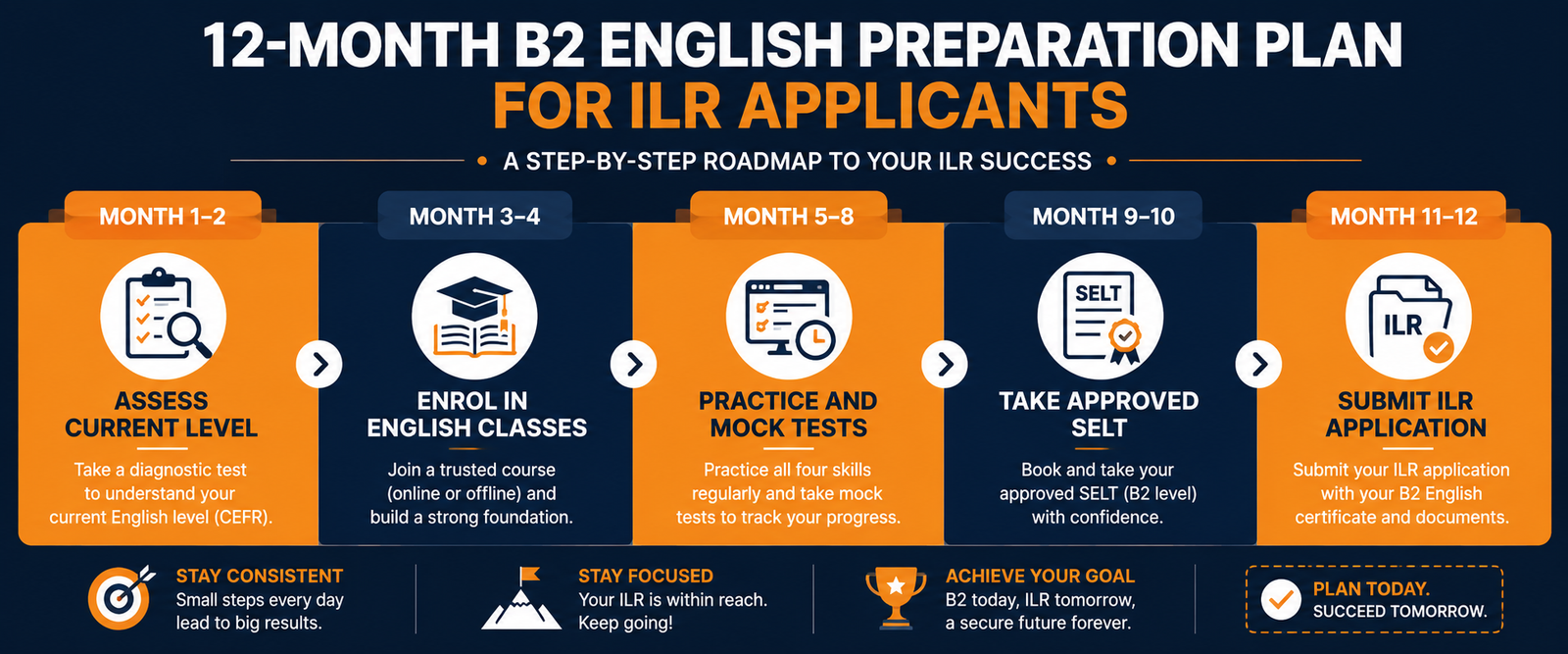
[Insert Content Image 3 here — 12-month roadmap timeline]
Month 1–2 (May–June 2026): Assess Where You Are Right Now
Take a free B2 diagnostic test — Cambridge English offers a free online placement test at cambridgeenglish.org. This tells you your current CEFR level and how far you are from B2
Check your ILR eligibility date — log into the UKVI online portal to confirm exactly when your qualifying period ends
Check if you qualify for an exemption — if you are over 65, have a recognised UK degree, or are a national of a majority English-speaking country — you may not need the test at all
If your ILR date is before 26 March 2027 — consult an immigration solicitor immediately about applying early under the current B1 rules
Month 3–4 (July–August 2026): Enrol and Start Structured Preparation
Enrol in a B2 preparation course — options range from British Council courses (in-person across UK cities), online platforms like Preply and Italki (one-to-one tutoring), to free resources from the BBC and British Council
Focus on speaking and listening — these are the two components tested in the IELTS Life Skills B2 and most SELTs. Written English is not assessed for ILR purposes, so spend 80% of your preparation time on spoken and listening skills
Book a mock test — many approved test centres offer practice exams. Doing a mock under timed conditions reveals where you are weakest before the real test
Month 5–8 (September–December 2026): Intensive Practice Phase
Practice speaking English in complex, structured discussions daily — use BBC Radio 4 and podcasts on complex topics (politics, economics, science) to improve comprehension of sophisticated spoken English
Do 2–3 full mock IELTS Life Skills B2 speaking and listening practice sessions per week
If your speaking confidence is still low at Month 6 — increase tutoring sessions to twice weekly
Target: Consistent B2 performance on mock tests before booking the real exam
Month 9–10 (January–February 2027): Take Your Approved SELT
Book your official SELT test — aim to take it by February 2027 at the latest. This gives you time for a re-sit if needed before March 2027
IELTS Life Skills B2 sittings can book up weeks in advance — do not leave this until February
Book at an approved SELT centre — find approved UK centres at GOV.UK's official SELT guidance page
If you do not pass — you can re-sit. Most providers allow re-sits within 4–6 weeks. If you applied in January and fail — there is still time to re-sit before March 2027
Month 11–12 (February–March 2027): Prepare and Submit ILR Application
Gather all ILR documents: passport, BRP, payslips (last 6 months), P60s (last 5 years), employer letter confirming ongoing employment, B2 SELT certificate, Life in the UK test pass certificate
Submit ILR application before 26 March 2027 if you are applying under B1 rules — or any time after with your B2 certificate if applying under the new rules
Application fee: £2,885 per adult applicant (plus any dependant applications) — budget accordingly
How to Prepare for B2 English: Practical Resources for Indians in the UK
Free Resources
British Council LearnEnglish: learnenglish.britishcouncil.org — free B2-level listening, speaking, and grammar practice with a specific section for IELTS preparation
BBC Learning English: bbc.co.uk/learningenglish — free audio, video, and interactive exercises at all CEFR levels. The "6 Minute English" podcast is excellent for B2 listening practice
Cambridge English Placement Test: cambridgeenglish.org/test-your-english — free, takes 25 minutes, tells you your current CEFR level accurately
IELTS Life Skills B2 sample materials: ielts.org — free sample test papers and speaking prompts for the Life Skills B2 format
Paid Resources Worth Investing In
British Council Courses (in-person across UK cities): britishcouncil.org/english — structured classroom courses specifically targeting B2, with experienced UK-based teachers. Recommended for anyone currently at B1
Preply or Italki (one-to-one online tutoring): 1–2 sessions per week with a qualified English tutor focused specifically on speaking fluency. Cost: £15–35 per hour. Most effective for improving spontaneous speaking
IELTS Preparation apps: IELTS Prep app by British Council, Magoosh IELTS, Ready4IELTS — all have B2-level practice tests with detailed feedback
💡 The Single Best Tip for Indians Specifically: Most Indian professionals in the UK are highly proficient in formal, written English — but B2 Life Skills tests your ability to hold a spontaneous spoken conversation on complex topics. The most effective preparation is regular speaking practice with native or near-native English speakers on topics outside your normal work domain (politics, environment, social issues). Join a public speaking group, a book club, or even a local community group where you discuss diverse topics in English. This real-world practice builds the spontaneous fluency that the speaking test assesses — and that daily IT office conversations do not.
What Happens If You Miss the March 2027 Deadline?
If your ILR qualifying period ends after 26 March 2027 and you apply without a B2 certificate, your application will be refused. This is not a grey area — the Immigration Rules are clear. The consequences of a refused ILR application are serious:
You remain on your current visa — which may be due for renewal, adding cost and uncertainty
A refused ILR application does not affect your legal status immediately, but it creates a record with the Home Office
You may re-apply once you have the B2 certificate — but the application fee (£2,885 per adult) is not refunded on a refused application
If your visa expires while you are preparing your B2 — you enter a gap in lawful status that could have serious long-term consequences
✅ ILR B2 Readiness Checklist — Check Before You Apply (2027)
SELT B2 certificate from an approved provider — valid (issued within last 2 years)
Life in the UK test pass certificate — still valid
5-year continuous lawful residence confirmed — check via UKVI portal
Absences from the UK within 5 years — total must be under 180 days
Valid passport covering the 5-year period (or evidence of previous passports)
Employment evidence — letter from employer, payslips (6 months), P60s (5 years)
BRP (Biometric Residence Permit) — current and valid
Application fee ready — £2,885 per adult applicant (May 2026 rate; check current fee at time of application)
Adult dependants — each has their own B2 certificate independently
Solicitor review (recommended) — especially if any gaps, absences, or complex history
Exemptions: Who Does NOT Need B2?
Not everyone will need to take a B2 test. The following categories remain exempt — but the list has not expanded, and the Home Office applies exemptions strictly:
Exemption Category | Condition | Evidence Needed |
|---|---|---|
Age — over 65 at time of ILR application | Automatic exemption | Passport showing date of birth |
UK degree or higher qualification | Degree taught in English, at RQF Level 6+ from a UK institution | Degree certificate + university language of instruction letter |
Majority English-speaking nationality | Nationals of certain countries (USA, Australia, Canada, NZ, etc.) — NOT India | Passport confirming nationality |
Physical or mental condition | Long-term condition preventing language learning — must be certified | Medical certificate from a qualified practitioner |
Degree from certain overseas institutions | If the degree meets the Home Office's overseas qualification equivalency | Degree certificate + NARIC/ECCTIS equivalency statement |
🚨 Indian nationals are NOT exempt on nationality grounds. India is not on the majority English-speaking country list. Every Indian national applying for ILR on or after 26 March 2027 (who does not have a qualifying UK degree) must take and pass an approved B2 SELT. No exceptions on the basis of being Indian, fluency claims, or workplace English use.
Not Sure If You Are Affected — Or Where to Start?
IndiaWale Abroad connects you with verified UK immigration solicitors and IELTS/SELT preparation experts who work specifically with the Indian community in the UK. Get a 30-minute consultation — understand exactly where you stand and what you need to do before March 2027.
Find a UK Immigration Expert on IndiaWale Abroad →
Related Guides for Indians Living in the UK
👉 UK Visa Fee Hike April 2026 — full breakdown of new costs for Indians including ILR fee increase
👉 UK Skilled Worker Salary Threshold £41,700 — are Indians still eligible?
👉 Canada vs UK in 2026 — which country is now easier for Indian immigrants?
👉 Germany Blue Card 2026 — ILR in 21 months as an alternative to the UK's longer settlement wait
👉 Building your Indian community in the UK — finding support while you settle
Official External Resources
🔗 UK GOV.UK — Approved SELT providers and test requirements for visa and settlement
🔗 Home Office HC 1691 — Official Statement of Changes confirming B2 requirement (March 2026)
🔗 House of Commons Library — Full analysis of UK visa and settlement rule changes 2025–2027
🔗 UKVI — Check your immigration status and qualifying period online
Frequently Asked Questions — UK ILR B2 English Requirement 2027
When does the B2 English requirement for UK ILR start?
The B2 English requirement for ILR comes into effect on 26 March 2027. It was formally confirmed in the Home Office's Statement of Changes HC 1691 published in March 2026. Applications submitted before 26 March 2027 are assessed under the current B1 requirement. Applications submitted on or after that date must demonstrate B2 English where the Immigration Rules require a language test. This is a fixed date with no flexibility.
Does my B1 certificate from my Skilled Worker visa application count for ILR?
Not if you apply on or after 26 March 2027. Even if your B1 certificate is still within its 2-year validity period, it will not satisfy the settlement requirement once B2 becomes mandatory. You will need a new B2 approved SELT result specifically for your ILR application. If your ILR date is before 26 March 2027 and your B1 certificate is valid, you may still use it — but check the expiry date carefully and apply as early as possible.
Which English test should I take for ILR B2?
The most popular choice for Indians in the UK is IELTS Life Skills B2 — it only tests speaking and listening (the components required for ILR), takes about 22 minutes, and results come within 5 working days. Important: You need IELTS Life Skills B2 specifically — not the standard IELTS Academic or General Training. Other accepted tests include Trinity ISE II, LanguageCert International ESOL SELT B2, PTE Academic UKVI, and Skills for English UKVI. All must be taken at an approved SELT centre. Always verify the approved provider list on GOV.UK before booking.
Does my Indian degree count as B2 English for ILR?
No. An Indian degree, even if taught entirely in English, does not satisfy the UK Home Office's English language requirement for ILR. Only a degree from a UK institution recognised by UKVI satisfies the requirement. If you have a UK bachelor's degree or higher (taught in English), you are generally exempt from the language test. If your degree is from India — you need an approved SELT regardless of your English proficiency.
Does my spouse or adult child also need B2 English for their ILR?
Yes — if they are applying for ILR on or after 26 March 2027. Under the new rules, adult dependants are assessed independently for ILR requirements including English language. Your spouse cannot rely on your English test result. Each adult applicant needs their own B2 SELT certificate. Children under 18 and applicants over 65 may be exempt — check the specific route requirements for each family member.
Will B2 English also reduce my ILR qualifying period?
Under the proposed (not yet confirmed) earned settlement rules, achieving C1 English (one level above the B2 minimum) would reduce the qualifying period by 1 year. B2 itself is the minimum requirement — it does not earn a reduction. Achieving C1 or above on your SELT could therefore save you a year in the earned settlement framework when it is finalised.
I arrived in the UK in early 2022. Do I need B2 or B1 for my ILR?
It depends on your exact arrival and qualifying period start date. If your 5-year qualifying period ends before 26 March 2027 and you submit your application before that date — B1 still applies. If you arrived in, say, March 2022 — your 5-year period ends in March 2027, right at the threshold. This is the highest-risk group and you should consult an immigration solicitor immediately to identify the exact earliest date you can apply and whether B1 or B2 applies to your specific situation.
Is the 10-year ILR qualifying period already in force?
As of May 2026, no — the five-year ILR route remains in force for all current routes. The proposal to extend the qualifying period to 10 years is part of the earned settlement consultation, which closed in February 2026 with over 130,000 responses. The Home Office is reviewing responses and implementation is targeted for autumn 2026, though no binding date has been set. The B2 English requirement (from 26 March 2027) is separate from the qualifying period change and is already written into the Immigration Rules. Monitor GOV.UK for any updates on the qualifying period change.


Comments
No approved comments yet. Be the first to comment.