
Imagine earning ₹55 lakh a year in one of Europe's most stable economies — with a clear path to permanent residency in just 21 months and the right to bring your entire family along. That is exactly what Germany's EU Blue Card offers Indian professionals in 2026.
Germany is actively looking for skilled workers. The country faces a shortage of over 96,000 IT specialists alone, plus massive gaps in engineering, healthcare, and data science. India produces the talent Germany desperately needs. The Germany Blue Card 2026 is the direct bridge between your career in India and a high-paying, stable future in Europe.
From 1 January 2026, Germany updated its EU Blue Card salary thresholds, eligibility rules, and shortage occupation lists. This guide covers everything Indian professionals need to know — salary numbers, eligibility criteria, documents required, the exact application process, and how to achieve German PR as quickly as possible.
€50,700
Min. salary 2026 — standard occupations (≈ ₹55.8 lakh/year)
€45,934
Shortage occupations: IT, Engineering, Healthcare (≈ ₹50.5 lakh/year)
21 Months
Fastest PR timeline with B1 German language
96,000+
IT specialist vacancies in Germany — Indians highly sought after
What Is the Germany Blue Card? (Simple Explanation)
The EU Blue Card (Blaue Karte EU) is Germany's premium work and residence permit for highly qualified professionals from non-EU countries. Think of it as a VIP work visa — it gives you the right to live, work, and eventually settle permanently in Germany, with far better conditions than a standard work visa.
It is issued under Section 18g of the German Residence Act and is specifically designed for people with university-level qualifications (or equivalent IT experience) who have a job offer meeting Germany's minimum salary threshold.
Key Benefits of the Germany Blue Card for Indians
Benefit | Details |
|---|---|
PR in 21–33 months | Fastest permanent residency route in Europe. 21 months with B1 German, 33 months without |
Family reunification | Spouse and children can join you immediately — spouse gets full, unrestricted work rights in Germany |
EU mobility | After 12 months, you can move and work in other EU countries under simplified rules |
High salary | Minimum €45,934–€50,700/year — significantly higher than equivalent Indian salaries |
No dual citizenship sacrifice | Since Germany's 2024 Nationality Act, you no longer have to give up your Indian passport to get German citizenship |
Permit validity | Initially issued for up to 4 years (or contract duration + 3 months) |
Schengen travel | 90 days visa-free across all 29 Schengen countries every 180 days |
Why Germany over UK or Canada? The UK now requires 10 years for ILR (permanent residency). Canada's PR targets are cut to 380,000 in 2026 with rising competition. Germany's Blue Card offers PR in 21 months — making it the fastest PR pathway available to Indians in any major Western country right now.
Germany Blue Card Salary 2026: Exact Requirements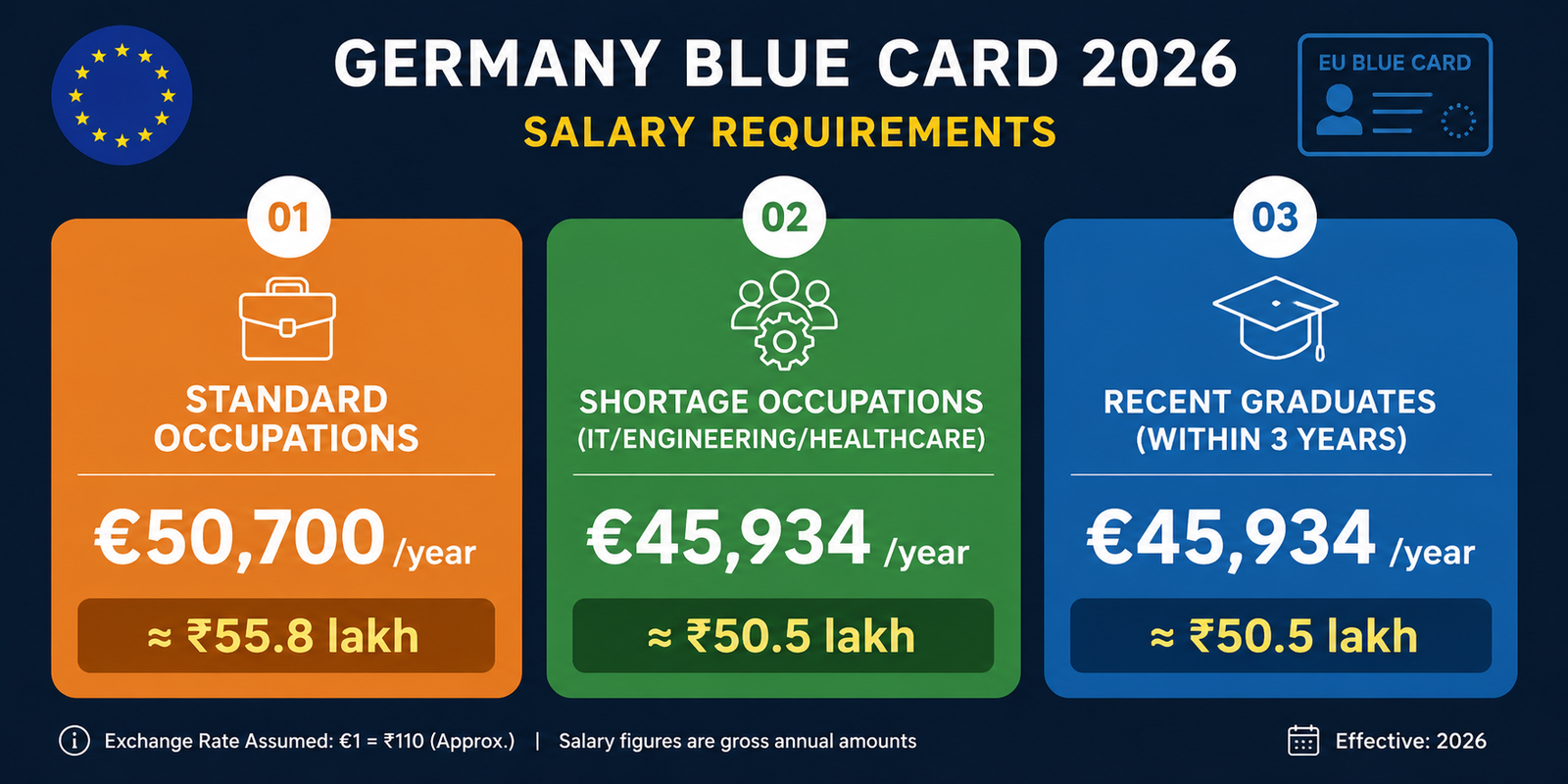
The most important number you need to know for the Germany Blue Card 2026 is your minimum salary. These thresholds are updated every year by the German Federal Ministry of the Interior, tied to Germany's national pension insurance ceiling. From 1 January 2026, the new figures are confirmed as follows.
[Insert Content Image 1 here — Salary comparison cards infographic]
Category 1: Standard Occupations — €50,700 per year
This applies to most professional roles in Germany that are not specifically listed as shortage occupations. It translates to approximately €4,225 per month (≈ ₹4.65 lakh per month or ₹55.8 lakh per year).
No Federal Employment Agency (BA) approval needed
Faster processing since employer approval is not required
Covers roles in management, finance, architecture, law, consulting, and non-shortage tech roles
Category 2: Shortage Occupations — €45,934.20 per year
If your profession is on Germany's official shortage occupation list (Mangelberufe), you qualify at the lower threshold of €45,934.20 per year (≈ €3,828/month or ₹50.5 lakh/year). This covers the vast majority of Indian applicants.
Federal Employment Agency approval is required — but this is arranged during the visa process, not by you
Shortage occupations include: Software engineers, data scientists, AI/ML engineers, cybersecurity specialists, mechanical/electrical/civil engineers, doctors, pharmacists, healthcare managers, scientists, mathematicians
Germany's expanded 2026 shortage list means more Indian professionals qualify at this lower threshold
Category 3: Recent Graduates — €45,934.20 per year
If you completed your last degree or equivalent qualification within the past 3 years, you automatically qualify for the lower shortage threshold regardless of your occupation. This is excellent news for Indian students who studied in Germany or recent engineering and IT graduates from India.
Salary Comparison: Germany vs India
Role | Typical India Salary (Annual) | Germany Blue Card Salary (Annual) | Difference |
|---|---|---|---|
Software Engineer (5 yrs exp) | ₹12–18 lakh | ₹55–65 lakh (€50K–€59K) | 3–4x higher |
Data Scientist (4 yrs exp) | ₹14–22 lakh | ₹52–70 lakh (€47K–€63K) | 3x higher |
Civil/Mechanical Engineer | ₹8–14 lakh | ₹50–60 lakh (€45K–€55K) | 4–5x higher |
Medical Doctor | ₹10–20 lakh | ₹60–90 lakh (€55K–€82K) | 4–5x higher |
AI/ML Engineer | ₹18–30 lakh | ₹55–88 lakh (€50K–€80K) | 2.5–3x higher |
Exchange rate used: €1 = ₹110 (April 2026). Rates change — verify before planning.
💡 Pro Tip — German Language = More Salary: Companies in Germany often offer 10–20% higher salaries to candidates who can communicate in German. One Indian software engineer in Munich received an initial offer of €52,000 — which was raised to €58,000 after he demonstrated B2 German. That's ₹6.6 lakh extra per year just for learning a language. Start German classes now, even before you have a job offer.
Who Is Eligible for the Germany Blue Card? (Indian Professionals)
The EU Blue Card Germany eligibility for Indians falls into three clear routes. Understanding which route you qualify for determines your salary requirement and process.
Route A: University Degree Holder (Standard Route)
Hold a recognised university degree (Bachelor's, Master's, or PhD)
Indian degrees are generally accepted — check your specific degree on the Anabin database (Germany's official recognition database)
Job offer from a German employer with salary ≥ €50,700/year (standard) or ≥ €45,934.20/year (shortage occupation)
No German language requirement for the Blue Card itself
Route B: Shortage Occupation Professional (Most Common for Indians)
Same as Route A but your specific field is listed as a shortage occupation
Lower salary threshold of €45,934.20 applies
Covers most Indian applicants in IT, engineering, and healthcare
Recent graduates (degree within 3 years) also qualify at this lower threshold
Route C: IT Professional WITHOUT a Degree (Game-Changer for Indian Tech Workers)
This is the most exciting change for Indian IT professionals. Since 2025 (fully applied 2026), Germany's official Make it in Germany programme allows IT specialists to qualify for the Blue Card WITHOUT a university degree if they meet all of the following:
At least 3 years of relevant IT work experience within the last 7 years
Experience must be equivalent to university graduate level
Signed employment contract with a German company in the IT sector
Salary meets shortage occupation threshold: €45,934.20/year
Federal Employment Agency (BA) approval required — arranged during visa process
✅ Big win for Indian IT workers: Millions of skilled Indian software developers, system administrators, network engineers, and tech professionals who never completed a formal degree can now qualify for Germany's most powerful residence permit — based purely on their work experience. This is unprecedented access to European immigration for non-degree holders.
Who Does NOT Qualify
People without a job offer from a German employer (unless applying for the Chancenkarte/Opportunity Card instead)
Those whose job offer salary falls below the applicable threshold
Degree not recognised or equivalent — check Anabin before applying
Roles that are not professional/university-level positions
Documents Required for Germany Blue Card Application
✅ Germany Blue Card Document Checklist for Indians (2026)
Valid Indian passport — minimum 6 months validity beyond intended stay, at least 2 blank pages
Signed job offer letter or employment contract from German employer — must clearly state annual gross salary
University degree certificate — original + certified English/German translation
Degree recognition proof — Anabin database confirmation, Statement of Comparability from anabin.kmk.org or KMK
Academic transcripts / marksheets — certified translation required
Proof of work experience — employment letters, payslips, tax returns (last 2–5 years, especially for IT no-degree route)
Biometric passport photographs — 35mm x 45mm, recent, white background
Completed German National Visa (Type D) application form
Travel health insurance — minimum €30,000 coverage for Germany/Schengen area
Proof of accommodation in Germany — landlord confirmation, hotel booking, or employer-arranged housing
Proof of German language knowledge (if aiming for 21-month PR track) — Goethe-Institut certificate A1/B1
For IT no-degree route: Detailed CV showing 3+ years IT experience, reference letters from previous employers
Visa fee: €75 (payable at German Embassy or consulate in India)
⚠ Degree Recognition is Critical: Many Indian applicants are rejected not because of salary or experience — but because their degree is not formally recognised. Check your institution and degree at anabin.kmk.org before applying. IIT, IIM, NIT, and major state universities are generally well-recognised. Smaller private colleges may need a Statement of Comparability from the KMK — this takes 4–6 weeks.
Step-by-Step Application Process for Germany Blue Card from India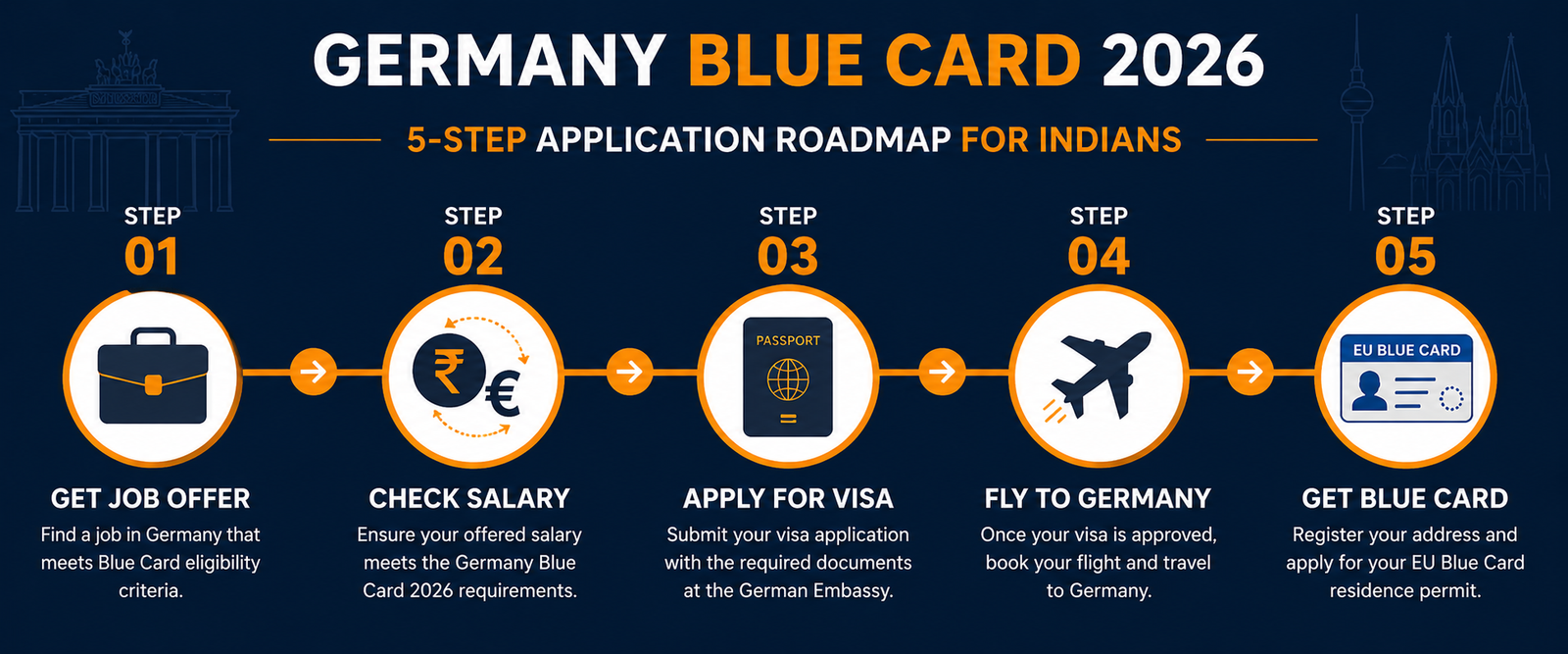
[Insert Content Image 2 here — 5-step application roadmap]
STEP 1
Get a Job Offer from a German Employer
This is the foundation of everything. Without a signed job offer meeting the salary threshold, there is no Blue Card application. Use these platforms to find German employers actively hiring Indians:
Make it in Germany job portal (official German government platform)
LinkedIn — search "Germany" + your role + "visa sponsorship"
StepStone.de and XING (Germany's leading job portals)
Direct applications to German companies — many Indian professionals get referrals through the Indian diaspora in Germany
Work Abroad job listings on IndiaWale Abroad — verified overseas opportunities for Indians
Timeline: 1–6 months depending on your sector and how actively you apply.
STEP 2
Verify Your Salary and Eligibility
Once you have a job offer, confirm two things before proceeding:
Is the annual gross salary at least €50,700 (standard) or €45,934.20 (shortage occupation/recent graduate)?
Is your degree recognised in Germany? Check at anabin.kmk.org
Is your occupation on Germany's shortage list? Check at make-it-in-germany.com
If the salary is below threshold — negotiate with your employer. Many German employers adjust the offer specifically to meet Blue Card eligibility — especially for shortage occupations where they desperately need you.
STEP 3
Apply for the Germany National Visa (Type D) at German Embassy in India
The Germany Blue Card is NOT applied for from India. You first apply for a long-stay National Visa (Type D) at the German Embassy or Consulate in India (Delhi, Mumbai, Bengaluru, Chennai, Kolkata).
Book your appointment at the German Embassy India website
Attend appointment with all documents from the checklist above
Pay visa fee: €75
Provide biometrics (fingerprints and photo) at the embassy
Processing time: Germany's new digital visa portal (launched February 2026) has cut processing from 8–12 weeks to approximately 4–6 weeks
STEP 4
Travel to Germany and Register Your Address
Once your National Visa is approved, fly to Germany and within 14 days of arrival:
Register your address at the local registration office (Einwohnermeldeamt / Bürgeramt) — this is mandatory by German law
Open a German bank account (required for salary payments and the Blue Card process)
Register for health insurance — either public (Techniker Krankenkasse, AOK) or private (mandatory for Blue Card)
Obtain your Tax ID (Steuer-ID) — arrives by post within 2–3 weeks of address registration
STEP 5
Apply for the EU Blue Card at the Foreigners' Registration Office
Once you are in Germany and have your address registration, apply for the actual Blue Card at your local Ausländerbehörde (Foreigners' Registration Office / Immigration Office).
Book an appointment at your local Ausländerbehörde — can now be done online in most German cities
Bring your original documents: passport, employment contract, degree certificate with recognition, address registration certificate, health insurance proof
Pay the fee: approximately €100–135
Blue Card is typically issued within 2–4 weeks of the appointment
Initial Blue Card validity: up to 4 years (or contract duration + 3 months)
💡 Pro Tip — German Language Speeds Everything Up: You do not need German to get the Blue Card. But if you have B1-level German, you qualify for PR in 21 months instead of 33 months — saving 12 months of uncertainty. Start learning German the moment you decide Germany is your goal. Free resources: DW Learn German (dw.com/learn-german), Goethe-Institut online courses.
Best Jobs in Germany for Indian Professionals (Blue Card Eligible)
Sector | Key Roles | Shortage Threshold? | Avg. Annual Salary (Germany) |
|---|---|---|---|
IT & Software | Software Engineer, DevOps, Data Scientist, Cloud Architect, AI/ML Engineer, Cybersecurity Analyst | ✅ Yes — €45,934 | €52,000–€75,000 |
Engineering | Mechanical, Electrical, Civil, Automotive, Aerospace Engineer | ✅ Yes — €45,934 | €50,000–€68,000 |
Healthcare & Medicine | General Practitioner, Specialist Doctor, Pharmacist, Dentist | ✅ Yes — €45,934 | €55,000–€90,000 |
Data & Analytics | Data Engineer, Business Intelligence Analyst, Data Architect | ✅ Yes — €45,934 | €52,000–€72,000 |
Finance | Financial Analyst, Risk Manager, Quantitative Analyst | ⚠ Check list | €55,000–€80,000 |
Research & Academia | University Researcher, Scientist, Research Associate | ✅ Yes — €45,934 | €48,000–€65,000 |
For Indians without a degree — IT is your door: Germany needs approximately 96,000 additional IT specialists by 2026. The Blue Card Route C (no degree needed) is specifically designed to attract skilled Indian tech workers who may not have formal degrees but have strong, demonstrable experience. If you have 3+ years in IT — Germany is actively looking for you.
Germany PR via Blue Card: Timeline and Benefits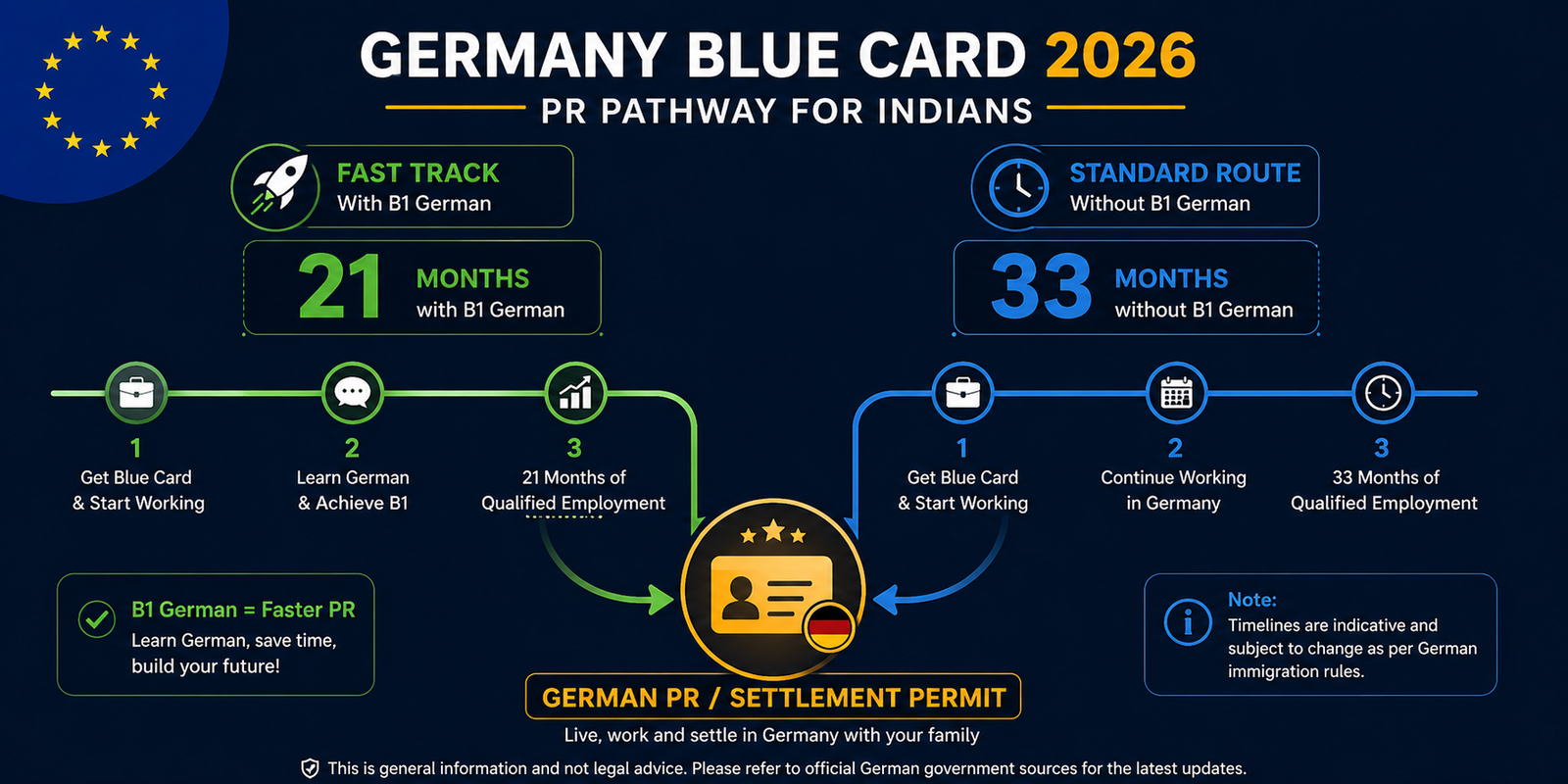
[Insert Content Image 3 here — PR timeline split-screen infographic]
The Germany PR via Blue Card is one of the fastest permanent residency pathways in the Western world. Here is exactly how it works:
Language Level | PR Timeline | What You Need |
|---|---|---|
B1 German (conversational) | 21 months | Valid Blue Card + B1 certificate + employment continuity |
A1 German (basic) | 27 months | Valid Blue Card + A1 certificate + employment continuity |
No German (or below A1) | 33 months | Valid Blue Card + employment continuity (no language requirement for PR itself) |
What German PR Gives You
Right to live and work in Germany permanently — no renewal, no expiry
Access to all German social benefits — unemployment, pension, and healthcare
Freedom to switch jobs, start your own business, or work freelance
Path to German citizenship — typically after 8 years (can be reduced to 5 years for exceptional contributions)
Since the 2024 German Nationality Act: you keep your Indian passport — Germany now accepts dual citizenship
✅ The dual citizenship game-changer: Before 2024, becoming a German citizen meant giving up your Indian passport. The new German Nationality Act changed this completely. Indian professionals can now hold both German and Indian citizenship — giving you freedom of movement across the EU plus the ability to return to India without visa restrictions.
Common Mistakes Indians Make When Applying for Germany Blue Card
Accepting a salary below the threshold: If your offer letter says €48,000 but the standard threshold is €50,700 — your application will be rejected immediately. Negotiate the salary up or confirm your occupation is on the shortage list. Never apply with a salary below threshold.
Not checking degree recognition before applying: Submitting an application with an unrecognised degree wastes months and money. Check Anabin.kmk.org before doing anything else. If your degree is not listed — get a Statement of Comparability (KMK) before applying.
Applying without a concrete job offer: The Blue Card is not a job-seeker visa. You must have a signed employment contract. If you want to come to Germany and search for a job — apply for the Chancenkarte (Opportunity Card) instead, then convert to Blue Card once you have an offer.
Ignoring German language from the start: You do not need German to get the Blue Card — but every month without B1 German costs you time on your PR clock. Starting language learning after arrival means you could be waiting 33 months instead of 21 months for PR.
Using forged or inaccurate documents: Germany's immigration system is thorough and precise. Document fraud results in a permanent visa ban from Germany and potentially the entire Schengen Area. Use only genuine, correctly translated, and certified documents.
Not verifying the employer's legitimacy: Fraudulent German job offers exist. Verify your employer on Germany's commercial register (Handelsregister) at unternehmensregister.de before signing anything.
Missing the 14-day address registration deadline: Failing to register your address within 14 days of arriving in Germany can create serious complications with your Blue Card application. Do this on your first or second day.
Pro Tips for Indians Applying for Germany Blue Card in 2026
💡 Tip 1 — Target Shortage Occupations Specifically: Structure your job search around Germany's official shortage occupation list. These roles offer the lower €45,934 threshold AND get Federal Employment Agency approval faster. Most Indian IT and engineering professionals naturally fall into this category — make sure your CV and job applications highlight your shortage-occupation skills explicitly.
💡 Tip 2 — Use LinkedIn with German-Specific Settings: Switch your LinkedIn location to "Germany" in your profile's Open to Work settings. Connect with Indian professionals already working in Germany (search "Indians in Germany IT" or "Indian engineers Munich"). Request referrals — a referral from an Indian already at the company is worth 50 cold applications.
💡 Tip 3 — Start German at A1 Immediately, Target B1 Within 18 Months: A1 German is enough for the 27-month PR track. B1 German gets you to PR in 21 months. The Goethe-Institut has centres across India (Delhi, Mumbai, Bengaluru, Chennai, Kolkata). Online alternatives: DW Learn German (free), Deutsche Welle, Lingoda (paid, structured).
💡 Tip 4 — Get Your Degree Recognition Early: The Anabin check is free and takes minutes. The Statement of Comparability (if needed) takes 4–6 weeks. Do both before you start job searching so you know exactly where you stand and can confidently tell German employers your qualification is recognised.
💡 Tip 5 — Consider the Chancenkarte First (If You Don't Have a Job Offer): Germany's Opportunity Card (Chancenkarte) allows you to enter Germany without a job offer and job-hunt on the ground for up to 1 year. You can work part-time (20 hours/week) while searching. Once you get an offer meeting Blue Card thresholds — convert directly to the Blue Card. This is the fastest way for Indians who don't yet have a German job offer. Read our complete guide on the Germany Opportunity Card for Indians.
Ready to Start Your Germany Journey?
IndiaWale Abroad connects you with verified immigration consultants who specialise in Germany Blue Card applications, Indians already working in Germany who can guide you, and verified overseas job listings through our Work Abroad platform. Don't navigate this alone — get expert support from people who have done it.
Find a Germany Immigration Expert on IndiaWale Abroad →
More Resources for Indians Planning to Work Abroad
👉 How to get jobs in Europe from India — complete strategy guide
👉 Study abroad opportunities for Indians — UK, Canada, Germany, Australia
👉 Schengen visa guide for Indians — application, documents, and tips
👉 Germany Opportunity Card 2026 — how Indians can move to Germany without a job offer
👉 Browse verified overseas job listings for Indians on Work Abroad
Frequently Asked Questions — Germany Blue Card 2026 for Indians
What is the minimum salary for Germany Blue Card 2026?
From 1 January 2026, the minimum salary is €50,700 per year (≈ ₹55.8 lakh) for standard occupations and €45,934.20 per year (≈ ₹50.5 lakh) for shortage occupations including IT, engineering, and healthcare. Recent graduates (degree within 3 years) also qualify at the lower €45,934 threshold. These are gross annual figures — your take-home pay after German taxes and social contributions will be lower.
Can Indians apply for the Germany Blue Card without a university degree?
Yes — but only for IT professionals. Since 2025 (fully applied in 2026), IT specialists without a formal university degree can qualify for the Blue Card if they have at least 3 years of relevant IT work experience in the last 7 years and a job offer with a salary of at least €45,934.20/year. This applies to software developers, system administrators, network engineers, and similar roles. For all other professions, a recognised university degree remains mandatory.
Is IELTS or German language required for Germany Blue Card?
No language test is mandatory to get the Germany Blue Card. Since most Blue Card roles are professional/technical positions and Germany actively recruits internationals, English proficiency is often sufficient for the job and visa application. However, learning German is strongly recommended: B1 German qualifies you for PR in 21 months (instead of 33 months), and knowing German can increase your salary offer by 10–20%.
How long does it take to get German PR with the Blue Card?
The fastest route is 21 months — if you hold a valid Blue Card, maintain continuous employment, and have B1-level German. Without B1 German (but with A1), it is 27 months. Without any German language qualification, it takes 33 months. This makes Germany's Blue Card the fastest PR pathway of any major Western immigration destination for Indian professionals.
Can my spouse work in Germany if I have the Blue Card?
Yes — immediately and without restrictions. When you get a Blue Card, your spouse and dependent children can join you in Germany on a family reunification visa. Your spouse receives an unrestricted right to work in Germany — they can take any job, at any employer, without needing their own work visa. Crucially, spouses of Blue Card holders do NOT need to prove German language skills to get their residence permit, unlike spouses of standard visa holders.
Do I need to give up my Indian passport to get German citizenship?
No — not anymore. Germany's 2024 Nationality Act now allows dual citizenship. Indian professionals who become German citizens through the Blue Card pathway can retain their Indian passport. This is a fundamental change that makes German citizenship significantly more attractive for Indians — you keep full rights in India while gaining EU citizen rights in Germany.
What is the difference between Germany Blue Card and Germany Opportunity Card (Chancenkarte)?
The Blue Card requires a signed job offer meeting the salary threshold — you apply from India and arrive with your job already confirmed. The Opportunity Card (Chancenkarte) allows you to enter Germany without a job offer and search for work on the ground for up to 1 year. You need a recognised degree (or equivalent), sufficient funds (€13,092 blocked account), and meet a points threshold. Once you find a qualifying job in Germany, you convert the Opportunity Card to a Blue Card or work visa. If you don't have a German job offer yet, the Opportunity Card is the better starting point.
How do I check if my Indian degree is recognised in Germany?
Go to anabin.kmk.org — Germany's official database of foreign educational qualifications. Search your institution and degree. If it shows "H+" or "H++" status, your degree is fully recognised. If it shows "H-" or is not listed, you need a Statement of Comparability from the KMK (Conference of Education Ministers) — this takes 4–6 weeks and costs approximately €200. Degrees from IIT, IIM, NIT, and major state universities are generally well-recognised. Always check before starting your application.


Comments
No approved comments yet. Be the first to comment.