
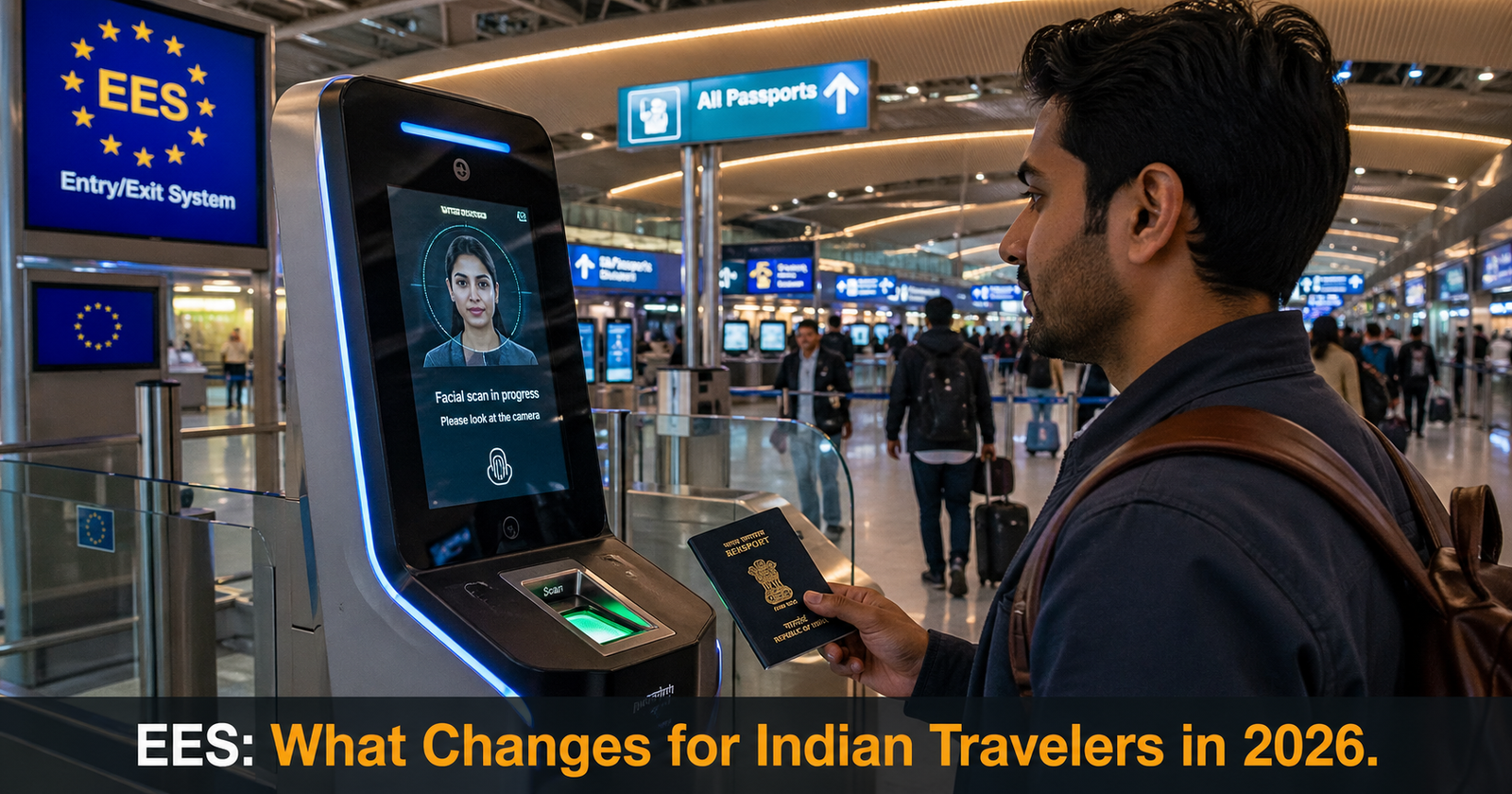
EU Entry/Exit System (EES) Is Now Live: Complete Guide for Indians Visiting Schengen in 2026
If you are an Indian planning to visit Europe in 2026 — for a holiday in Paris, a business meeting in Frankfurt, or a university semester in Amsterdam — the rules at the border have fundamentally changed.
The European Union's new Entry/Exit System (EES) went fully live on 10 April 2026 after a phased rollout that began on 12 October 2025. The old passport stamp is gone. In its place: biometric registration — your fingerprints and a facial scan — recorded digitally every single time you enter or exit any of the 29 Schengen countries.
For Indian travelers — whether tourists, students, or business visitors — this is the biggest change to European border control in decades. This guide tells you exactly what changed, what you must do, what to expect at the airport, and how to make sure your Europe trip goes smoothly under the EU Entry Exit System EES for Indians.
29
Schengen countries now using EES at all external borders
45M+
Border crossings registered under EES since October 2025
24,000+
People refused entry under EES since launch
600+
Security threats identified and blocked by EES biometric checks
What Is the EU Entry/Exit System (EES)?
The EU Entry/Exit System (EES) is an automated digital border management system developed by the European Union and managed by eu-LISA (the EU Agency for the Operational Management of Large-Scale IT Systems). It replaces the decades-old manual passport stamping system with a fully electronic, biometric-based record of every non-EU traveler's movements across Schengen borders.
Put simply: every time an Indian traveler crosses into or out of the Schengen Area for a short stay, EES creates a digital record containing your name, passport details, biometric data, and the exact date and place of each crossing.
The Three Core Purposes of EES
Track overstays automatically: The system calculates your remaining days under the 90/180-day Schengen rule in real time. Overstaying is now automatically flagged — no more slipping through the cracks.
Prevent identity fraud: Biometric checks catch people using forged passports or traveling under different identities. Since launch, EES has already caught multiple cases of travelers using two different identities, including one person who had been denied entry three times under a separate name.
Modernise and speed up border control: Over time, automated kiosks replace slow manual checks — reducing queues for repeat travellers who are already enrolled in the system.
Important for Indian travelers: EES applies to ALL non-EU, non-Schengen nationals — including Indians with valid Schengen visas. Even if your visa is approved and valid, you will still go through biometric registration at the border under EES. There is nothing you need to do before you travel — EES registration happens at the border, not online.
EES Timeline: When Did It Go Live?
The EU Entry Exit System EES for Indians and all non-EU travelers has had a phased rollout. Here is the exact timeline:
Date | Milestone |
|---|---|
20 Nov 2017 | EES Regulation adopted by EU Parliament and Council |
4 Dec 2024 | European Commission proposes progressive start of operations |
18 Jul 2025 | Regulation on progressive EES start adopted and entered into force 26 July 2025 |
12 Oct 2025 | EES Phase 1 begins — progressive rollout starts at select airports (Madrid, Düsseldorf, others) |
10 Apr 2026 | EES fully operational — mandatory at all 29 Schengen external borders |
Apr–Sep 2026 | Flexibility period — member states can temporarily suspend checks (max 90 days + 60 day extension) to manage summer travel congestion |
Q4 2026 | ETIAS (a separate system for visa-exempt travelers) expected to launch |
⚠ Note on delays: Some reports suggest certain countries and airports may temporarily suspend EES checks during the summer 2026 travel rush (June–September). Member states are permitted to pause checks for up to 90 days after April 10, with a 60-day extension — ending no later than early September 2026. Check with your airline and destination country before traveling. Regardless, the system is now mandatory and permanently in place.
How EES Works: Step-by-Step for Indian Travelers at the Border
Here is exactly what happens when you land at a Schengen airport — for example, Paris Charles de Gaulle, Amsterdam Schiphol, Frankfurt Airport, or Rome Fiumicino — as an Indian traveler under the new EES system.
First-Time Entry (Your First Visit Under EES)
Arrive at immigration / border control as you normally would after landing or at the land border point
Present your passport to the border officer or at the automated kiosk — your travel document is scanned electronically
Facial scan: A camera photographs your face. This takes approximately 10–15 seconds. You do not need to do anything — just look at the camera
Fingerprint scan: Four fingerprints from each hand are scanned. Children under 12 are exempt from fingerprint scanning but still require a facial scan
Data recorded: Your name, passport details, biometrics, entry date, entry point, and duration of permitted stay are all digitally recorded in the EU's central EES database
Questions about your visit: Border officers may ask about your accommodation, purpose of visit, and finances — same questions as before EES, just now asked more consistently
Entry stamp removed: Your passport is no longer stamped. The digital EES record replaces this entirely
Entry approved (or refused): If entry is approved, you proceed. If refused, the refusal is also recorded in EES — affecting any future entry attempts to any Schengen country
Subsequent Visits (You Are Already Enrolled)
Once your biometrics are registered in EES, your data is stored for 3 years. On your next visit to Schengen, the border kiosk recognises you from your stored biometric profile — making the process significantly faster. You still present your passport and do a quick facial verification, but the full fingerprint enrolment is not repeated.
At Exit (Leaving the Schengen Area)
When you leave a Schengen country — at the airport before your departure flight — your exit is also registered in EES. This closes your visit record and confirms you left within your permitted stay period. For the first time, European authorities now have a complete, accurate picture of who is in the Schengen Area at any given moment.
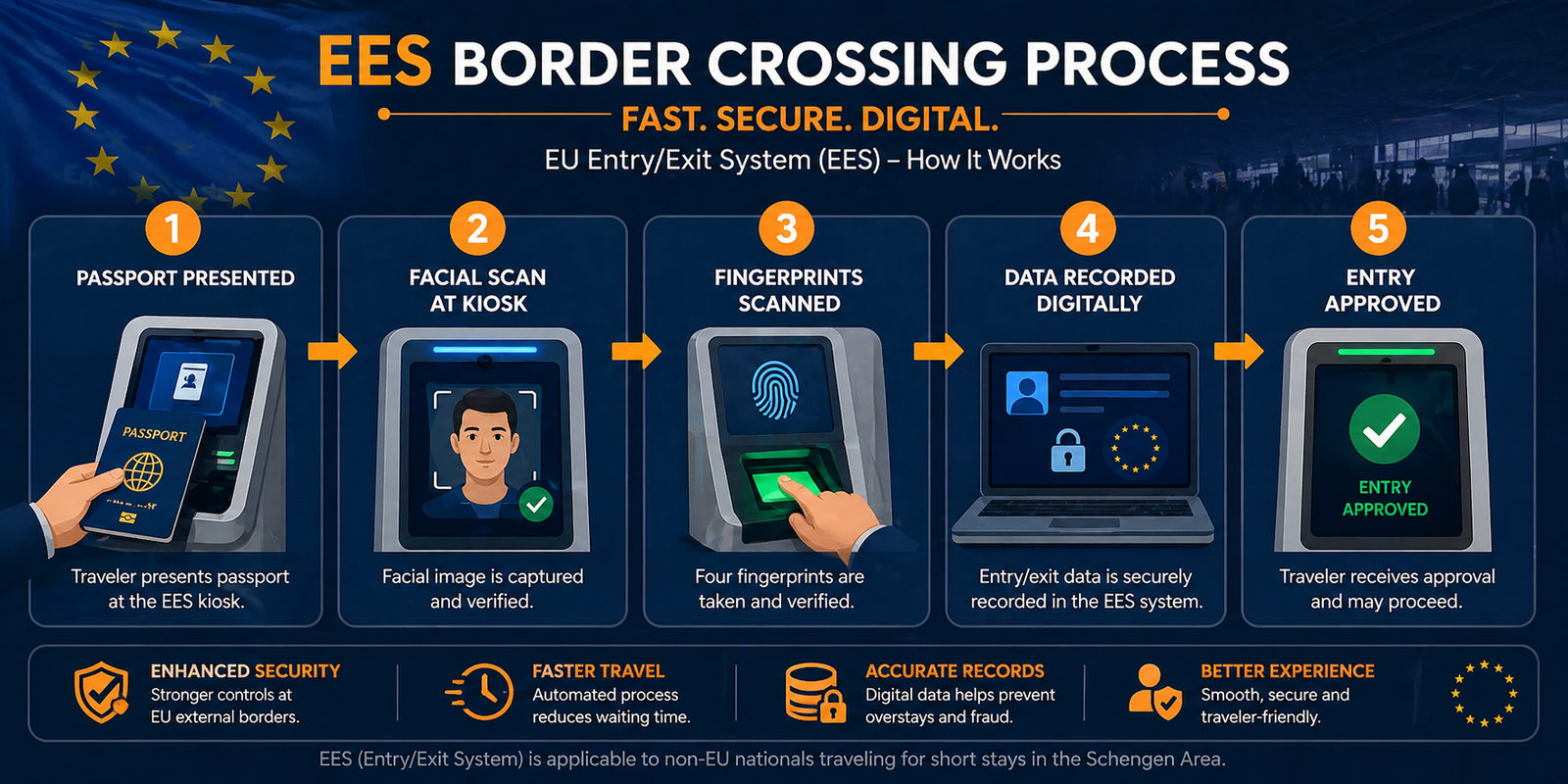
💡 Pro Tip for Indian Travelers: At major airports, EES self-service kiosks are now installed before the staffed border control booths. Use the kiosk first — it pre-registers your biometric data so the officer at the booth can process you much faster. Look for kiosks with the EU flag and "EES Registration" signage as soon as you approach the immigration area.
Major Changes for Indian Travelers Under EES: What Is Different Now
1. No More Passport Stamps — But Your Record Is More Complete
Many Indian travelers love collecting passport stamps as memories. Under EES, passport stamping has ended. Your entries and exits are now stored digitally in the EU's secure database. If you want a record of your Europe visit, take a screenshot of your visa or save your boarding passes — passport stamps are now a thing of the past across all 29 Schengen countries.
2. Biometrics Are Now Mandatory at Every Entry
Every Indian traveler — regardless of how many times they have visited Europe before — must provide a facial scan and fingerprints at the Schengen border. This is mandatory, not optional. Refusing to provide biometrics can result in denied entry. Children under 12 give a facial scan only (no fingerprints).
3. Overstay Tracking Is Now Automatic and Immediate
This is the most significant change for Indian travelers. Previously, overstaying a Schengen visa was difficult to detect — passport stamps were easily miscounted, and many travelers slipped through. Under EES, overstays are detected automatically and in real time.
The system calculates exactly how many days you have been in Schengen, across all 29 countries combined, within any rolling 180-day period. The maximum is 90 days within any 180-day period. If you overstay — even by one day — it is recorded and will affect every future Schengen visa application and entry attempt.
4. Entry Refusals Are Now Recorded Across All 29 Countries
If you are refused entry at one Schengen border, that refusal is recorded in EES and visible to all 29 member states. You cannot simply try your luck at a different Schengen airport or land border. A refusal in Paris is a refusal everywhere in Schengen — simultaneously.
5. Longer Processing Times — Especially on Your First Visit
The Airports Council International has reported that processing times increased by up to 70% in some locations during the initial EES rollout. Your first registration takes longer than a normal passport check. Plan for this — arrive at the airport early, especially for early morning flights or peak travel periods.
Documents Required for Indian Travelers Under EES
✅ EES Travel Checklist for Indian Travelers to Schengen (2026)
Valid Indian passport — minimum 3 months validity beyond your intended return date, with at least 2 blank pages
Valid Schengen visa (C-type for short stays) — issued by the embassy of your main destination country
Travel insurance — minimum €30,000 medical coverage, valid across all Schengen countries
Proof of accommodation — hotel bookings, host's address, or confirmed stay details for your entire trip
Proof of sufficient funds — bank statements showing you can support your stay (approx €50–100 per day is a common benchmark)
Return or onward flight ticket
Purpose of visit documentation — hotel bookings (tourist), business invitation letter (business), university acceptance letter (student)
Biometric data — provided at the border (fingerprints + facial scan). Nothing to prepare in advance for this.
Individual passport for each traveler — group or collective passports no longer accepted under EES
New under EES — one person, one passport, always: The old system allowed school groups and some family groups to travel on collective or group passports. This is no longer possible under EES. Every individual traveler — including children — must have their own individual, valid passport. If you are traveling with family, confirm that everyone in your group has their own separate passport before booking.
Impact of EES on Schengen Visa Rules for Indians
Does EES Change Schengen Visa Rules?
EES does not change the underlying visa rules. You still need a valid Schengen visa as an Indian citizen to enter the Schengen Area for short stays. The 90/180-day rule still applies. What EES changes is how those rules are enforced — digitally, precisely, and automatically rather than through manual passport stamp counting.
What this means practically:
If you have a multiple-entry Schengen visa, EES now tracks exactly how many days you have used across all your visits — down to the day
You can no longer informally exceed 90 days and hope border officers miscalculate from passport stamps
The 90-day count now starts from your first EES-registered entry — even from October 2025 onwards if you traveled then
Read our complete guide on Schengen Visa for Indians to understand the visa application process in detail
Does Having EES Data Help Future Visa Applications?
Potentially yes. If your EES record shows consistent, clean travel history — you entered on time, followed the rules, always exited before your permitted stay expired — this positive travel record is visible to EU embassies when you apply for future Schengen visas. A clean EES record can support stronger visa applications.
EES vs ETIAS: Two Different Systems — Clearly Explained
Many Indian travelers are confused between EES and ETIAS. They are two completely separate systems with very different purposes. Here is a clear comparison:
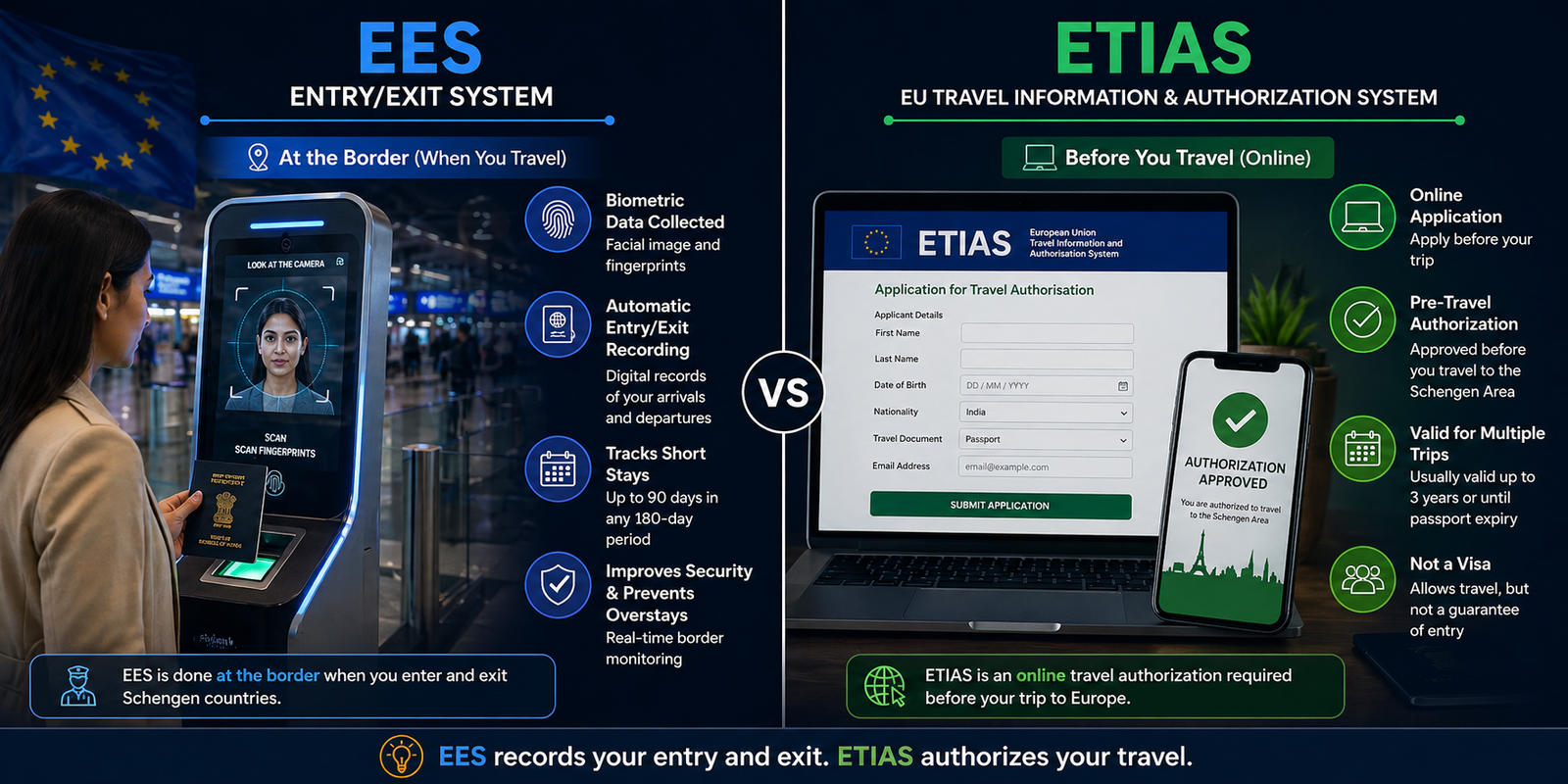
Feature | EES (Entry/Exit System) | ETIAS (Travel Authorisation System) |
|---|---|---|
What it is | Digital border registration system | Pre-travel electronic authorisation |
Who it applies to | ALL non-EU/non-Schengen travelers (including Indians with visas) | Only visa-EXEMPT travelers (e.g., UK, USA, Australia citizens). NOT applicable to Indians who need a Schengen visa |
When it applies | At the border — on arrival and departure | Before travel — online application required |
Cost | Free — no charge to the traveler | €7 per application (when launched) |
Status | ✅ LIVE — fully operational from 10 April 2026 | ❌ NOT YET LIVE — expected Q4 2026 |
Purpose | Track entries, exits, and overstays digitally | Pre-screen visa-exempt travelers for security risks |
Do Indians need this? | ✅ YES — mandatory for all Indian travelers at Schengen borders | ❌ NO — Indians need a Schengen visa, not ETIAS |
Valid for | 3-year biometric record once registered | 3-year authorisation once approved |
Like what? | Digital passport stamp system | Similar to ESTA (USA) or ETA (Australia/UK) |
Apply before travel? | No — happens at the border automatically | Yes — must apply online before flying |
✅ Simple rule for Indian travelers: As an Indian citizen, you need a Schengen visa (as always). EES registration happens automatically at the border — nothing to do in advance. ETIAS does NOT apply to you because you are not visa-exempt. Ignore ETIAS for now — focus only on your Schengen visa and EES at the border.
Benefits of EES for Indian Travelers (Yes, There Are Real Advantages)
Faster future crossings: Once registered, your biometric profile is stored for 3 years. Repeat visitors to Europe will experience faster border processing on subsequent trips as the system recognises you
Cleaner visa history: A digitally verified, clean travel record supports stronger future Schengen visa applications — especially useful for frequent European travelers
Automatic 90-day tracking: EES shows you in real time exactly how many Schengen days you have used. No more guessing or manual calculation — reducing the risk of accidental overstay
Better security for everyone: EES has already flagged 600+ security risks and caught multiple identity fraud cases. A more secure Schengen Area benefits all genuine travelers including Indians
No extra paperwork or pre-registration: Unlike ETIAS (for others) or ESTA (for US travel), EES requires nothing from you before you travel. Registration happens automatically at the border
Challenges and Concerns: What Indian Travelers Should Be Aware Of
1. Longer Queue Times — Especially in Summer 2026
This is real. Processing times at some European airports increased by up to 70% during the initial EES rollout period (October 2025 to April 2026), according to the Airports Council International. Paris, Italy, and Germany reported the most significant delays. Summer 2026 (June–August) will be the first major travel season under full EES — expect queues to be longer than usual, particularly at Paris CDG, Rome FCO, and Madrid MAD.
2. Inconsistent Implementation Across Countries
Not every Schengen country has deployed EES equally. Some airports have fully operational self-service kiosks; others still rely heavily on staffed booths with biometric capture equipment. Some travelers have reported being asked to re-register biometrics on return trips due to system inconsistencies, particularly in Spain and Switzerland. Procedures may vary between your entry and exit countries.
3. Data Privacy
Your biometric data — fingerprints and facial images — is stored in the EU's central EES database for 3 years after your last recorded exit, or 5 years if there is a recorded overstay. The EU states this data is governed by strict GDPR-compliant data protection rules and is only accessible to border authorities of member states. According to the official EU Home Affairs website, the system is built with fundamental rights protections embedded into its design.
4. Pre-Enrolled Biometric Issues
Some travelers have reported issues where previously enrolled biometrics do not match at subsequent crossings — due to lighting conditions during the scan, finger injuries, or ageing of stored data. If this happens, border officers will manually verify your identity — which takes longer. Ensure your face is clearly visible during the scan (remove glasses, caps, and scarves).
Practical Tips for Indian Travelers at Schengen Borders in 2026
💡 Tip 1: Arrive Early — Add at Least 30–45 Minutes Extra
Corporate travel firm Cadence Travel and ABTA (UK's travel association) both recommend building a minimum 30-minute buffer for first-time EES registration. For peak travel times — summer, Christmas, Easter — add at least 45–60 minutes beyond your usual airport arrival time.
💡 Tip 2: Use the Self-Service Kiosk First
Look for EES registration kiosks as soon as you approach the immigration area. Pre-registering at the kiosk speeds up your time at the staffed booth significantly. Kiosks are marked with EU flag signage and "Biometric Registration" instructions in multiple languages including English.
💡 Tip 3: Make Sure Every Family Member Has Their Own Passport
Group passports and collective travel documents are no longer valid under EES. Every person — including young children — must have their own individual passport. Verify this before your trip — discovering this at the airport gate is a nightmare.
💡 Tip 4: Know Your Remaining Schengen Days Before You Travel
Calculate your 90/180-day Schengen allowance before every trip. Count all your Schengen visits in the last 180 days — not just to one country, but all 29 combined. Use the Schengen Visa Calculator at schengenvisainfo.com to verify. EES will catch any miscalculation immediately.
💡 Tip 5: Keep Your Documents Organised and Accessible
Have your passport, visa, accommodation details, travel insurance, and return ticket easily accessible — not buried in your bag. Border officers under EES are still empowered to ask questions about your stay, finances, and purpose of visit. Being organised reduces your time at the booth.
💡 Tip 6: Do Not Overstay — Even by One Day
Under the old system, a one-day overstay was often missed. Under EES, it is recorded automatically and permanently. An overstay record can result in a Schengen visa ban, rejection of future visa applications, and complications for any European immigration plans. If your plans change and you need to extend your stay, contact the immigration authority of the country you are in before your permitted stay expires.
Real Scenarios: How EES Affects Different Indian Travelers
SCENARIO 1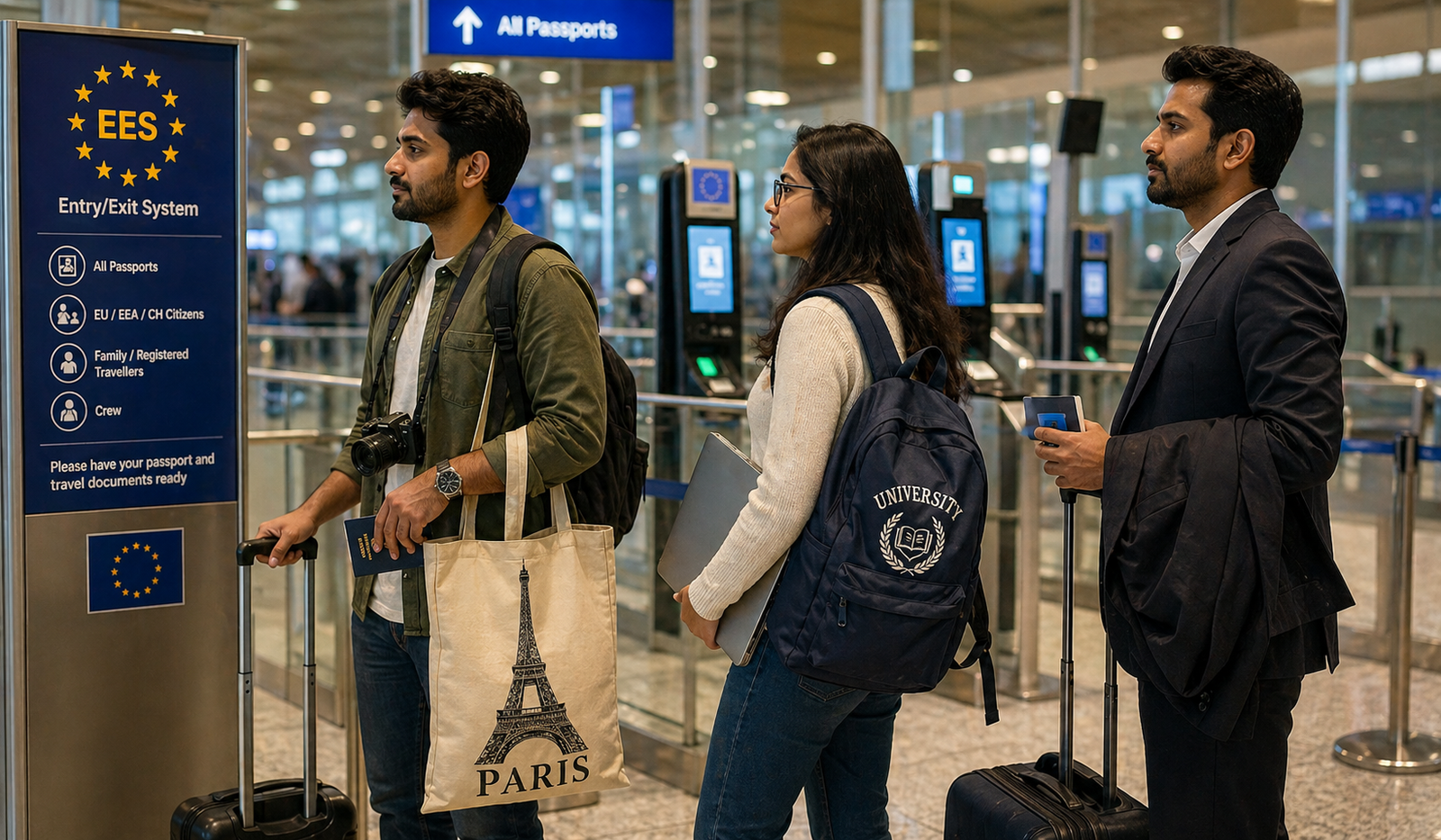
Priya — Tourist from Mumbai Visiting France and Italy for 15 Days
Priya arrives at Paris CDG with a valid Schengen visa (issued by the French embassy). At border control, she uses the self-service kiosk — her passport is scanned, facial scan completed in 12 seconds, fingerprints taken from both hands. Her entry is registered in EES with an allowed stay of 90 days. She tours France for 7 days, then takes a train to Italy. At no point does she go through border control between France and Italy — internal Schengen borders are open. At the end of her 15 days, she flies home from Rome. Her exit is registered at Rome airport. Clean record, no issues. Future visa applications will reflect this clean EES history.
SCENARIO 2
Arjun — IT Professional from Bangalore on a Business Trip to Germany
Arjun visited Germany for 10 days in December 2025. Now in May 2026, he is returning for another business meeting for 5 days. At Frankfurt Airport, EES recognises his biometric profile from his previous visit. His facial scan at the kiosk matches his stored data in seconds. His remaining 90-day allowance (10 days used in December, now calculating from that 180-day window) is automatically checked. EES confirms he has sufficient days remaining. Border processing takes under 4 minutes — significantly faster than his first visit. He is waved through without issue.
SCENARIO 3
Ritu — Student from Delhi Arriving in Netherlands for University Semester
Ritu holds a national D-type long-stay visa for the Netherlands (not a short-stay Schengen C visa). Long-stay visa holders and those with residence permits are exempt from EES registration. Ritu goes through the standard border check presenting her D-visa and university letter. She is not required to give fingerprints or a facial scan for EES — her long-stay visa places her outside the EES scope. However, if she takes a weekend trip to France or Belgium within the Schengen Area, she will not be stopped at internal borders as she holds a valid Dutch residence document.
Key exception to know: Indians holding long-stay visas (D-type, issued for stays over 90 days) or valid EU/Schengen residence permits are exempt from EES registration. EES applies only to short-stay travelers — tourists, business visitors, and short-course students on C-type Schengen visas.
Indian Travelers to Schengen: By the Numbers
To understand why EES matters so much for Indian travelers specifically, look at the scale of India-Europe travel:
Metric | Data | Source / Year |
|---|---|---|
Schengen visas issued to Indians (2023) | 1.08 million — highest ever | EU Schengen Statistics, 2023 |
India rank among Schengen visa applicants | Top 3 globally by volume | EU Visa Statistics Report |
Schengen visa refusal rate for Indians (2023) | Approximately 25–30% | Schengen Visa Info, 2024 |
Total EES border crossings registered (Oct 2025–Apr 2026) | 45 million+ | EU Commission, April 2026 |
People refused entry under EES (to date) | 24,000+ | EU Commission, April 2026 |
Security threats blocked by EES biometrics | 600+ | EU Home Affairs, April 2026 |
Processing time increase at some airports (initial phase) | Up to 70% | Airports Council International, 2025 |
EES biometric data storage period | 3 years (5 years if overstay recorded) | EES Regulation (EU) 2017/2226 |
Where Can You Get Help Planning Your Schengen Trip as an Indian Traveler?
Navigating Schengen visa applications, understanding EES rules, calculating your 90-day allowance, or finding the right travel insurance — all of this can be confusing. IndiaWale Abroad connects Indian travelers with verified immigration consultants, travel experts, and a growing community of Indians who have already visited or are living in Europe.
📖 Check our complete guide on Schengen Visa for Indians — application, documents, and tips
✈️ Read our article on planning a budget Europe trip from India
👨💼 Connect with verified visa consultants on IndiaWale Abroad's Expert Directory
Planning a Europe Trip in 2026? Get Expert Help Before You Apply.
Understanding Schengen visa rules, EES requirements, travel insurance needs, and border procedures can be overwhelming. IndiaWale Abroad connects you with verified immigration consultants and a community of Indians already in Europe — so you travel with confidence, not confusion.
Connect with a Visa Expert on IndiaWale Abroad →
Frequently Asked Questions (FAQs) — EES for Indian Travelers
Do Indian travelers need to register for EES before visiting Europe?
No. EES registration happens automatically at the Schengen border when you arrive. There is no online pre-registration required. Simply travel with your valid Schengen visa and passport — biometric registration (facial scan + fingerprints) is done at the airport border control on arrival. Nothing needs to be done before you fly.
Is EES mandatory for Indian visitors to Schengen countries?
Yes. EES is mandatory for all non-EU, non-Schengen nationals traveling on short stays — including Indian tourists, business visitors, and students on short-stay Schengen visas. Refusing to provide biometrics at the border can result in entry being denied. The only Indians exempt are those with long-stay visas (D-type) or valid EU/Schengen residence permits.
Will EES cause longer waiting times at European airports?
Yes — especially for first-time EES registration. Processing times increased by up to 70% at some airports during the initial rollout. For your first EES registration, budget an extra 30–45 minutes at the border. Subsequent visits are faster as your biometrics are already stored. Summer 2026 is expected to be the most congested period — arrive at European airports earlier than usual.
What is the difference between EES and ETIAS?
EES (Entry/Exit System) is a digital border registration system that applies to ALL non-EU travelers including Indians — it records your entries and exits biometrically. ETIAS (European Travel Information and Authorisation System) is a pre-travel online authorization similar to US ESTA — but it applies ONLY to visa-EXEMPT travelers (like UK, US, Australian citizens). As an Indian citizen, you need a Schengen visa and are subject to EES — but ETIAS does not apply to you.
Is my biometric data safe under EES?
The EU states that EES data is protected under GDPR (General Data Protection Regulation) — the world's strictest data protection law. Your biometric data is stored in the EU's central database (managed by eu-LISA) and is only accessible to border authorities of member states for specific, permitted purposes. Data is automatically deleted after 3 years (or 5 years in overstay cases). Independent privacy advocates have raised concerns about large-scale biometric databases, but the EU maintains that all legal safeguards are in place.
What happens if I overstay my Schengen visa under EES?
Under EES, overstays are detected automatically and recorded permanently in the system. The consequences are serious: a recorded overstay can result in refusal of future Schengen visa applications, possible entry bans, and complications for any European immigration plans. If your plans change and you cannot leave on time, contact the local immigration authority of the country you are in before your visa expires — do not simply stay and hope it goes unnoticed. It will not.
Can children travel to Schengen countries without their own passport under EES?
No. EES has made individual passports mandatory for every traveler regardless of age. Group and collective passports are no longer accepted. Every child in your travel group must have their own valid individual passport. Children under 12 are exempt from fingerprint scanning but will still need a facial scan for EES registration. Ensure all family members have their own passports before traveling.
Does EES affect the Schengen 90/180 day rule for Indians?
The 90/180-day rule itself has not changed — Indian Schengen visa holders can still stay for a maximum of 90 days within any rolling 180-day period across all 29 Schengen countries combined. What has changed is enforcement: EES now tracks this digitally and automatically, making it impossible to accidentally or intentionally exceed the limit without immediate detection. Use the official Schengen calculator at schengenvisainfo.com to track your days before every trip.



Comments
No approved comments yet. Be the first to comment.