
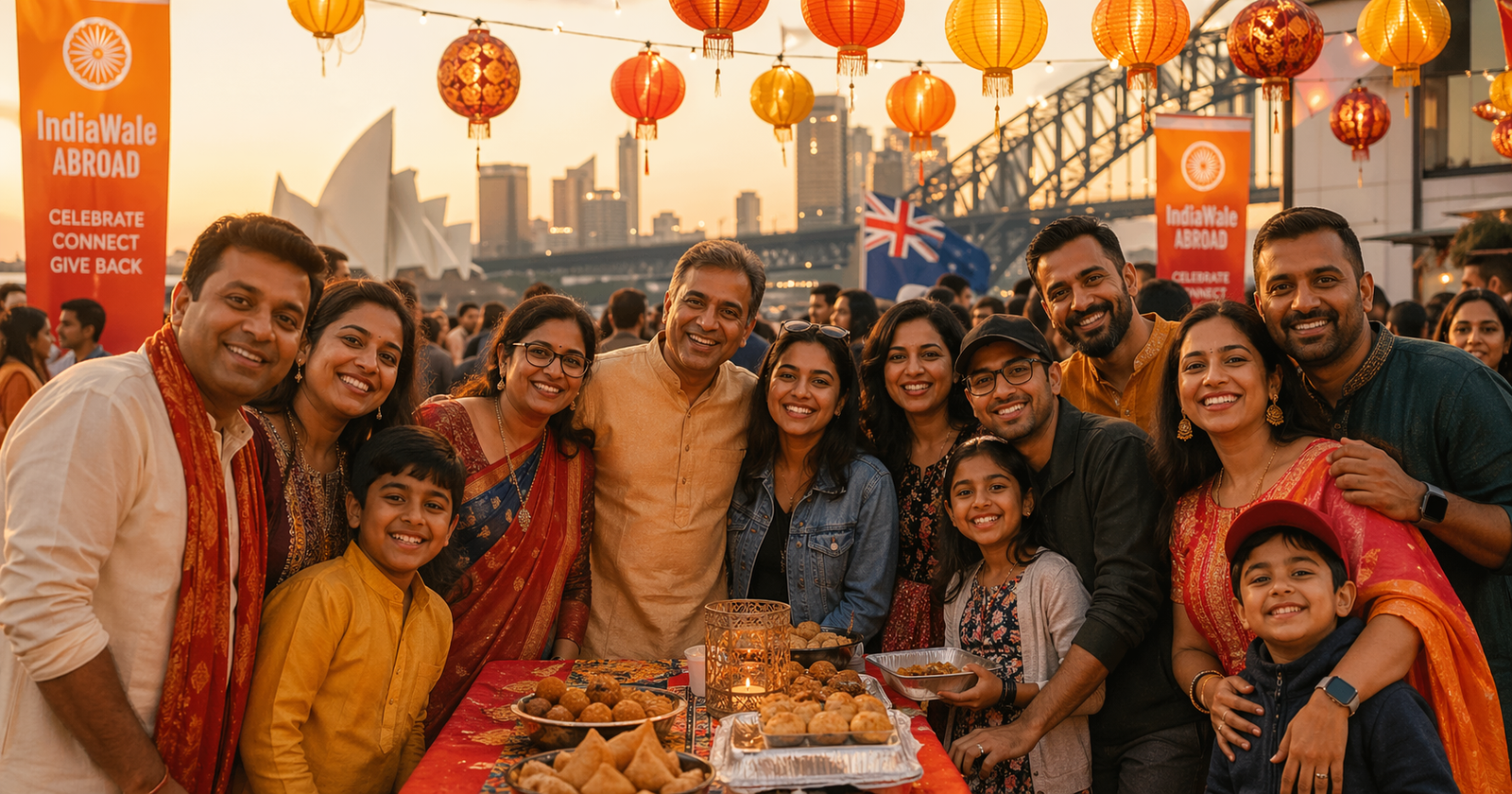
You landed your dream job in London. Or got your Canadian PR. Or finally made the move to Melbourne. The first few weeks were a rush — new country, new workplace, new life. But then came the silence.
No one to share Sunday dal-chawal with. Diwali passing like any other evening. A bad day at work and no one nearby who truly gets it. The professional success was real. But so was the loneliness.
If this sounds familiar, you are far from alone. According to VisaVerge, an estimated 3 million NRIs are actively struggling with loneliness and social isolation abroad in 2026. And research published in leading academic journals shows that 60–65% of international students report significant loneliness during their time overseas.
The solution is not moving back to India. The solution is building your community where you are.
This guide — written specifically for Indians living abroad in 2026 — gives you the data, the tools, and the exact steps to find, join, and build a thriving Indian community no matter where in the world you are.
35.4M
Indians living outside India globally (MEA 2024)
200+
Countries with an established Indian diaspora presence
$120B
Remittances sent home by Indians in 2023 — world's largest
24
Fortune 500 companies currently led by Indian-origin CEOs
The Indian Diaspora in 2026: The World's Largest Migrant Community
Before we talk about building community, let us understand just how big and how significant the Indian community abroad already is.
According to the Ministry of External Affairs, Government of India (2024), the global Indian diaspora stands at approximately 35.42 million people — comprising 15.85 million Non-Resident Indians (NRIs) and 19.57 million Persons of Indian Origin (PIOs). This makes India the world's largest source of emigrants, accounting for 6% of all international migrants globally.
In 2024, the UAE and USA each hosted 17% of all Indian emigrants. The UK is home to approximately 1.93 million Indians — making British Indians the largest ethnic minority group in the country. Canada has the fastest-growing Indian population among major destination countries, with Indians now the largest migrant group in Canada.
Country | Indian Diaspora Population (2025) | Notable Facts |
|---|---|---|
United States | 5,160,203 | Largest Indian diaspora globally; 24 Fortune 500 Indian CEOs |
United Arab Emirates | ~3.5 million | Indians make up nearly 40% of all immigrants in UAE |
Malaysia | 2,019,600 | Long-established Tamil community since colonial era |
United Kingdom | 1,927,150 | Largest ethnic minority; highest avg hourly pay among ethnic groups |
Canada | ~1.8 million | Fastest-growing; largest migrant group in Canada |
Saudi Arabia | ~2.5 million | Indians make up ~25% of total population |
Australia | ~900,000 | Third-largest immigrant group; fastest-growing community |
Singapore | ~650,000 | Significant Tamil and professional Indian communities |
Despite being the world's largest diaspora, Indian communities abroad are often fragmented — divided by state, language, religion, and generation. Many Indians abroad know of each other but never truly connect. That gap — between the size of our community and the depth of our connection — is exactly what needs to change.
Why Building a Community Abroad Is So Hard — The Real Challenges
Moving abroad is hard enough. Building genuine human connections in a new country is even harder — and for Indians specifically, there are unique challenges that most settlement guides never talk about.
1. The Loneliness Epidemic Among NRIs
Professional success does not automatically create belonging. Many Indians abroad report feeling invisible the moment they close their laptop and return to an empty flat. A 2026 report by VisaVerge found that loneliness hits an estimated 3 million NRIs — people who outwardly look successful but inwardly miss the warmth, noise, and connection of home.
2. The Pressure to Look Like You Are Thriving
Indian families back home expect stability, progress, and visible achievement. That pressure makes loneliness feel like a personal failure — when in reality, it is a normal human response to distance. Many Indians abroad stay silent about their struggles rather than risk appearing weak or unsuccessful.
3. Cultural Disconnect in Western Workplaces
British or Canadian colleagues may be friendly, but the cultural depth of an Indian friendship — the chai conversations, the festival celebrations, the shared understanding of family pressure — is hard to replicate across cultural lines. Indians often find their workplace relationships surface-level, no matter how professionally fulfilling the work is.
4. Fragmentation of the Indian Community Itself
The Indian community abroad is not monolithic. It is divided by state (Punjabis, Keralites, Gujaratis, Tamils), by religion (Hindu, Muslim, Sikh, Christian), by generation (first-generation migrants vs second-generation British/Canadians), and by profession. These divisions mean that even in cities with large Indian populations, many individuals still struggle to find their specific tribe.
5. No Roadmap for Building Connection
Nobody tells you how to make friends as an adult in a foreign country. Schools and universities have built-in social structures. The working world does not. Most Indians abroad improvise and hope — rather than proactively building the community they need.
Data point: Research across Australia, UK, and USA shows that 60–65% of international students — the majority of whom are from Asian countries including India — report significant loneliness during their time abroad. Among those, only 13.1% seek help, according to a study reviewed by PMC (US National Library of Medicine).
Best Ways to Find Your Indian Community Abroad in 2026

The good news: in 2026, there are more ways to find your Indian community than ever before. Here is a structured, practical guide — ranked from easiest to most impactful.
1. Join Online Communities First — Then Go Offline
Before you even arrive in a new city, you can start building your network. Facebook Groups, WhatsApp communities, and platforms like IndiaWale Abroad connect you with Indians already living in your destination city. These online spaces let you ask questions, get honest advice, and identify people with similar backgrounds before you meet in person.
Search for: "Indians in [City]", "[State] community [City]" (e.g., "Punjabi community London"), "[Profession] Indians [City]" (e.g., "Indian doctors UK")
2. Attend Indian Cultural Events and Festivals
Every major city with an Indian population hosts Diwali, Holi, Navratri, and Eid celebrations. These events are the single fastest way to meet Indians who share your cultural background — in a setting specifically designed to feel like home. In the UK alone, the Diwali in Leicester event draws over 35,000 people annually. Trafalgar Square's Diwali celebration in London consistently attracts 30,000+ attendees.
3. Connect Through Indian Grocery Stores and Restaurants
Sound simple? It works. Indian grocery stores — especially family-owned ones — are informal community hubs. The owner often knows who lives in the area, which temple is active, which WhatsApp group to join. The same goes for Indian restaurants: many become regular gathering points for the local Indian community. Do not underestimate the power of a good biryani as a community builder.
4. Join Indian Temples, Gurudwaras, and Cultural Centres
Regardless of your personal relationship with religion, Indian places of worship abroad serve as powerful community infrastructure. The BAPS Swaminarayan Mandir in London serves as both a spiritual and social anchor for tens of thousands of Indians in the UK. Gurudwaras across Canada — particularly in Brampton and Surrey — are central to the Punjabi community. These spaces run language classes, youth groups, and community meals (langar) that are open to everyone.
5. Join Professional Indian Networks
If you are a professional or entrepreneur, dedicated Indian professional networks provide both community and career value. The UK India Business Council (UKIBC), TiE (The Indus Entrepreneurs) with chapters across the USA, UK, and Canada, and BANGA (British Asian Network of Global Advocates) are examples. These communities combine the cultural warmth of Indian connection with the practical value of professional networking.
6. Use Community Platforms Built Specifically for Indians Abroad
General social media platforms are noisy. Platforms built specifically for the Indian diaspora are focused, relevant, and genuinely useful. IndiaWale Abroad is built exactly for this purpose — connecting Indians globally through a directory of businesses, jobs, experts, accommodation, and a growing community of people who understand what it means to be Indian and far from home.
Type of Community | Where to Find It | Best For |
|---|---|---|
Online diaspora communities | IndiaWale Abroad, Facebook Groups, WhatsApp | First connections before you arrive |
Cultural festivals and events | Local Indian associations, council websites | Meeting people with shared cultural roots |
Temples and gurudwaras | Google Maps, local Indian stores | Long-term belonging and social infrastructure |
Professional networks | TiE, UKIBC, LinkedIn Indian groups | Career + community combined |
Indian restaurants and grocery stores | Google, Yelp, word of mouth | Informal introductions and local intel |
University Indian societies | Your university's student union | Students and recent graduates |
Sports and hobby groups | Meetup.com, Facebook | Cricket, Bollywood dance, yoga, cooking |
How to Actually Build Deep Community — Not Just Surface Connections
Finding Indians abroad is the easy part. Building genuine, lasting community is harder — and more valuable. Here is what research and the experience of thousands of NRIs shows actually works.
1. Create a Regular Gathering — Not Just One-Off Events
The most powerful Indian communities abroad are built around regularity. A Sunday lunch that happens every week. A Bollywood movie night on the last Friday of each month. A cricket match every Saturday morning. Consistent, recurring touchpoints create familiarity, trust, and eventually — friendship. One great event does not build community. Ten mediocre regular gatherings do.
2. Organise Around Shared Specifics, Not Just "Being Indian"
"Indian community" is too broad. The most successful sub-communities are specific: Malayali nurses in NHS London. Gujarati entrepreneurs in Toronto. Tamil IT professionals in Melbourne. Indian mothers in Edinburgh. The more specific your community focus, the deeper the connection — because people feel truly seen and understood.
3. Be the One Who Starts It
Most Indians abroad are waiting for someone else to build the community they want to be part of. The person who sends the first WhatsApp message, who books the first restaurant table for 10 people, who sets up the first cricket game — that person becomes the hub of their local Indian community. The barrier to starting is lower than you think. A WhatsApp group, a Facebook post, or even a message in an existing online community is enough to begin.
4. Mix Generations Deliberately
The healthiest Indian communities abroad mix first-generation migrants (who bring cultural depth) with second-generation Indians (who bring local knowledge and established networks). When a fresh-off-the-boat Indian engineer connects with a British-born Indian solicitor, both benefit enormously. Do not silo yourself only with people who arrived around the same time as you.
5. Maintain Strong Ties Back to India
Research consistently shows that NRIs with strong, maintained connections to family and friends back in India fare better psychologically abroad. A PMC-published review of international student mental health emphasises that transnational ties — regular calls, shared experiences, even virtual celebrations — are a proven buffer against loneliness and depression. Fixed weekly call times with family, virtual Diwali celebrations, and online card games with cousins are not childish — they are emotionally intelligent.
"Life abroad often looks fuller from the outside than it feels from within. A busy job, a safe apartment, and a strong salary do not automatically create belonging. Many people in expat communities report that they still feel invisible when they return home to an empty flat after work." — VisaVerge, 2026
The Economic Power of Indian Community Networks Abroad
Community is not just about emotional wellbeing. It is also about economic opportunity — and the Indian diaspora's economic network is one of the most powerful in the world.
In 2023, India received $120 billion in remittances from overseas Indians — nearly double what Mexico receives and the highest remittance inflow of any country in the world, according to the Indian Diaspora Foundation. This is not just money flowing home — it is a network of trust, relationship, and shared economic interest spanning 200+ countries.
Economic Metric | Data | Source |
|---|---|---|
India's remittance inflows (2023) | $120 billion | World Bank / Indian Diaspora Foundation |
Fortune 500 companies with Indian-origin CEOs | 24 companies | Indian Diaspora Foundation, 2024 |
Share of US startups with Indian-origin founders | ~15% | UC Berkeley / NBER Research |
Indian-Americans' median household income | $119,000/year | US Census Bureau, 2023 |
British Indians' poverty rate | Lowest of all ethnic groups | UK ONS, 2024 |
Indians as % of UAE population | ~30% | UAE Government Statistics, 2024 |
Within Indian communities abroad, economic opportunity flows through trust networks. A Gujarati businessman in Leicester who needs a good Indian accountant asks his community first. A Punjabi nurse in Toronto who wants to open a restaurant looks to her gurudwara network for investors. A Tamil engineer in Sydney who is starting a tech company finds his first three hires through an Indian professional WhatsApp group.
Being part of your local Indian community abroad is not just culturally enriching — it is economically smart.
Celebrating Culture Abroad: Why It Matters More Than You Think
One of the most powerful things Indian communities abroad do is keep Indian culture alive — not out of nostalgia, but out of identity. Research on immigrant wellbeing consistently shows that maintaining cultural practices significantly reduces rates of depression and anxiety among expat communities.
Festivals Are Anchor Points
Diwali, Holi, Eid, Navratri, Lohri, Onam, Pongal, Gurpurab, Christmas — these festivals are not just celebrations. For Indians abroad, they are anchor points of identity. They say: I know who I am. I know where I come from. And I am not alone in that.
Organising a community Diwali event — even in your living room with five people — does more for your sense of belonging than a hundred professional LinkedIn connections.
Language as Community Glue
Hindi, Tamil, Telugu, Punjabi, Malayalam, Gujarati, Bengali — India's languages are among the most spoken in the world. In Canada and the UK, Indian languages are among the top five most spoken languages after English. Running or joining a mother-tongue language class, book club, or film screening builds bonds that transcend mere acquaintance. When you speak your first language with someone thousands of miles from home, it is an instant, deep connection.
Food as a Gateway
No discussion of Indian community building is complete without food. Indian food is not just sustenance — it is hospitality, identity, and love. Starting a community with a shared meal — a potluck, a cooking class, a group trip to a new Indian restaurant — lowers barriers and builds warmth faster than any structured networking event.
Mental Health and Community: Why This Matters Beyond Friendships
Building community abroad is not a lifestyle choice. For many Indians, it is a mental health necessity.
According to a comprehensive review published by the US National Library of Medicine (PMC, 2025), international students — the majority of whom are from Asian countries including India — face anxiety rates of 2.4–43%, depression rates of 3.6–38.3%, and psychological distress of 31.6–54%. The primary drivers include loneliness, financial strain, and cultural isolation.
Community is the single most effective preventive intervention for all of these — and it is free.
Having just 3–5 meaningful connections in a new city reduces risk of depression by up to 40%, according to social psychology research
Indians who participate in cultural communities abroad report significantly higher life satisfaction scores than those who do not
NRIs with active community memberships are more likely to stay abroad long-term and more likely to achieve professional success, per OECD migration research
Community connections accelerate career progression through referrals, mentorship, and professional visibility
Remember: Seeking connection is not a sign of weakness. It is one of the most intelligent things you can do in a new country. Every successful Indian abroad who has built a life they love has done it with the support of a community — not alone.
How IndiaWale Abroad Helps You Build Your Community
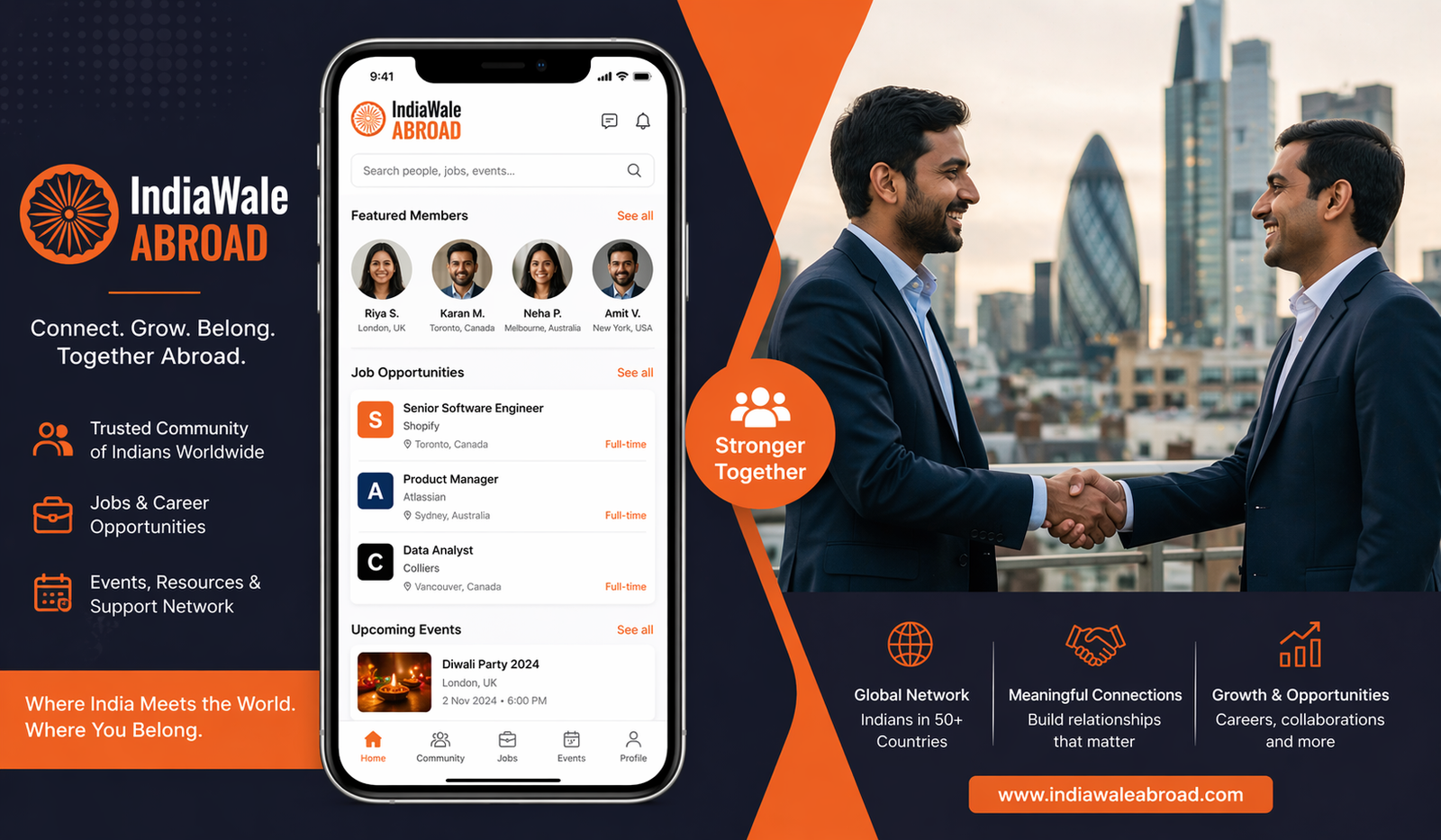
IndiaWale Abroad was built specifically to solve the community problem for Indians living overseas. It is more than a website — it is a growing ecosystem of connection, support, and opportunity for the Indian diaspora worldwide.
What IndiaWale Abroad Offers
Feature | What It Does | Who It Helps |
|---|---|---|
Business Directory | Find and list Indian-owned businesses worldwide — from restaurants to legal firms to IT companies | Entrepreneurs, freelancers, consumers looking for trusted Indian businesses |
Jobs Board | Work Abroad listings for Indians seeking employment opportunities overseas | Job seekers, professionals planning to move abroad |
Study Listings | GlobalEd-powered study abroad guidance and university listings | Indian students planning to study overseas |
Accommodation | Verified accommodation listings for Indians abroad | New arrivals, students, professionals relocating |
Expert Directory | Verified immigration consultants, legal advisors, and career coaches | Anyone navigating complex immigration or career decisions |
Events | Community events, networking meetups, and cultural celebrations | Indians wanting to connect in person with their local community |
Podcasts | Real stories from Indians living abroad — honest, unfiltered, inspiring | Anyone wanting to learn from those who have already made the journey |
Blog | Up-to-date immigration news, lifestyle guides, and community stories | All Indians planning to go abroad or already living overseas |
IndiaWale Abroad is free to join and growing every month. Whether you are in London, Toronto, Dubai, Melbourne, or Singapore — if you are Indian and you are abroad, there is a home for you here.
Join the IndiaWale Abroad Community Today
Connect with thousands of Indians living across the UK, Canada, Australia, UAE and beyond. Find jobs, accommodation, immigration experts, and most importantly — people who understand your journey. Because no Indian should have to navigate life abroad alone.
Join IndiaWale Abroad — It's Free →
A 30-Day Action Plan to Build Your Indian Community Abroad
Stop waiting for community to find you. Here is a practical, week-by-week plan to go from isolated to connected in 30 days.
Week | Action | Expected Outcome |
|---|---|---|
Week 1 | Join 3 online Indian communities relevant to your city and background (Facebook, WhatsApp, IndiaWale Abroad) | First digital connections; early awareness of local events |
Week 1 | Find the nearest Indian temple, gurudwara, or cultural centre and attend one session | First in-person Indian connection in your new city |
Week 2 | Identify one upcoming Indian cultural event (Diwali, Holi, food festival) and register or attend | Meet 5–15 Indians in a natural, celebratory setting |
Week 2 | Visit an Indian grocery store; introduce yourself to the owner; ask what community exists locally | Local intelligence; often leads to WhatsApp group invitations |
Week 3 | Host a small informal gathering — invite 4–6 Indians you have met online or in person for chai or dinner | Transform acquaintances into real friends |
Week 3 | Join or create a recurring group: cricket, Bollywood dance, Indian cooking class, or study circle | Recurring structure that sustains community |
Week 4 | List your business or professional services on IndiaWale Abroad; update your profile with your location and background | Visibility within the diaspora community; inbound connections |
Week 4 | Re-establish regular contact with family and friends in India — fixed weekly call time | Transnational connection that supports mental health |
Frequently Asked Questions (FAQs)
I just moved abroad and do not know anyone. Where do I start?
Start online before you go offline. Join the IndiaWale Abroad community, find Facebook groups for Indians in your city, and search for Indian cultural events in the first month. The easiest first step is finding your nearest Indian grocery store or temple — both are informal community hubs that lead quickly to genuine connections.
How large is the Indian diaspora in the UK and Canada?
The UK is home to approximately 1.93 million Indians, making British Indians the largest ethnic minority group in the country. In Canada, Indians are the largest migrant group, with approximately 1.8 million Indian-origin people. Both communities are growing rapidly, particularly in cities like London, Birmingham, Toronto, Vancouver, and Brampton.
Is loneliness really that common among Indians abroad?
Yes — and it is more common than most people admit. Research from 2026 estimates that 3 million NRIs are actively struggling with loneliness. Studies across Australia, UK, and USA show that 60–65% of international students report significant loneliness. This is not a weakness — it is a normal human response to distance from home. Building community is the most effective solution.
How can I find Indian professionals in my field abroad?
Look for professional Indian networks specific to your industry — TiE (Indus Entrepreneurs) for business, Indian Medical Association chapters for healthcare, Indian tech communities on LinkedIn, and occupation-specific WhatsApp groups. IndiaWale Abroad's Expert Directory also connects you with verified Indian professionals in immigration, law, finance, and career coaching across multiple countries.
Can I list my Indian business on IndiaWale Abroad?
Yes. IndiaWale Abroad has a Business Directory specifically for Indian-owned businesses across the globe. Whether you run an Indian restaurant in London, an IT firm in Toronto, or a legal practice in Melbourne — listing your business connects you with the Indian community that is most likely to trust and support you.
How do I celebrate Indian festivals abroad when I do not have family there?
Your local Indian community is your festival family abroad. Search for Diwali, Holi, Navratri, or Eid events in your city — most large cities host official community celebrations. Your local temple or cultural centre will also run events. And for private celebrations, a potluck with your Indian friends abroad creates some of the most memorable festive moments people experience overseas.
What is IndiaWale Abroad and how is it different from other Indian community platforms?
IndiaWale Abroad is a comprehensive community platform built specifically for Indians living overseas. Unlike general social media, it combines a verified business directory, jobs board, immigration expert listings, accommodation, events, podcasts, and a growing community — all in one place designed specifically around the needs of the Indian diaspora globally. Visit indiawaleabroad.com to explore.



Comments
No approved comments yet. Be the first to comment.