

Countries Getting Easier for Indians in 2026: Hidden Alternatives to UK and Canada
For the past decade, the answer to "where should I move abroad?" for most Indians was the same: UK, Canada, USA, or Australia. These four countries absorbed the vast majority of Indian skilled migrants, students, and families year after year.
But 2026 is different. The rules have changed — and not in India's favour.
The UK is proposing to extend ILR (permanent residency) from 5 years to 10 years, raising English requirements to B2, and hiking visa fees by 7% across the board. Canada has cut its PR targets by nearly a quarter — from over 500,000 to just 380,000 in 2026 — and is prioritising people already in the country over overseas applicants. The US H-1B lottery has never been more competitive, with a $100,000 fee now imposed on large employers sponsoring overseas workers. Australia's salary thresholds keep rising with annual indexation.
Meanwhile, seven other countries are actively opening their doors to skilled Indians in 2026 — with faster PR timelines, lower costs, better quality of life, and far less competition. These are the hidden alternatives that most Indians have never seriously considered.
This blog compares every one of them — with real visa routes, salary figures, PR timelines, and honest assessments of who each country suits best.
35.4M
Indians living abroad globally — world's largest diaspora (MEA 2024)
−24%
Canada's PR target cut in 2026 vs 2023 peak levels
21 Months
Germany Blue Card → PR with B1 German — fastest in Europe
5 Years
Portugal citizenship timeline — one of the fastest EU routes
Why UK and Canada Are Getting Harder for Indians in 2026
Before looking at alternatives, it is worth being clear about exactly what has changed with the traditional big-four — so you understand why the alternatives matter more than ever.
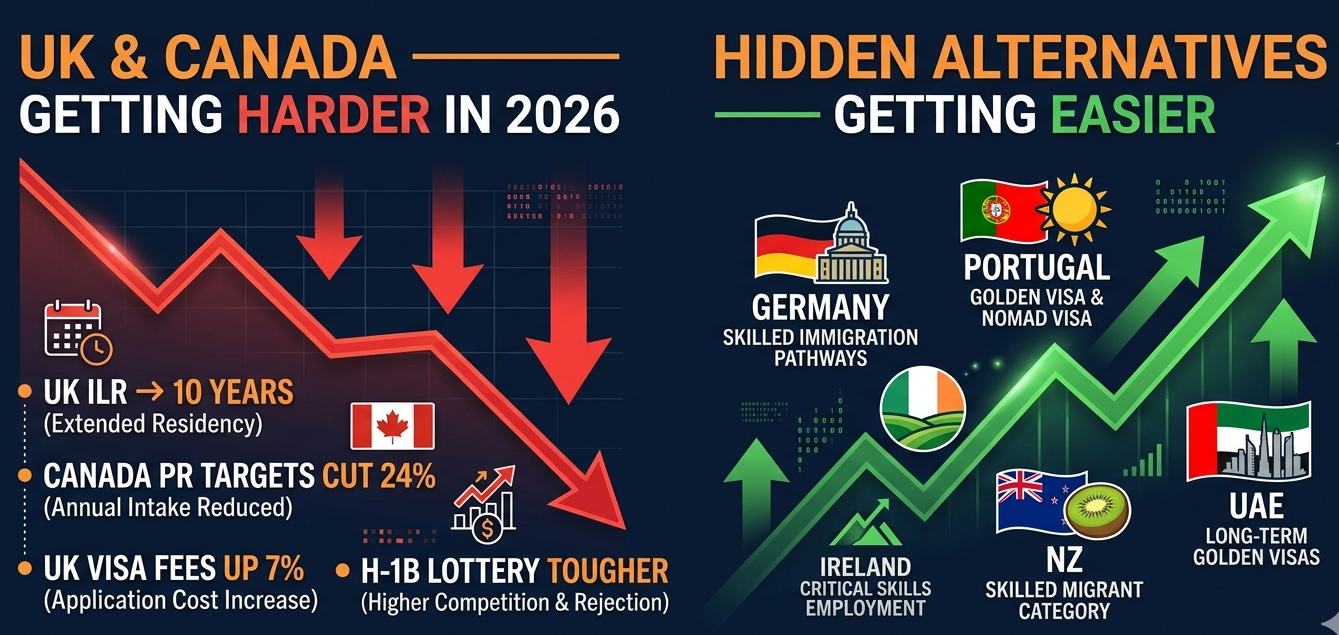
Country | What Changed in 2026 | Impact on Indians |
|---|---|---|
🇬🇧 UK | ILR proposed to extend to 10 years; B2 English for ILR from March 2027; Visa fees up 7%; Graduate visa cut to 18 months | Settlement takes twice as long; Higher test requirements; More expensive; Less post-study flexibility |
🇨🇦 Canada | PR targets cut to 380,000; Settlement services capped at 6 years; Study permits sharply down; Housing crisis in major cities | More competition for fewer spots; Longer waits; Harder for overseas applicants vs in-country |
🇺🇸 USA | H-1B lottery tighter; $100,000 fee on large employers; More RFEs on green card; EB-2/EB-3 backlog for Indians is decades long | Lower chances via lottery; Employer reluctance; Realistic PR wait of 50+ years for many Indians |
🇦🇺 Australia | Salary thresholds rising every July; Student visa rejections up 34%; Work holiday visa ballot limited | Higher bar for skilled workers; Tougher student environment; Rising cost of living |
The opportunity: While the traditional four are tightening, labour shortages across Europe, the Gulf, and the Pacific are forcing other governments to actively recruit Indian talent. The countries below are not consolation prizes — for many Indian professionals, they are the better choice in 2026.
The 7 Countries Getting Easier for Indians in 2026
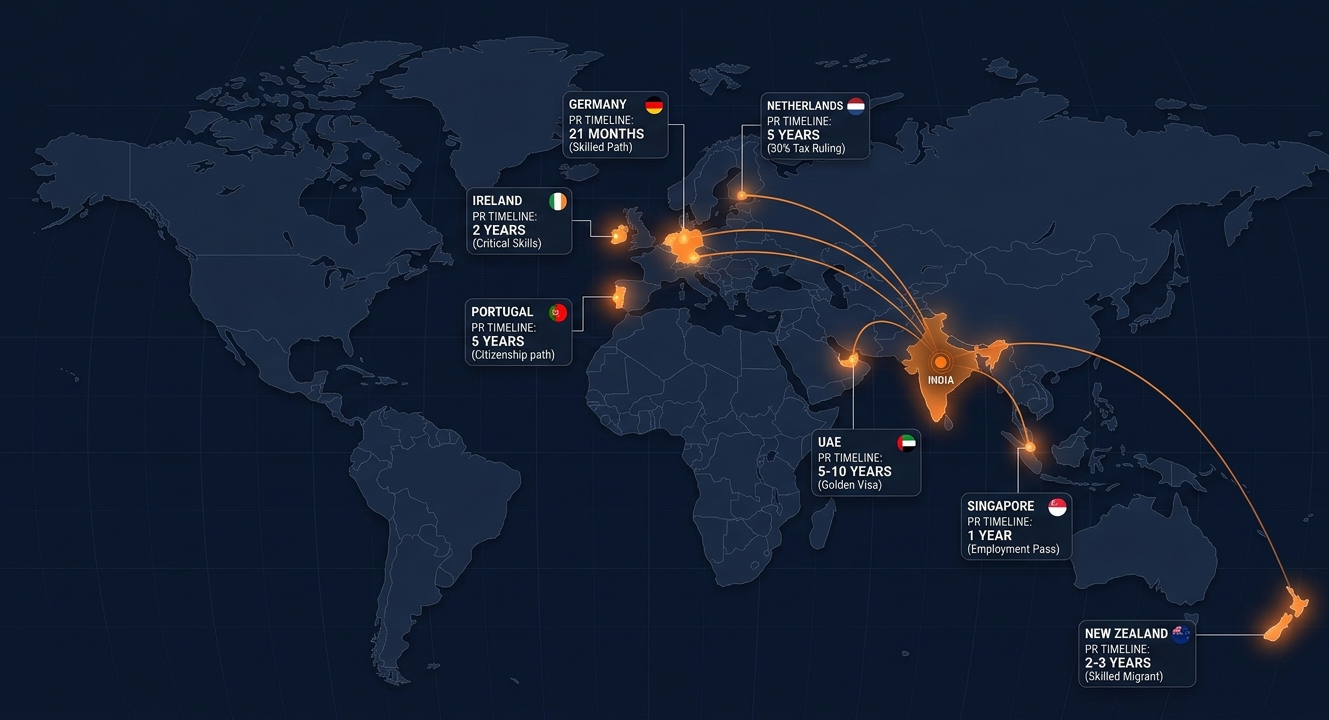
🇩🇪 COUNTRY 1
Germany — The Fastest PR in Europe, Built for Indian Talent
PR in 21 monthsNo degree needed for ITLearn German for best resultsMin salary €45,934/yr
Germany is the single most significant immigration opportunity for skilled Indians in 2026. The country has a shortage of over 96,000 IT specialists and faces a broader skilled worker deficit of approximately 7 million people by 2035 as its working-age population shrinks. The German government's response has been to make immigration faster and more accessible than almost any comparable economy.
What Changed in Germany's Favour for Indians
Chancenkarte (Opportunity Card): Introduced in 2024 and fully active in 2026 — allows skilled Indians to enter Germany without a job offer and job hunt on the ground for up to 1 year. Work part-time (20 hours/week) while searching. Apply via Make it in Germany
EU Blue Card — IT exception: Indian IT professionals without a university degree now qualify for Germany's most powerful residency permit if they have 3+ years of relevant experience and a job offer at €45,934+ per year
Fastest PR in Europe: Blue Card holders with B1 German achieve permanent residency in just 21 months — compared to 5–10 years in UK/Canada
Dual citizenship now allowed: Germany's 2024 Nationality Act means Indians can get German citizenship without giving up their Indian passport
Spouse gets unrestricted work rights immediately on Blue Card family reunification
Factor | Details |
|---|---|
Key visa routes | EU Blue Card, Chancenkarte (Opportunity Card), Skilled Worker Visa, Student Visa |
Minimum salary (Blue Card) | €45,934/year shortage occupations (≈ ₹50.5 lakh) | €50,700 standard (≈ ₹55.8 lakh) |
PR timeline | 21 months (B1 German) | 33 months (no German) |
Citizenship | 8 years (can reduce to 5 with exceptional contributions) |
Language needed? | Not for Blue Card itself — but B1 German speeds up PR significantly |
Best for Indians in | IT, software engineering, data science, mechanical/electrical engineering, healthcare |
Average salary | €50,000–€75,000/year (≈ ₹55–82 lakh) for IT and engineering |
Read our complete guide: Germany Blue Card 2026 — Salary Requirements and Step-by-Step Guide for Indians
🇵🇹 COUNTRY 2
Portugal — Cheapest EU Citizenship Pathway, No Salary Minimum for D7
Citizenship in 5 yearsNo minimum salary for D7EU Citizenship includedLive on €1,200/month
Portugal has emerged as the most accessible EU citizenship pathway for Indians in 2026. According to the Portuguese Agency for Integration, Migration, and Asylum, Indian nationals ranked among the top five applicants for the Portugal Golden Visa programme in 2023, with 199 Indian investors securing Golden Visas that year. And that is before the D7 and Digital Nomad visas — which are even more accessible.
Portugal's Three Routes for Indians in 2026
Route A — D7 Passive Income Visa: If you have any passive income — rental income from India, pension, dividends, freelance/remote work income — you can move to Portugal on a D7 visa with a minimum income of just €820/month (≈ ₹90,000/month). No Portuguese job needed. No IELTS needed. Residency in 6 months, citizenship eligibility after 5 years of residence.
Route B — Digital Nomad / Remote Work Visa: If you work remotely for a non-Portuguese employer — including Indian companies or international clients — Portugal's Digital Nomad visa allows you to live in Portugal on a minimum income of €3,280/month (≈ ₹3.6 lakh/month). Portugal has become the number one destination for remote-working Indian professionals in Europe.
Route C — Golden Visa (Investor Route): A minimum investment of €250,000 in approved Portuguese funds gives you residency and a clear citizenship pathway. Not for everyone — but for Indian investors and business owners, this is one of the most cost-effective EU citizenship-by-investment routes available.
Factor | Details |
|---|---|
Key visa routes | D7 (passive income), Digital Nomad Visa, Golden Visa, Job Seeker Visa, Student Visa |
Income requirement (D7) | €820/month (≈ ₹90,000) — one of the lowest in Europe |
PR timeline | 2 years temporary residence → PR application eligible |
Citizenship | 5 years — with basic A2 Portuguese language |
Language needed? | A2 Portuguese for citizenship (basic level — achievable in 6 months of study) |
Best for Indians | Remote workers, freelancers, passive income holders, retirees, investors |
Cost of living | Significantly lower than UK/Canada — Lisbon monthly cost ≈ £1,800 vs London ≈ £3,200 |
✅ The Portugal advantage nobody talks about: Portuguese citizenship gives you full EU citizenship — the right to live and work in all 27 EU member states, including Germany, France, Netherlands, Spain, and Ireland. An Indian who gets Portuguese citizenship can then move to Germany without any visa, any salary threshold, or any language requirement. It is the EU back door.
🇮🇪 COUNTRY 3
Ireland — English-Speaking, EU Member, Tech Hub, PR in 2 Years
English-speaking EU countryPR in 2 years (Critical Skills)High salariesGoogle, Meta, Apple HQ
Ireland is the most underrated destination for Indian IT professionals in Europe. It is the only English-speaking EU member state — combining the language familiarity of the UK with the freedom of EU membership and much faster settlement than either. Ireland's booming economy and friendly atmosphere make it a hidden gem for Indian professionals and students.
Google, Meta, Apple, Microsoft, LinkedIn, Twitter, Airbnb, and dozens of other global tech companies have their European headquarters in Dublin. For Indian software engineers, data scientists, and product managers — Ireland's tech ecosystem offers UK-level salaries with EU mobility rights and a shorter path to permanent residency.
Ireland's Critical Skills Employment Permit — The Fast Track
Designed for occupations on Ireland's Critical Skills list — includes software engineers, data scientists, doctors, nurses, pharmacists, and financial analysts
Minimum salary: €38,000/year for roles on the Critical Skills list; €64,000/year for roles not on the list
After 2 years on a Critical Skills permit → eligible to apply for Long-Term Residency (Ireland's equivalent of PR)
Spouse gets immediate work authorisation — unrestricted work rights in Ireland
No IELTS or English test required — you are already applying in English
Citizenship eligibility after 5 years of residence — Irish citizenship includes full EU citizenship rights
Factor | Details |
|---|---|
Key permit | Critical Skills Employment Permit, General Employment Permit |
Minimum salary | €38,000/year (Critical Skills list) | €64,000/year (non-listed) |
PR timeline | 2 years on Critical Skills → Long-Term Residency eligible |
Citizenship | 5 years residence |
Language requirement | None — English-speaking country |
Best for Indians | Software engineers, data scientists, doctors, nurses, financial professionals |
Top employers hiring Indians | Google, Meta, Apple, Microsoft, Stripe, LinkedIn, HubSpot, Pfizer, Medtronic |
🇳🇿 COUNTRY 4
New Zealand — Green List Fast Track, World's Best Work-Life Balance
Green List — direct PR in 2 yearsEnglish-speakingLifestyle — #1 globallyHigh demand for healthcare
New Zealand consistently ranks as one of the world's most liveable countries — and in 2026, it is actively recruiting from India for its Green List shortage occupations. New Zealand is well known for its welcoming immigration policies and high living standards. Its points-based immigration system is transparent, its English-language environment makes integration easy, and its Green List creates a direct-to-PR pathway for occupations in high demand.
New Zealand's Green List — What It Means for Indians
The Green List contains occupations in critical shortage where New Zealand actively needs overseas talent. Green List applicants skip the normal immigration queue and get significantly faster pathways to residency. Key Green List occupations where Indians are in high demand:
Tier 1 (Straight to Residence): GPs, specialist doctors, surgeons, midwives, nurses — can apply directly for residency without working first
Tier 2 (Work to Residence — 2 years): Software engineers, data scientists, construction managers, electrical engineers, early childhood teachers, quantity surveyors
Agriculture, viticulture, and food technology specialists in high demand across regional New Zealand
Factor | Details |
|---|---|
Key visa routes | Green List Work Visa, Skilled Migrant Category, Accredited Employer Work Visa |
Income requirement | Median wage NZD $29.66/hour (≈ ₹1,450/hour) minimum for most work visas |
PR timeline | Immediate for Green List Tier 1 (doctors) | 2 years for Tier 2 professionals |
Citizenship | 5 years as PR |
Language requirement | English proficiency — IELTS 6.5+ recommended (no formal test required for many employer-sponsored routes) |
Best for Indians | Healthcare professionals (especially GPs and nurses), engineers, IT professionals, teachers |
Average salary | NZD $70,000–$120,000/year (≈ ₹35–60 lakh) for skilled professionals |
💡 Hidden advantage of New Zealand for Indian doctors: India trains more doctors per year than almost any country in the world — but the UK PLAB, USA USMLE, and Australia AMC are all highly competitive to sit and pass. New Zealand's Medical Council pathway is considered more accessible, with a streamlined registration process for Indian-trained doctors in shortage specialties. For Indian GPs and specialist doctors — New Zealand is offering direct PR. This is extraordinarily rare globally.
🇦🇪 COUNTRY 5
UAE / Dubai — Zero Tax, 10-Year Golden Visa, Closest to Home
Zero income tax3.5M Indians already there10-year self-sponsored residencyNo IELTS required
The UAE is not new to Indians — 3.5 million Indians already live and work there, making it the world's second-largest Indian community after the USA. But in 2026, the UAE's expanding Golden Visa programme makes it significantly more attractive as a long-term destination rather than just a short-term posting.
Why the UAE Is Better Than Ever in 2026
Golden Visa (10-year self-sponsored residency): Indian professionals earning AED 30,000/month (≈ ₹8.5 lakh/month) can self-sponsor a 10-year Golden Visa without employer dependency. No job loss = no visa loss. This is a massive change from the old employment-linked system.
Zero personal income tax: What you earn, you keep. An Indian engineer earning AED 25,000/month (≈ ₹7 lakh/month) keeps every dirham — vs losing 20–40% in UK or Canada tax
No IELTS required: The UAE issues employment visas without any formal English language test
Proximity to India: 3-hour flight to Delhi or Mumbai. Easy to maintain family ties, manage Indian property, and return for festivals without losing your life abroad
Strong Indian infrastructure: Indian schools (CBSE curriculum), Indian grocery stores everywhere, Indian banks, temples, cultural events — settling is far less of a culture shock
Factor | Details |
|---|---|
Key visa routes | Employment Visa (employer-sponsored), Golden Visa (self-sponsored 10-year), Freelance Visa, Investor Visa |
Golden Visa income requirement | AED 30,000/month (≈ ₹8.5 lakh/month) for self-sponsored professional Golden Visa |
PR timeline | UAE does not offer traditional PR — Golden Visa (10 years, renewable) is the equivalent |
Citizenship | Not routinely available — UAE naturalisation is rare and discretionary |
Language requirement | None — no IELTS, no language test |
Best for Indians | Finance, IT, hospitality, construction, retail management, healthcare, education |
Income tax | Zero personal income tax |
⚠ UAE honest caveat: The UAE does not offer a pathway to citizenship for most Indians, and Golden Visa holders cannot become "permanent" in the European sense. If your goal is a second passport or long-term settlement for children's citizenship — UAE is not the answer. But for 10–20 years of tax-free, high-earning, culturally familiar life close to India — it remains unmatched.
🇸🇬 COUNTRY 6
Singapore — Asia's Finance Hub, High Salaries, PR After 2 Years
PR after 2 yearsEnglish-speakingHigh cost of livingTax rate 17% (low)
Singapore's Employment Pass (EP) remains one of the most accessible high-income work visas for Indian professionals in Asia. The minimum qualifying salary was raised to SGD 5,000/month (≈ ₹3.1 lakh/month) in 2023, with additional points under the new COMPASS system favouring diversity, skills, and qualifications. Indian IT, finance, and pharma professionals with strong credentials are well-positioned.
PR eligibility typically after 2 years of EP residency — one of the faster PR routes in Asia
Low personal income tax — maximum rate of 22%, with most mid-level professionals paying 15–17%
English is the primary business language — no language learning required
World-class healthcare, education, and infrastructure — consistently ranked #1 for quality of life in Asia
Strong Indian community — Little India district in central Singapore, Tamil as an official language
Gateway to ASEAN business opportunities — ideal for Indian entrepreneurs and business professionals
Factor | Details |
|---|---|
Key visa routes | Employment Pass (EP), S Pass, EntrePass (entrepreneurs), Tech.Pass (senior tech talent) |
Minimum EP salary | SGD 5,000/month (≈ ₹3.1 lakh/month) — higher for financial services |
PR timeline | Approximately 2 years on EP |
Citizenship | After 2 years as PR — but Singapore discourages dual citizenship |
Language requirement | None — English-speaking country |
Best for Indians | Finance, banking, fintech, tech, pharma, management consulting |
Average salary (tech/finance) | SGD 7,000–15,000/month (≈ ₹4.3–9.3 lakh/month) |
🇳🇱 COUNTRY 7
Netherlands — 30% Tax Ruling, English Everywhere, EU Access
30% tax ruling for 5 yearsEnglish-speaking work culturePR after 5 yearsAmsterdam, Rotterdam, Eindhoven
The Netherlands is one of Europe's most internationally-minded countries and one of the most English-friendly in continental Europe. Over 90% of Dutch people speak English, making it possible to live and work entirely in English for years. For Indian IT professionals, engineers, and researchers — ASML, Philips, Shell, ING, and dozens of major multinationals actively recruit Indian talent through the Highly Skilled Migrant (HSM) Permit.
The 30% Tax Ruling — The Netherlands' Secret Weapon for Indians
For the first 5 years of working in the Netherlands, highly skilled migrants can apply for the 30% tax ruling — where 30% of your salary is paid tax-free as an expense allowance. For an Indian engineer earning €70,000/year, this effectively reduces your taxable income to €49,000 — saving approximately €6,000–8,000 in taxes every year.
Factor | Details |
|---|---|
Key visa route | Highly Skilled Migrant (HSM) Permit — employer-sponsored |
Minimum salary | €46,107/year for professionals under 30 | €63,503/year for professionals 30+ (2026 rates) |
PR timeline | 5 years |
Citizenship | 5 years + renounce Indian passport (Netherlands does not allow dual citizenship except in specific cases) |
Language requirement | None for the permit — Dutch helps for integration but not required for work |
Best for Indians | Software engineers, chip/semiconductor engineers (ASML), researchers, finance professionals |
30% tax ruling benefit | Approx €6,000–8,000 annual tax saving for 5 years |
Master Comparison: All 7 Countries vs UK and Canada
Country | PR Timeline | Min. Salary / Income | Language Test? | English-Speaking? | Tax Rate (approx) | Best For |
|---|---|---|---|---|---|---|
🇩🇪 Germany | 21 months | €45,934/yr | No (but German helps) | No (learn German) | ~35–42% | IT, Engineering, Healthcare |
🇵🇹 Portugal | 2 years (D7) | €820/month | A2 Portuguese for citizenship | Partial | ~20–28% | Remote workers, Freelancers, Investors |
🇮🇪 Ireland | 2 years | €38,000/yr | No | ✅ Yes | ~20–40% | Tech professionals, Doctors, Finance |
🇳🇿 New Zealand | Immediate–2 yrs | NZD $29.66/hr min | IELTS 6.5 (some routes) | ✅ Yes | ~28–33% | Doctors, Nurses, Engineers, Teachers |
🇦🇪 UAE | N/A (Golden Visa = 10yr) | AED 30K/month (Golden) | No | ✅ Yes (business) | 0% | Finance, IT, Hospitality, any sector |
🇸🇬 Singapore | ~2 years | SGD 5,000/month | No | ✅ Yes | ~15–22% | Finance, Tech, Pharma, Management |
🇳🇱 Netherlands | 5 years | €46,107–63,503/yr | No | ✅ Yes (work) | ~37% (30% ruling saves ₹5–8L/yr) | Tech, Semiconductor, Research, Finance |
🇬🇧 UK | 5–10 years | £41,700/yr | B1 now, B2 from 2027 | ✅ Yes | ~20–40% | Broad — but getting harder |
🇨🇦 Canada | 3–5+ years | CAD 62K avg | IELTS 6.0+ | ✅ Yes | ~20–33% | Broad — but target cuts |
Which Country Suits You Best? Match Your Profile
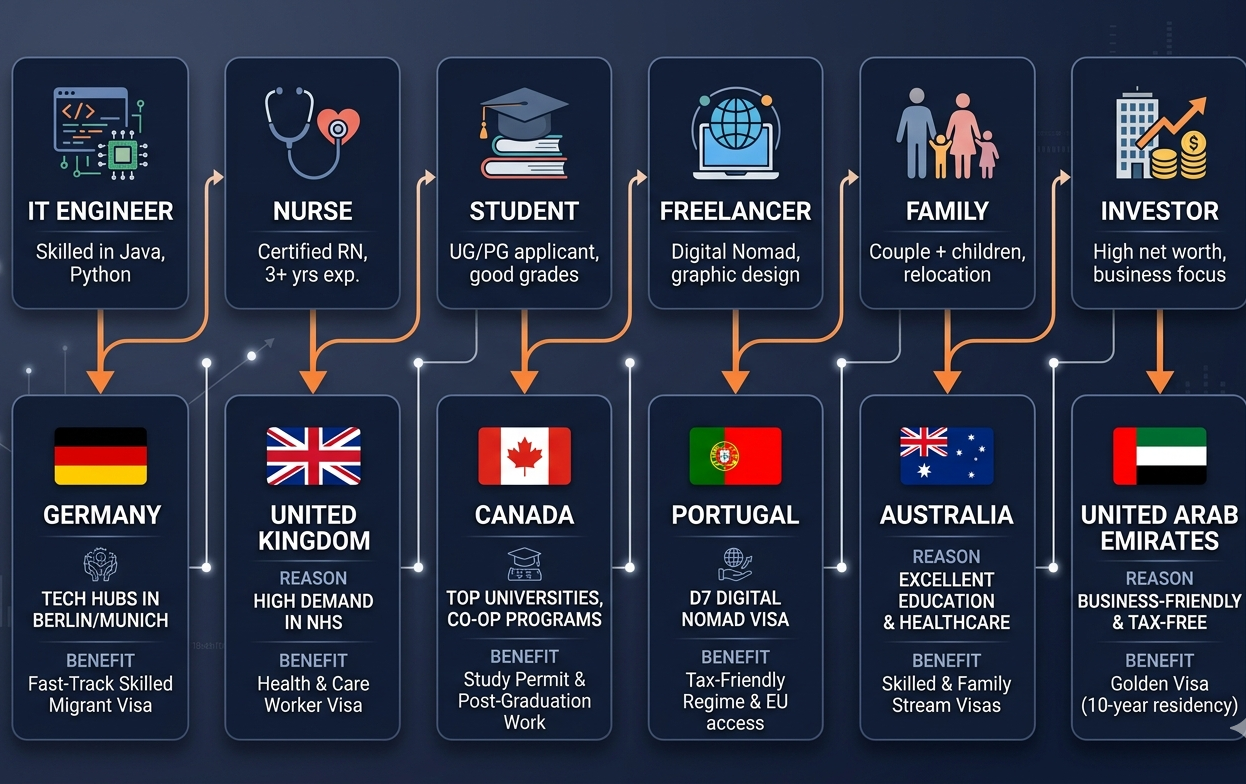
Your Profile | Best Alternative Country | Why |
|---|---|---|
Indian IT professional (3–10 yrs exp) | 🇩🇪 Germany or 🇮🇪 Ireland | Germany: PR in 21 months, Blue Card IT no-degree route. Ireland: English-speaking, tech companies HQ, PR in 2 years |
Indian nurse or doctor | 🇳🇿 New Zealand or 🇩🇪 Germany | NZ Green List: direct to PR for GPs. Germany: nursing and healthcare on shortage list at €45,934 threshold |
Remote worker / freelancer | 🇵🇹 Portugal | D7 visa requires only €820/month passive/remote income. Cheapest EU living. Citizenship after 5 years |
Finance professional | 🇸🇬 Singapore or 🇮🇪 Ireland | Singapore: Asia's finance capital, PR in 2 years. Ireland: EU financial hub, English-speaking |
Family with children | 🇳🇿 New Zealand or 🇩🇪 Germany | NZ: safe, excellent schools, balanced lifestyle. Germany: free university education for children after PR |
Indian investor or entrepreneur | 🇵🇹 Portugal or 🇦🇪 UAE | Portugal Golden Visa: €250K → EU citizenship in 5 years. UAE: zero tax, easy business setup, Golden Visa |
Semiconductor/chip engineer | 🇳🇱 Netherlands | ASML (world's only EUV machine maker) and Philips actively hire Indians. 30% tax ruling saves ₹5–8 lakh/year |
Indian who wants to stay close to India | 🇦🇪 UAE | 3-hour flight, Indian community of 3.5M, zero tax, no culture shock, easy entry — ideal for India ties |
What These Countries Have in Common — The Pattern Indians Should Notice
Looking across all 7 countries, a clear pattern emerges that explains why they are all becoming easier for Indians simultaneously in 2026:
Ageing populations and labour shortages: Germany, Ireland, Portugal, Netherlands, and New Zealand all face demographic crises — not enough working-age people to run their economies. India's young, skilled workforce is the solution they need.
Deliberate policy changes to attract talent: Germany's Chancenkarte, Ireland's Critical Skills expansion, New Zealand's Green List, Portugal's Digital Nomad visa — all introduced or expanded in 2024–2025 specifically to attract non-EU talent. These are not accidents.
Indians are already succeeding there: The presence of established Indian diaspora communities in all these countries — doctors in New Zealand, tech workers in Ireland, engineers in Germany — makes the path easier for newer arrivals through community support, referrals, and established integration networks.
Less competition than UK/Canada: Because most Indians default to UK/Canada/USA, these seven countries have significantly lower competition for their immigration slots. Your application is less likely to be lost in a massive queue.
The core insight: The best immigration opportunities for Indians in 2026 are not the ones most talked about at family dinners. They are the ones where the gap between demand for Indian talent and Indian awareness of the opportunity is largest. Germany, Ireland, and New Zealand all fit this description perfectly. The Indians who move in 2026 will be ahead of the wave. Those who wait until these become as popular as UK and Canada will face the same queue and competition problems all over again.
Common Mistakes Indians Make When Considering These Countries
Dismissing non-English-speaking countries without research: "I don't speak German" should not end the conversation. The Blue Card, the Chancenkarte, and many German employer roles — especially in tech — operate entirely in English. Learning German after arrival is different from needing it before arrival.
Comparing gross salaries without adjusting for tax and cost of living: A UAE salary of AED 25,000/month looks smaller than a UK salary of £4,000/month — until you realise the UAE number is tax-free and rent is lower. Always compare net disposable income, not gross salary.
Assuming UK/Canada are automatically the "best" options: For some profiles — freelancers, investors, doctors, IT professionals — Germany, Portugal, and Ireland are objectively better in 2026. The reputation of UK/Canada was built on conditions of 5–10 years ago that no longer apply.
Not checking if their degree is recognised: Every country has its own degree recognition process. Germany has Anabin, UK has NARIC/ECCTIS, New Zealand has NZQA, Australia has AQF. Check before applying — not after.
Waiting for the "right time": The Chancenkarte, the Portugal D7, the Ireland Critical Skills permit — these exist now, with current labour shortages driving demand. Waiting 2 years means waiting for demand to cool or competition to increase.
Not Sure Which Country Is Right for You?
IndiaWale Abroad connects you with verified immigration consultants who specialise in Germany, Portugal, Ireland, New Zealand, UAE, Singapore, and Netherlands applications — and with Indians already living in each country who can give you honest, unfiltered guidance. No guesswork. Real experience.
Find Your Country Expert on IndiaWale Abroad →
More Guides to Help You Plan Your Move
👉 Germany Blue Card 2026 — Complete salary guide and step-by-step application for Indians
👉 UK ILR English going up to B2 — how this affects Indians already in the UK
👉 UK Visa Fee Hike April 2026 — full cost breakdown in pounds and rupees for Indians
👉 Canada's new work visa rule 2026 — what open work permit holders must know
👉 How to get a job abroad from India in 2026 — complete step-by-step strategy
Official External Resources
🔗 Germany Chancenkarte (Opportunity Card) — official Make it in Germany portal
🔗 Ireland Critical Skills Employment Permit — official Irish Immigration
🔗 New Zealand Green List Work Visa — official NZ Immigration
🔗 Portugal D7 Passive Income Visa — official Portuguese consular guidance
🔗 Singapore — MyCareersFuture official job portal for Employment Pass applicants
Frequently Asked Questions
Which country is now the easiest for Indians to immigrate to in 2026?
It depends on your profile. Germany is the easiest for skilled IT and engineering professionals — the Chancenkarte allows entry without a job offer and the Blue Card gives PR in 21 months. Portugal is the easiest for remote workers and freelancers — the D7 visa requires only €820/month income. UAE is the easiest overall entry with no language test, no minimum qualification for most roles, and a massive existing Indian community. Ireland is the easiest English-speaking EU destination for tech and healthcare professionals with PR in just 2 years.
Can Indians get citizenship in Germany, Portugal, or Ireland?
Yes to all three. Germany: citizenship after 8 years (reduceable to 5), and since 2024 India-Germany dual citizenship is allowed — you keep your Indian passport. Portugal: citizenship after 5 years of residence with basic A2 Portuguese — and Portuguese citizenship is full EU citizenship, giving you the right to live and work across all 27 EU member states. Ireland: citizenship after 5 years of residence — Irish citizenship also includes EU citizenship rights.
Do I need to learn German to move to Germany?
Not to get a visa or start working — especially in IT and engineering roles where many companies work in English. However, learning German is strongly recommended for two reasons: (1) B1 German reduces your PR timeline from 33 months to 21 months — saving over a year; (2) knowing German significantly increases your salary offers and career options. You can apply for the Chancenkarte or Blue Card without any German, but start learning from day one.
Is Portugal really a good option or just a lifestyle country?
Portugal is genuinely one of the best strategic immigration choices for Indian remote workers, freelancers, and investors in 2026. It is not just a lifestyle destination. Here is why: (1) it offers EU citizenship in 5 years — meaning after 5 years in Portugal you can move to Germany, Ireland, or any EU country without any visa; (2) the D7 visa income requirement of €820/month is achievable for most Indians with any passive or remote income; (3) cost of living in Portugal is 40–50% lower than the UK. It is the EU's most accessible front door.
How does Ireland compare to the UK for Indian professionals?
Ireland beats the UK on several key factors in 2026: (1) PR in 2 years via Critical Skills vs the UK's proposed 10 years; (2) Ireland is an EU member — giving EU mobility rights that UK no longer provides; (3) Google, Meta, Apple, Microsoft and major tech companies have European HQs in Dublin offering equivalent UK salaries; (4) no language test required; (5) Ireland is also a cheaper place to live than London. The main advantage the UK still has is the larger Indian community, more established professional networks, and direct non-stop flights from every Indian city.
What is the UAE Golden Visa and who qualifies for it?
The UAE Golden Visa is a 10-year self-sponsored residency permit — meaning your visa is not tied to your employer. If you lose your job, your visa does not automatically expire. Key qualifying routes for Indians: (1) Skilled professionals earning AED 30,000/month (≈ ₹8.5 lakh/month) in approved sectors; (2) Investors with a UAE property investment of AED 2 million+; (3) Entrepreneurs with an approved startup; (4) Exceptional talents in arts, sports, or science. The Golden Visa has no income tax implications and includes family members.
Can Indian nurses and doctors move to New Zealand easily?
New Zealand's Green List Tier 1 includes GPs and specialist doctors who can apply directly for residence — bypassing the usual work-visa-first process. Registered nurses are on Tier 2, meaning 2 years of work in New Zealand leads directly to PR. The New Zealand Medical Council has a structured registration process for overseas-trained doctors that, while rigorous, is considered more accessible than the UK GMC or Australian AMC pathways for Indian-trained doctors. New Zealand actively recruits Indian healthcare professionals and the healthcare sector faces significant shortages.
How do I decide between these 7 countries?
Three questions narrow it down quickly: (1) Do you want an English-speaking country? → Ireland, New Zealand, UAE, Singapore, Netherlands (work culture). (2) Do you want EU citizenship? → Germany, Portugal, Ireland, Netherlands. (3) What is your occupation? IT → Germany or Ireland. Healthcare → New Zealand or Germany. Finance → Singapore or Ireland. Remote/freelance → Portugal. Investment → UAE or Portugal. Use our IndiaWale Abroad expert directory to speak with a specialist for your specific profile before committing.



Comments
No approved comments yet. Be the first to comment.