
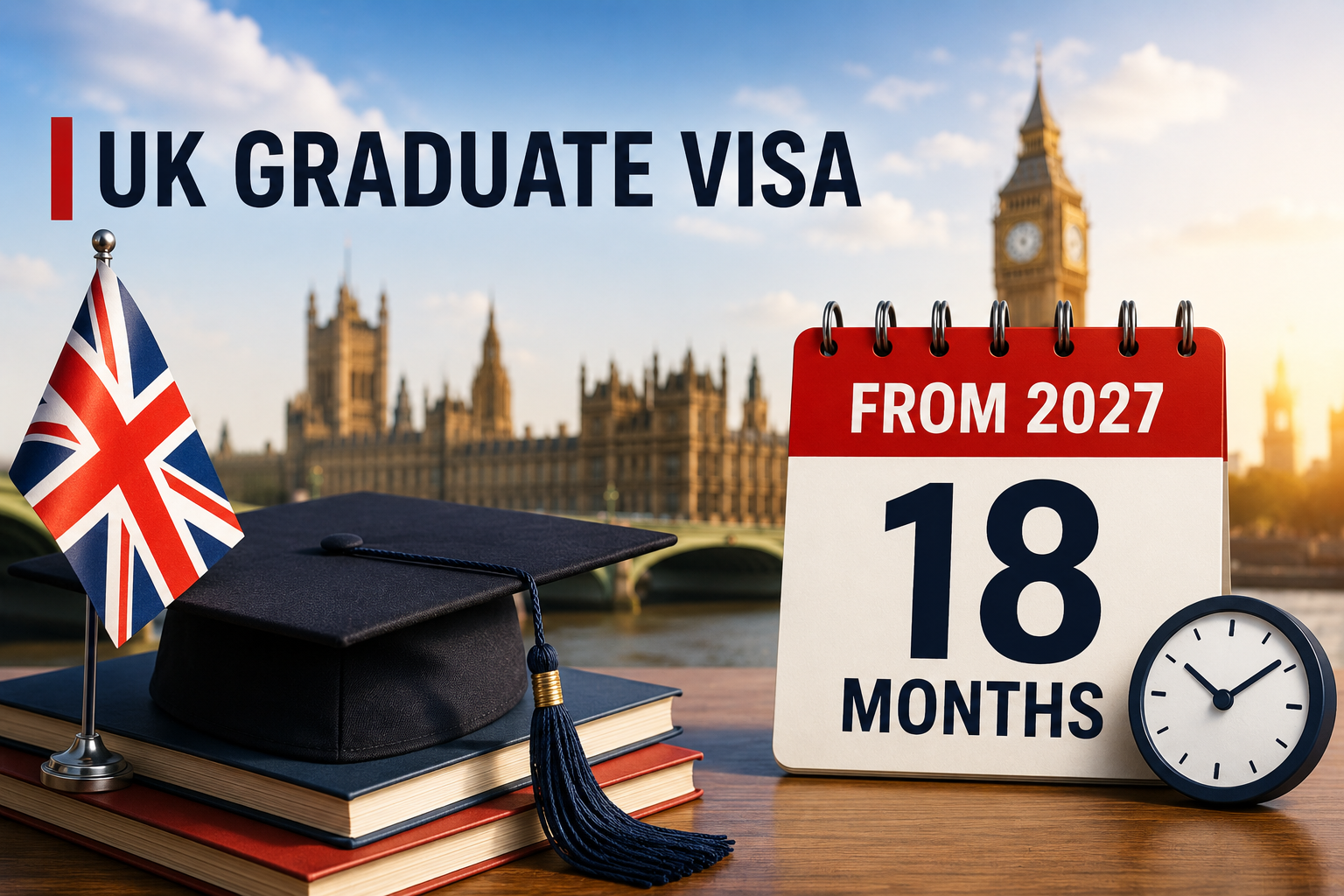
Planning to study in the UK? A major immigration policy change could significantly impact your career plans after graduation.
The UK Government has announced that the Graduate Route Visa for bachelor's and master's degree holders will be reduced from 2 years to 18 months for eligible applications made from 1 January 2027. While students applying before this date will continue to receive a 2-year Graduate Visa, future applicants will have less time to secure employment and transition to a long-term work visa. PhD graduates are not affected and will continue to receive a 3-year Graduate Visa.
For Indian students—one of the largest international student communities in the UK—this update raises important questions:
Should you still choose the UK for higher education?
Will the shorter Graduate Visa make it harder to find a job?
How will this affect your return on investment (ROI)?
Should you apply before the new rule comes into effect?
In this comprehensive guide, we'll explain everything you need to know about the UK Graduate Visa changes, who is affected, what it means for Indian students, and how you can plan your study abroad journey wisely.
What Is the UK Graduate Visa?
The Graduate Route Visa allows international students who successfully complete an eligible degree in the UK to remain in the country after graduation without requiring employer sponsorship.
Unlike the Skilled Worker Visa, the Graduate Visa allows graduates to:
Work full-time
Switch employers freely
Look for permanent jobs
Gain UK work experience
Start a business (subject to immigration rules)
The Graduate Route has become one of the biggest reasons why thousands of Indian students choose the UK every year.
What Has Changed?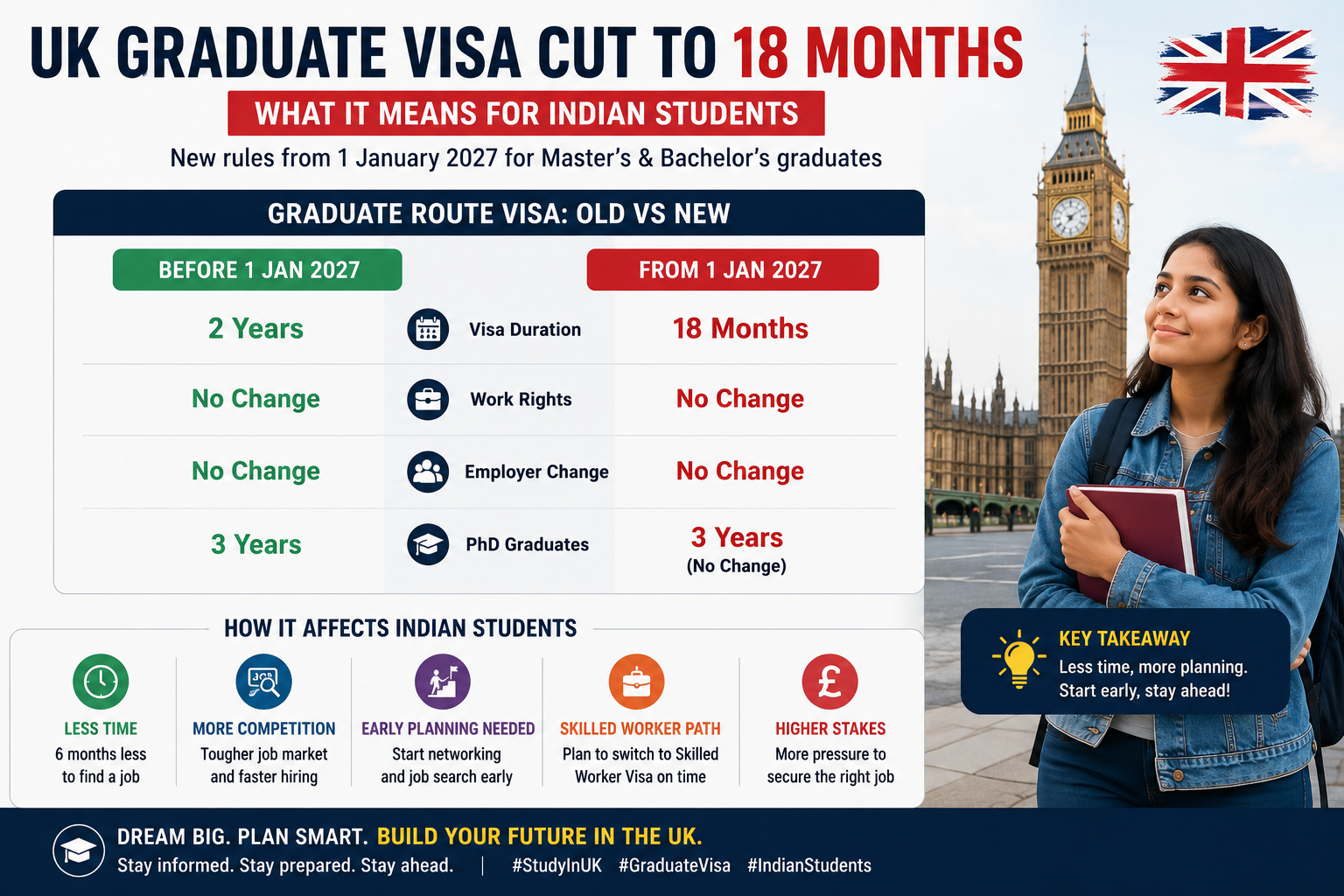
The biggest change announced by the UK Government is the reduction in the Graduate Visa duration for bachelor's and master's graduates.
Graduate Visa Duration Comparison
Student Category | Until 31 Dec 2026 | From 1 Jan 2027 |
|---|---|---|
Bachelor's Degree | 2 Years | 18 Months |
Master's Degree | 2 Years | 18 Months |
PhD / Doctorate | 3 Years | 3 Years |
This means future graduates will have 6 months less to find employment and switch to another eligible visa category.
Why Did the UK Government Reduce the Graduate Visa?
The UK Government has stated that the change is part of broader immigration reforms aimed at reducing net migration while continuing to attract highly skilled international talent.
The government wants graduates to move more quickly into skilled employment and transition to long-term work routes if they intend to remain in the UK.
Although the Graduate Route remains available, the shorter duration encourages graduates to secure qualifying employment sooner rather than relying on an extended post-study work period.
Who Is Affected by the New Rule?
The new Graduate Visa duration primarily affects international students planning to begin or complete bachelor's or master's degrees where the Graduate Route application will be made from 1 January 2027 onward.
Students Affected
Undergraduate students
Master's students
Future UK applicants
Indian students planning September 2026 and later intakes (depending on graduation and application timing)
Students Not Affected
The following groups remain unaffected:
Students who successfully apply for a Graduate Visa before 1 January 2027
PhD and doctoral graduates, who continue to receive a 3-year Graduate Visa
Individuals already holding a valid Graduate Visa granted under the previous rules
Why This Matters for Indian Students
India consistently ranks among the largest sources of international students in the UK. For many Indian families, studying abroad is a significant financial investment, often costing ₹25 lakh to ₹60 lakh or more, depending on the university and course.
A shorter Graduate Visa means students have less time to:
Build UK work experience
Recover tuition and living expenses
Secure a Skilled Worker Visa
Improve long-term career prospects
For students pursuing highly competitive sectors such as finance, consulting, engineering, healthcare, law, or technology, six fewer months could make a meaningful difference in the job search process.
What Does the Graduate Visa Allow You to Do?
Despite the reduced duration, the Graduate Route remains one of the most flexible post-study work options available.
With a Graduate Visa, eligible graduates can:
Work full-time in most occupations
Change employers without sponsorship
Take up temporary or permanent employment
Gain valuable UK industry experience
Search for Skilled Worker Visa opportunities
Be self-employed or start certain businesses
Continue living legally in the UK during the visa period
However, it is important to note that the Graduate Visa does not directly lead to permanent settlement. Graduates wishing to remain in the UK long term typically need to transition to another eligible immigration route, such as the Skilled Worker Visa.
How Will the 18-Month Graduate Visa Affect Job Hunting?
One of the biggest concerns among Indian students is whether 18 months is enough time to secure a skilled job.
The answer depends on several factors:
Job Market Competition
Competition remains strong in industries such as:
Software Engineering
Artificial Intelligence
Data Science
Finance
Healthcare
Cybersecurity
Accounting
Business Analytics
Graduates who begin networking, internships, and placement preparation during their studies are generally better positioned to secure employment before graduation.
Less Margin for Delay
Under the previous two-year Graduate Visa, students had additional time to:
Improve English communication
Build professional networks
Complete internships
Change jobs if necessary
With only 18 months available, graduates may need to start applying for jobs much earlier and remain proactive throughout their studies.
Graduate Visa vs Skilled Worker Visa
Many students confuse the Graduate Visa with the Skilled Worker Visa.
The key difference is sponsorship.
Graduate Visa | Skilled Worker Visa |
|---|---|
No employer sponsorship required | Employer sponsorship required |
Temporary post-study work route | Long-term employment route |
Open work rights | Job must meet immigration requirements |
Does not directly lead to settlement | Can contribute toward long-term residence eligibility |
For most Indian students, the Graduate Visa serves as a bridge between university education and securing sponsorship under the Skilled Worker route.
Important Dates You Should Know
Event | Date |
|---|---|
Graduate Visa remains 2 years | Applications made on or before 31 December 2026 |
Graduate Visa becomes 18 months | Applications made on or after 1 January 2027 |
PhD Graduate Visa | Remains 3 years |
Planning your intake and graduation timeline carefully could have a significant impact on the amount of post-study work time available in the UK.
Should Indian Students Still Choose the UK?
The reduction in the Graduate Visa duration has raised concerns among thousands of Indian students. However, the UK continues to be one of the world's leading study destinations because of its globally recognized universities, shorter course duration, strong employment market, and international career opportunities.
Instead of viewing the new rule as a disadvantage, students should focus on planning their careers more strategically.
The UK still offers several advantages:
World-renowned universities
One-year master's programs that save both time and tuition costs
Access to multinational companies
High demand for skilled professionals
Excellent networking opportunities
A clear pathway to the Skilled Worker Visa for eligible graduates
For students who prepare early, build relevant skills, and actively search for employment during their studies, the UK remains an attractive destination.
How to Maximize Your 18-Month Graduate Visa
Although graduates will have six fewer months to remain in the UK after completing their studies, careful planning can help make the most of the available time.
1. Start Job Hunting Before Graduation
Don't wait until your degree is completed. Begin networking, attending career fairs, and applying for graduate roles during your final semester.
Many UK employers recruit students months before graduation.
2. Gain Relevant Work Experience
Employers value practical experience.
Look for:
Internships
Placement programs
Part-time jobs
Volunteering opportunities
University research projects
These experiences can significantly improve your CV.
3. Build In-Demand Skills
Focus on skills that UK employers actively seek.
Examples include:
Artificial Intelligence
Data Analytics
Cybersecurity
Software Development
Cloud Computing
Accounting
Finance
Healthcare
Digital Marketing
Project Management
Professional certifications can also improve your employability.
4. Improve Your Professional Network
Networking is one of the most effective ways to find job opportunities.
Students should:
Attend university career events
Join LinkedIn professional groups
Connect with alumni
Participate in industry conferences
Engage with recruiters
Many graduate jobs are filled through referrals and professional connections.
5. Prepare for the Skilled Worker Visa
The Graduate Visa is temporary.
Students who wish to remain in the UK long-term should aim to secure employment with a licensed sponsor and transition to the Skilled Worker Visa before their Graduate Visa expires.
Planning this transition early reduces stress and increases the chances of long-term career success.
Graduate Visa Application Process
Applying for a Graduate Visa is relatively straightforward, provided you meet the eligibility requirements.
Step 1
Successfully complete an eligible course at a UK university.
Step 2
Ensure your university reports your successful course completion to UK Visas and Immigration (UKVI).
Step 3
Apply online before your current Student Visa expires.
Step 4
Provide your identity documents and supporting information.
Step 5
Pay the visa application fee and Immigration Health Surcharge (IHS).
Step 6
Wait for your application to be processed.
Most Graduate Visa decisions are made within 8 weeks after submitting the online application and providing the required documents.
Graduate Visa Costs (2026)
Students applying for a Graduate Visa should budget for both the application fee and the Immigration Health Surcharge (IHS).
Expense | Amount |
|---|---|
Graduate Visa Application Fee | £937 |
Immigration Health Surcharge (18-month visa) | £1,152.50 |
Immigration Health Surcharge (2-year visa) | £2,070 |
Immigration Health Surcharge (3-year PhD visa) | £3,105 |
Applicants should always check the latest UK Government fee schedule before applying, as immigration fees may change.
Common Mistakes Students Should Avoid
Many Graduate Visa applications are delayed or refused because of avoidable errors.
Avoid these common mistakes:
Applying after your Student Visa expires.
Travelling outside the UK while your Graduate Visa application is being processed.
Waiting too long to start your job search.
Not preparing a professional CV.
Ignoring university career services.
Missing important visa deadlines.
Failing to understand Skilled Worker Visa requirements.
Being proactive throughout your studies can save time and improve your career prospects.
Frequently Asked Questions (FAQs)
1. Is the UK Graduate Visa being cancelled?
No. The Graduate Route is not being cancelled. The duration for eligible bachelor's and master's graduates is being reduced from 2 years to 18 months for applications made on or after 1 January 2027. PhD graduates remain eligible for a 3-year Graduate Visa.
2. Who is affected by the new rule?
The change affects eligible bachelor's and master's graduates applying for a Graduate Visa from 1 January 2027 onward.
3. Will PhD students receive only 18 months?
No. PhD and other doctoral graduates continue to receive a 3-year Graduate Visa.
4. Can I work full-time on a Graduate Visa?
Yes. Graduate Visa holders can work full-time in most jobs without requiring employer sponsorship.
5. Can I switch to a Skilled Worker Visa?
Yes. If you receive a qualifying job offer from a licensed UK employer, you can switch to the Skilled Worker Visa, provided you meet the eligibility requirements.
6. Does the Graduate Visa lead directly to permanent residency?
No. The Graduate Route itself does not lead directly to settlement. Students usually need to switch to another eligible visa category, such as the Skilled Worker Visa, to continue their long-term stay.
7. Should I still choose the UK in 2026?
Yes. The UK remains one of the world's leading study destinations. While the Graduate Visa duration is shorter for future applicants, strong academic quality, one-year master's programs, and excellent employment opportunities continue to make it an attractive option.
Final Thoughts
The decision to reduce the Graduate Visa from 2 years to 18 months represents a significant change in the UK's post-study work policy. For Indian students, it means less time to secure employment after graduation, making early career planning more important than ever.
However, this update should not discourage students from pursuing higher education in the UK. The country continues to offer internationally respected degrees, access to global employers, and a strong job market in sectors such as technology, healthcare, engineering, finance, and business.
The key to success lies in preparation. Students who begin networking early, gain practical experience, develop in-demand skills, and actively use university career services will be better positioned to secure employment and transition to a long-term work visa.
If you're planning to study in the UK, understanding these new rules now will help you make informed decisions about your university, course, and future career.
Need Expert Guidance for Studying in the UK?
Planning to study in the UK but unsure how the new Graduate Visa rules may affect your future?
IndiaWaleAbroad helps students make informed study abroad decisions by providing expert guidance on:
UK university admissions
Student Visa applications
Scholarships and financial planning
Graduate Route Visa guidance
Skilled Worker Visa pathways
Career planning after graduation
Our experienced counselors stay updated with the latest UK immigration policies to help Indian students achieve their international education and career goals.
📞 Connect with IndiaWaleAbroad today and take the next step toward your dream of studying and building a successful career in the United Kingdom.
References
This article is based on the latest guidance from official UK Government and UK Visas and Immigration (UKVI) resources regarding the Graduate Route, eligibility, application process, fees, and immigration rules. Students should always refer to official government sources for the most up-to-date information before submitting any visa application.

Comments
No approved comments yet. Be the first to comment.