
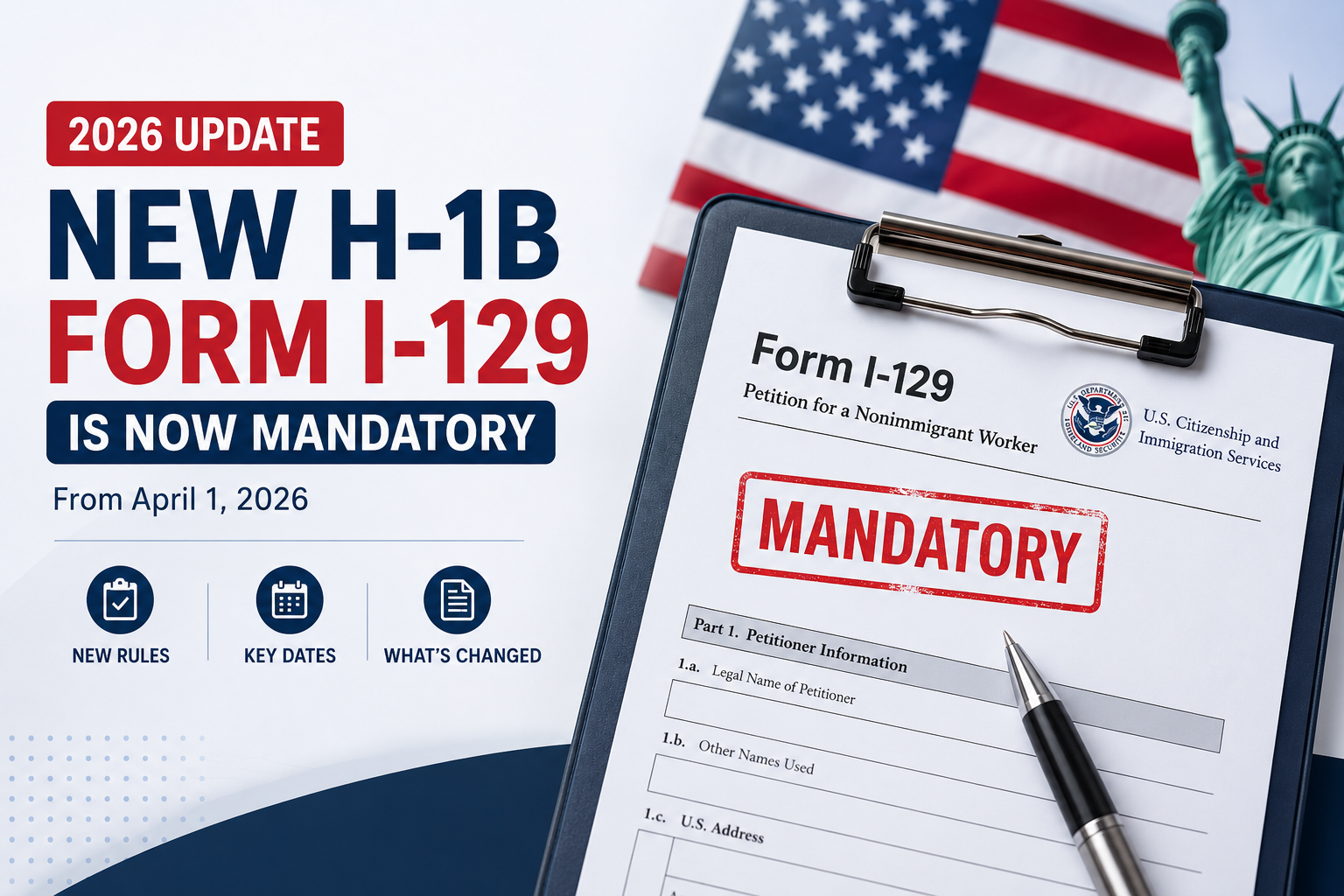
Planning to work in the United States? A major USCIS rule change could affect your H-1B application immediately. If you are an Indian professional, an H-1B lottery selectee, or a U.S. employer sponsoring foreign talent, using the wrong version of Form I-129 could result in your petition being rejected.
The U.S. Citizenship and Immigration Services (USCIS) has introduced a new mandatory edition of Form I-129, bringing important changes to the H-1B filing process. These updates are designed to improve transparency, strengthen compliance, and ensure employers provide more accurate information about the positions they intend to fill.
Whether you're filing your first H-1B petition or have sponsored employees before, understanding these changes is essential. In this guide, we'll explain everything you need to know about the new Form I-129, who it affects, what has changed, filing deadlines, required documents, common mistakes, and expert tips to avoid delays.
What Is Form I-129?
Form I-129, officially known as the Petition for a Nonimmigrant Worker, is a petition filed by U.S. employers with USCIS to request permission for a foreign national to work temporarily in the United States.
For H-1B visas, the employer—not the employee—files Form I-129 after the beneficiary has been selected (if cap-subject) and all eligibility requirements are met.
Besides H-1B, Form I-129 is also used for several employment-based visa categories, including:
H-2A
H-2B
H-3
L-1
O-1
O-2
P Visas
Q-1
R-1
Without an approved Form I-129, USCIS cannot approve an H-1B work visa petition.
Latest USCIS Update on Form I-129
USCIS has released a new edition of Form I-129 dated 02/27/2026.
Important Filing Dates
Date | USCIS Rule |
|---|---|
February 27, 2026 | New Form I-129 published |
March 31, 2026 | Last day USCIS accepts the previous edition |
April 1, 2026 | Only the 02/27/2026 edition is accepted |
Important: Any H-1B petition received on or after April 1, 2026, using the older Form I-129 edition will be rejected by USCIS.
Why Did USCIS Update Form I-129?
The updated Form I-129 reflects USCIS's ongoing efforts to improve the integrity and transparency of the H-1B program.
The revised form requires employers to provide more detailed information about the offered position, making it easier for USCIS officers to determine whether the job qualifies as a specialty occupation.
The changes also reduce ambiguity, improve consistency during adjudication, and strengthen compliance with H-1B regulations.
Major Changes in the New H-1B Form I-129
The updated H Classification Supplement now asks employers for more detailed information than before.
Employers must now provide:
Minimum education required
Exact field of study required
Minimum work experience
Whether supervisory duties are involved
Additional details about the offered position
More precise job information
These updates allow USCIS to better evaluate whether the position genuinely qualifies for H-1B classification.
Old Form vs New Form
Previous Form | New Mandatory Form |
|---|---|
Limited job details | Detailed job description required |
General education requirement | Exact degree and field required |
Less emphasis on experience | Minimum experience must be stated |
Minimal supervisory information | Supervisory responsibilities required |
Accepted until March 31, 2026 | Mandatory from April 1, 2026 |
Who Is Affected?
The new mandatory Form I-129 affects several groups.
H-1B Lottery Selected Candidates
Candidates selected in the H-1B cap season must ensure their sponsoring employer files the correct edition.
U.S. Employers
Every employer filing an H-1B petition must use the updated form.
Immigration Attorneys
Legal representatives preparing H-1B petitions must ensure all filings use the latest USCIS edition.
HR Departments
Human Resources teams handling immigration sponsorship should update their internal filing procedures immediately.
What Happens If You Use the Old Form?
Using the outdated Form I-129 after the mandatory implementation date can have serious consequences.
Possible outcomes include:
Immediate rejection of the petition
Missed filing deadlines
Delayed employment start dates
Additional filing costs
Increased administrative work
Potential impact on visa planning
Simply correcting the mistake later may not always be possible if filing windows have closed.
Documents Required for H-1B Filing
The employer should prepare the following documents before filing Form I-129.
Document | Required |
|---|---|
Certified Labor Condition Application (LCA) | Yes |
Completed Form I-129 | Yes |
H Classification Supplement | Yes |
Employer Support Letter | Yes |
Employee Passport Copy | Yes |
Degree Certificates | Yes |
Educational Evaluation (if applicable) | Yes |
Experience Letters | If applicable |
Resume | Recommended |
Filing Fee Payments | Yes |
Preparing a complete petition package significantly reduces the risk of Requests for Evidence (RFEs) and processing delays.
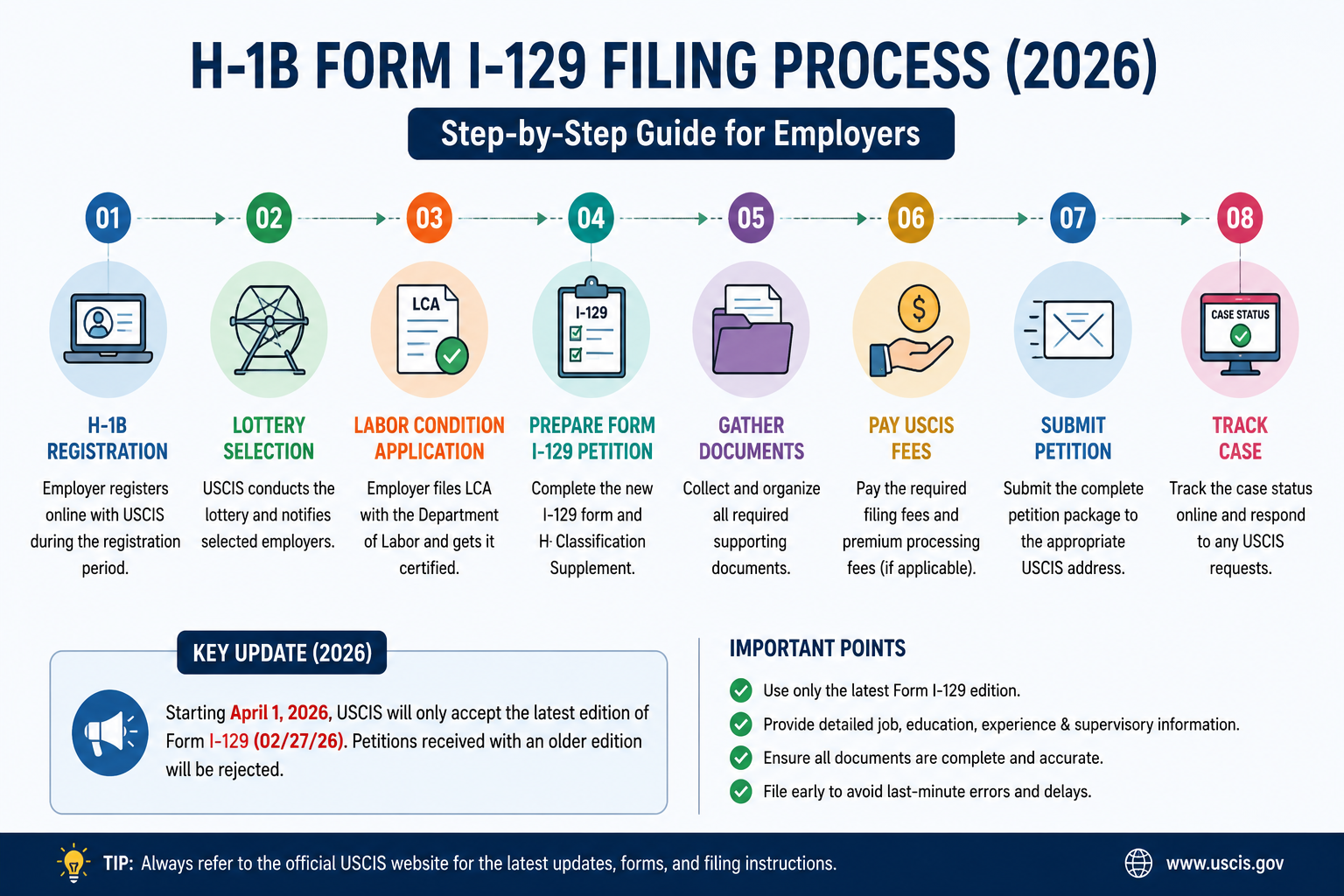
Step-by-Step H-1B Filing Process
Step 1: Register for the H-1B Cap (if applicable)
Employers first complete the electronic H-1B registration process during the designated registration period.
Step 2: Selection
If selected, the employer becomes eligible to submit the complete H-1B petition.
Step 3: Obtain a Certified Labor Condition Application
The employer files an LCA with the U.S. Department of Labor and waits for certification.
Step 4: Complete the New Form I-129
Use only the latest mandatory edition and carefully complete every section.
Step 5: Prepare Supporting Documents
Attach all required educational, employment, and company documentation.
Step 6: Pay USCIS Filing Fees
Include the correct filing fees and ensure payment methods comply with USCIS instructions.
Step 7: Submit the Petition
Mail the petition to the appropriate USCIS filing location before the filing deadline.
Step 8: Track the Case
Once accepted, USCIS issues a receipt notice that can be used to track the petition's status.
Common Mistakes to Avoid
Many H-1B petitions face delays because of preventable errors.
Avoid these common mistakes:
Using the outdated Form I-129
Missing signatures
Incorrect filing fees
Incomplete employer information
Incorrect beneficiary details
Inconsistent job descriptions
Missing supporting evidence
Incorrect Labor Condition Application information
Failure to provide required educational details
Mailing the petition to the wrong USCIS address
Carefully reviewing the petition before submission can save valuable time and reduce the risk of rejection.
Employer Responsibilities
Employers sponsoring H-1B workers must:
Use the latest Form I-129
Provide truthful information
Offer a qualifying specialty occupation
Pay the required wage
Maintain compliance with Department of Labor requirements
Keep public access files where required
Notify USCIS of material changes when applicable
Failure to comply with immigration regulations may result in penalties or petition denials.
Employee Responsibilities
H-1B beneficiaries should:
Provide accurate educational records
Share valid passport information
Maintain communication with the sponsoring employer
Respond quickly to document requests
Keep copies of all immigration documents
Inform the employer of any significant changes
Remember, the employer files Form I-129 on behalf of the employee, but accurate information from both parties is essential for a successful petition.
USCIS Filing Fees for H-1B Petitions
The total cost of filing an H-1B petition depends on the employer's size, whether premium processing is requested, and other applicable statutory fees. Since USCIS periodically updates filing fees, employers should always verify the latest fee schedule before submitting the petition.
Fee Type | Who Pays? | Mandatory |
|---|---|---|
Form I-129 Filing Fee | Employer | Yes |
Fraud Prevention & Detection Fee | Employer | Yes (Initial/Change of Employer) |
ACWIA Training Fee | Employer | Applicable Employers |
Asylum Program Fee (if applicable) | Employer | Depends on Employer Type |
Premium Processing Fee | Optional | Optional |
Expert Tip: Never send incorrect filing fees. USCIS may reject the entire petition if the payment amount or payment method is incorrect.
Estimated H-1B Petition Timeline
Although processing times vary depending on the USCIS service center and whether premium processing is used, the general timeline is as follows:
Stage | Estimated Time |
|---|---|
H-1B Registration | March |
Lottery Selection | March–April |
Petition Filing | April onwards |
USCIS Receipt Notice | 1–3 Weeks |
Biometrics (if applicable) | As Scheduled |
Regular Processing | Several Weeks to Months |
Premium Processing | Expedited (subject to USCIS timelines) |
Visa Stamping | Depends on U.S. Embassy Availability |
Processing times can change based on workload, RFEs, and policy updates.
Benefits of the New Form I-129
Although the updated form requires more detailed information, it also provides several advantages for employers and applicants.
Better Transparency
The revised form helps USCIS understand the exact nature of the job, reducing ambiguity during case review.
Stronger Specialty Occupation Verification
By collecting detailed educational and experience requirements, USCIS can more accurately determine whether the position qualifies for H-1B classification.
Improved Petition Quality
Employers who prepare comprehensive petitions are less likely to receive Requests for Evidence (RFEs) due to missing or unclear job information.
Enhanced Program Integrity
The additional questions help discourage misuse of the H-1B program and promote fair hiring practices.
Possible Challenges for Employers
While the updated form improves transparency, employers may face a few practical challenges:
Collecting more detailed job information
Updating internal HR documentation
Coordinating with immigration attorneys
Training HR teams on the revised requirements
Ensuring consistency across the LCA, support letter, and Form I-129
Advance preparation can help minimize these challenges.
Expert Tips for a Successful H-1B Filing
Follow these best practices to improve the quality of your H-1B petition:
Download the latest Form I-129 directly from the USCIS website.
Double-check the edition date before completing the form.
Ensure the job description clearly explains why the position qualifies as a specialty occupation.
Keep the information consistent across the Labor Condition Application (LCA), employer support letter, and Form I-129.
Verify all supporting documents before mailing the petition.
Submit the petition well before the filing deadline whenever possible.
Maintain copies of every document submitted to USCIS.
Consult an experienced immigration professional if the case involves complex eligibility issues.
Quick Summary
✔ Only the latest edition of Form I-129 is accepted from the mandatory implementation date.
✔ Employers—not employees—must file Form I-129.
✔ The revised form requires more detailed job-related information, including education, field of study, work experience, and supervisory responsibilities.
✔ Using an outdated edition may lead to rejection of the petition.
✔ Careful preparation and complete documentation can help avoid delays and RFEs.
Frequently Asked Questions (FAQs)
1. What is Form I-129?
Form I-129 is the petition that U.S. employers file with USCIS to sponsor eligible foreign workers for temporary employment under visa categories such as H-1B, L-1, O-1, and others.
2. Who files Form I-129?
The sponsoring U.S. employer files Form I-129. Individual applicants cannot self-file an H-1B petition.
3. Is the new Form I-129 mandatory?
Yes. USCIS requires employers to use the latest mandatory edition after the effective implementation date. Petitions submitted with an outdated edition may be rejected.
4. Can employees submit Form I-129 themselves?
No. Only the sponsoring employer or an authorized representative may file Form I-129.
5. Why did USCIS update Form I-129?
USCIS revised the form to collect more detailed information about H-1B job positions, improve transparency, and strengthen compliance with immigration regulations.
6. What information has been added to the new form?
The revised form requests additional details about educational qualifications, field of study, work experience requirements, supervisory duties, and the offered position.
7. What happens if the wrong version of the form is submitted?
USCIS may reject the petition if an outdated edition is used after the mandatory acceptance date.
8. Does the new form change H-1B eligibility?
No. The updated form primarily changes the information required during filing rather than the basic eligibility criteria for the H-1B program.
9. Can I correct mistakes after filing?
Minor issues may sometimes be addressed through USCIS requests, but certain filing errors can result in rejection or significant delays. Review the petition carefully before submission.
10. Is premium processing available?
Yes. Eligible employers may request premium processing by filing the appropriate USCIS form and paying the required fee.
11. Does every H-1B petition require an LCA?
Yes. A certified Labor Condition Application is generally required before filing an H-1B petition.
12. How can employers avoid RFEs?
Provide complete documentation, ensure consistency across all forms, accurately describe the job duties, and submit all required supporting evidence.
13. Where can I download the latest Form I-129?
Always download the form directly from the official USCIS website to ensure you are using the current edition.
14. Does Form I-129 apply only to H-1B visas?
No. Form I-129 is also used for several other temporary employment-based visa categories, including L, O, P, Q, R, H-2A, H-2B, and H-3 classifications.
15. Should employers seek professional guidance?
Many employers choose to work with experienced immigration professionals to reduce filing errors, improve documentation quality, and ensure compliance with evolving USCIS requirements.
Final Thoughts
The introduction of the new mandatory Form I-129 marks another significant step in the evolution of the U.S. immigration system. While the updated form requires employers to provide more comprehensive information, these changes are intended to improve the integrity of the H-1B program and streamline petition review.
For employers, the key to a successful filing is preparation. Carefully review the latest USCIS instructions, use the correct edition of the form, maintain consistency across all supporting documents, and submit a complete petition package. For H-1B applicants, staying informed and working closely with your sponsoring employer can help prevent avoidable delays.
As immigration policies continue to evolve, keeping up with official USCIS announcements is essential for both employers and foreign professionals planning to work in the United States.
Need Help with Your H-1B Application?
Navigating the H-1B process can be challenging, especially when USCIS introduces new filing requirements. Whether you're an Indian professional pursuing career opportunities in the U.S. or an employer preparing an H-1B petition, expert guidance can make a significant difference.
IndiaWaleAbroad is committed to helping applicants understand the latest U.S. immigration updates, documentation requirements, employer sponsorship procedures, and H-1B filing process.
If you need assistance with H-1B petitions, U.S. work visas, employer sponsorship, or immigration documentation, connect with IndiaWaleAbroad today and take the next step toward your American career with confidence.
References
For the latest forms, filing instructions, edition dates, and policy updates, always rely on official U.S. government resources, including:
U.S. Citizenship and Immigration Services (USCIS)
U.S. Department of Homeland Security (DHS)
U.S. Department of Labor (DOL)
Disclaimer: Immigration regulations and filing requirements may change. Always verify the latest guidance on official government websites before submitting any petition.


Comments
No approved comments yet. Be the first to comment.