
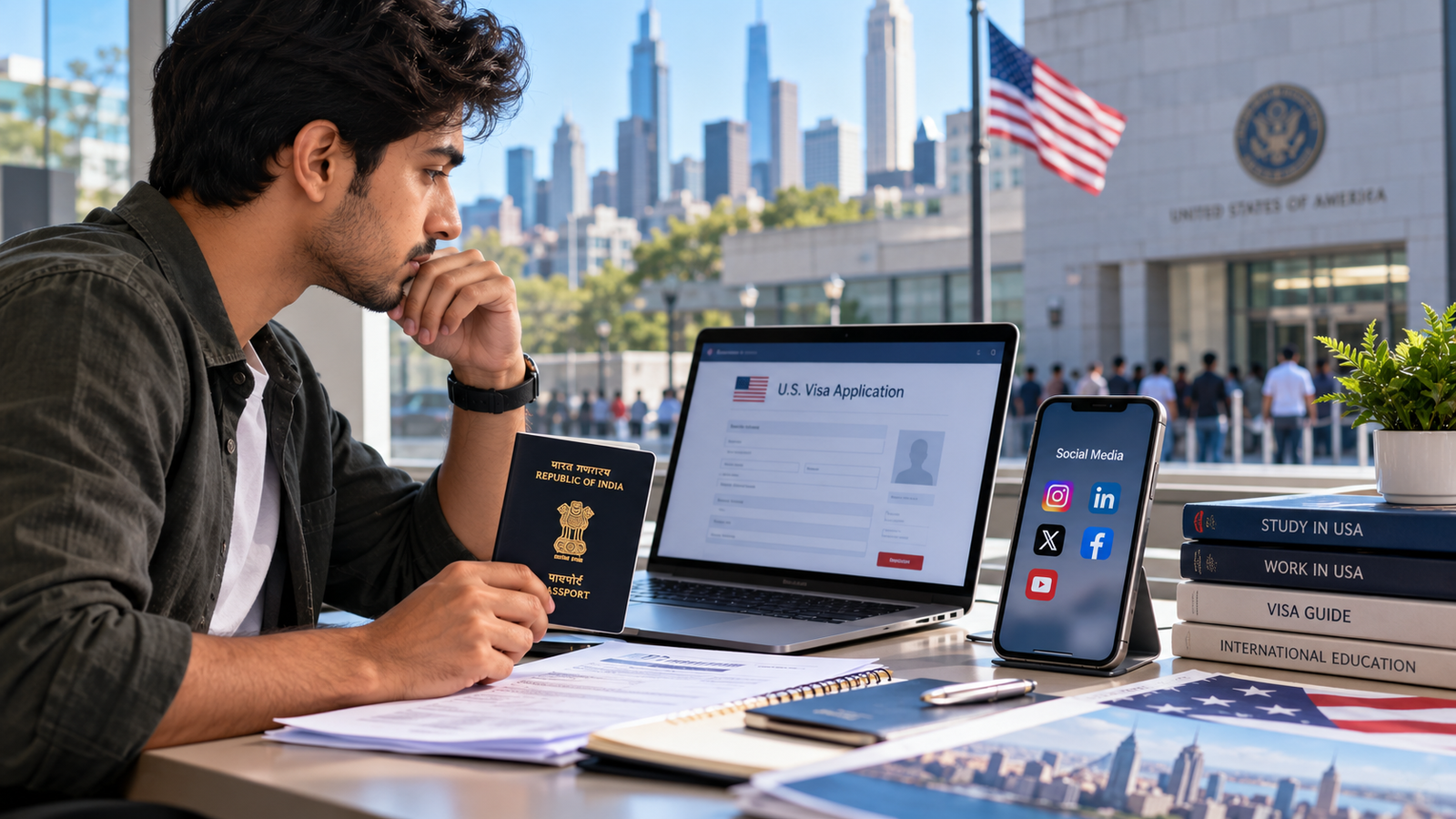
On September 18, 2026, the U.S. Department of State announced that, effective October 1, 2026, it will expand its online-presence review to three more nonimmigrant visa classifications. These are I (foreign media representatives), TN (USMCA professionals) and TD (dependents of TN professionals). For anyone tracking the US visa rules October 2026, this is the headline change.
Applicants for I, TN and TD visas are instructed to set the privacy settings on all their social media profiles to "public" or "open."
This is not the first time the United States has used online-presence review. The State Department says the expansion builds on vetting that already applies to student, exchange visitor, H-1B, H-4 and several other categories. Indian applicants should read the update in that context.
It matters to Indians because so many apply for U.S. student and work visas each year. Most of those categories, including F-1, J-1, H-1B and H-4, were already covered before October 1. The three newly added categories will affect far fewer Indian applicants, for reasons explained below.
This guide sticks to what the State Department has said. It does not speculate about how individual cases will be handled.
Quick summary
Announced: September 18, 2026 (U.S. Department of State)
Effective: October 1, 2026
Newly added: I, TN and TD nonimmigrant visas
Instruction for these applicants: set all social media profiles to "public" or "open"
Already covered: F, M, J, H-1B, H-3, H-4 and other categories listed below
Nationality: the announcement is not India-specific
US Visa Rules October 2026: What Is Changing From October 1?
From October 1, 2026, the State Department is expanding online-presence review to applicants in the I, TN and TD nonimmigrant visa classifications. The Department's announcement says that, to support this vetting, all applicants for I, TN and TD visas are instructed to set the privacy settings on all their social media profiles to "public" or "open."
This is not a rule that every U.S. visa applicant will have their social media checked. It applies to the listed categories only.
Visa category | Who it covers | Online-presence review from October 1? |
|---|---|---|
I | Foreign media representatives | Yes, newly added |
TN | USMCA professionals | Yes, newly added |
TD | Dependents of TN professionals | Yes, newly added |
F-1 / F-2 | Students and dependents | Already covered |
M-1 / M-2 | Vocational students and dependents | Already covered |
H-1B / H-4 | Temporary workers and dependents | Already covered |
J-1 / J-2 | Exchange visitors and dependents | Already covered |
Source: U.S. Department of State, "Announcement of Expanded Screening and Vetting for Visa Applicants," updated September 18, 2026.
What Is Online-Presence Review for a US Visa?
"Online presence" is the State Department's term for the information about an applicant that is available online, including social media. The Department says it "relies on every available source of information" during visa screening and vetting. The stated aim is to identify applicants who may be inadmissible to the United States, including those who may pose a threat to national security or public safety.
A few points are worth keeping in mind:
It is one part of screening. Visa screening also involves the application form, the interview, supporting documents and security checks.
The stated reason for public profiles. The Department instructs covered applicants to make profiles public or open to support the vetting process.
The State Department has not said every post is reviewed or that any post type causes automatic refusal. The announcement does not say either.
Normal eligibility still applies. The Department says each applicant must credibly demonstrate eligibility for the visa requested, including a genuine intent to abide by the terms of admission.
The Department also states that a U.S. visa is a privilege granted at the government's discretion, not an entitlement.
Which US Visa Categories Already Have Social Media Screening?
According to the September 18, 2026 announcement, the October expansion builds on online-presence review that already applies to these categories:
Group | Categories already covered |
|---|---|
Diplomatic and official visas | A-3, C-3 (if a domestic worker), G-5 |
Students | F-1, F-2, M-1, M-2 |
Temporary workers and trainees | H-1B, H-3, and H-4 dependents of H-1B and H-3 |
Exchange visitors | J-1, J-2 |
Fiancé(e) and dependents | K-1, K-2, K-3 |
International cultural exchange | Q |
Religious occupations | R-1, R-2 |
Witnesses, informants and victims | S, T, U |
For readers of IndiaWaleAbroad, the most relevant rows are below.
Category | Purpose | Screening status |
|---|---|---|
F-1 | Academic students | Already covered |
F-2 | Dependents of F-1 students | Already covered |
H-1B | Temporary professional workers | Already covered |
H-4 | Dependents of H-1B workers | Already covered |
J-1 | Exchange visitors | Already covered |
K-1 | Fiancé(e) of a U.S. citizen | Already covered |
I | Foreign media | Added October 1, 2026 |
TN | USMCA professionals | Added October 1, 2026 |
TD | TN dependents | Added October 1, 2026 |
If your category is not on these lists, the announcement does not say online-presence review applies to it. Check the State Department's visa pages for your category.
What Does This Mean for Indian Students?
Indian F-1 applicants were already within the categories subject to online-presence review. The October 1 expansion does not newly create social media review for F-1 applicants, and it does not introduce any new requirement specific to Indian students.
Online-presence review for F, M and J applicants has been in place since June 2025, when the State Department announced it. That includes F-2 and M-2 dependents.
For an Indian student, the normal F-1 process is unchanged:
University admission. You need to be accepted by a SEVP-certified school.
Form I-20 and SEVIS. The school issues the I-20, and your SEVIS record is created for it.
DS-160. You complete the online nonimmigrant visa application accurately.
Financial documentation. You show how you will fund your studies and stay.
Visa interview. A consular officer assesses eligibility and the purpose of your travel.
Academic purpose and intent. You must be able to show you intend to study and follow the terms of your admission.
What should students take from this? Online-presence review is one part of broader screening. It does not replace the other steps, and it does not change what you need to qualify.
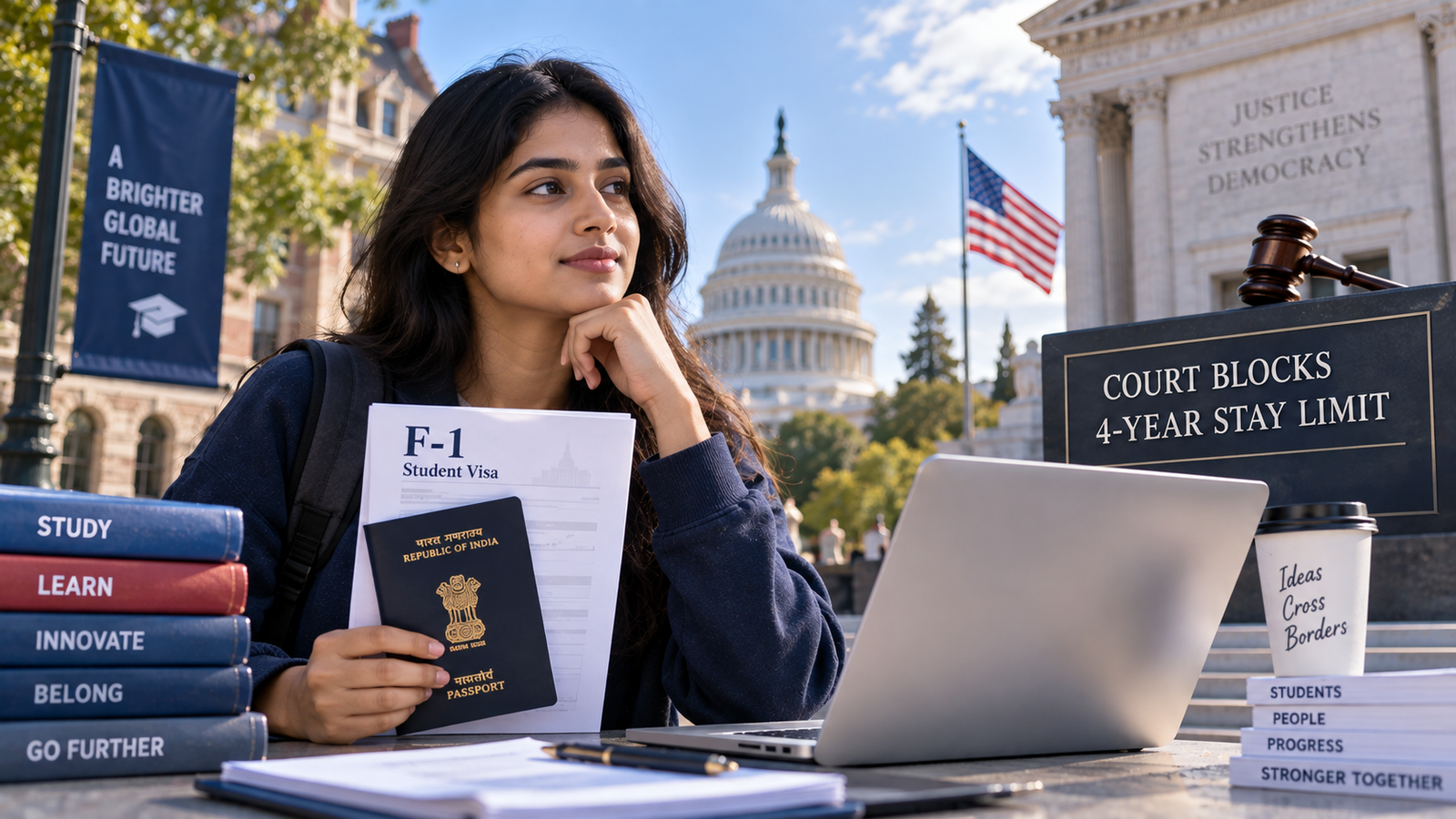
Separately, students have been following a court ruling on how long F-1 students can stay in the U.S. That is a different issue from visa screening. See our explainer: US Student Visa 2026: Court Blocks 4-Year Stay Limit — What Indian Students Need to Know.
What Does This Mean for Indian H-1B Workers and H-4 Dependents?
H-1B and H-4 applicants were already included in online-presence review before this October expansion. The State Department announced that expansion on December 3, 2025, and it took effect on December 15, 2025. The October 1 rule does not newly apply to H-1B applicants.
For Indian H-1B workers and H-4 spouses and children, the practical points are the same as before:
Follow the privacy-setting instruction. Covered applicants are instructed to set social media profiles to "public" or "open."
Keep the visa application accurate. Employment, education and personal details in your DS-160 should be truthful.
Be consistent. Your application should match your supporting documents and your publicly available professional information, such as a LinkedIn profile.
Plan travel with care. Visa stamping happens at U.S. consulates abroad, so check current appointment availability at your post.
Note that this article covers visa applications at consulates. It does not cover H-1B petition filing or the lottery. For that, see H-1B FY 2027: No Second Lottery Announced. If you are an H-4 or F-1 dependent extending status inside the U.S., our guide to USCIS Forms I-539 and I-765 Updated September 15, 2026 covers a different process from consular visa screening.
What Does the New Rule Mean for TN and TD Visa Applicants?
TN status is for qualifying professionals under the United States-Mexico-Canada Agreement (USMCA). TD status is for their qualifying dependents, generally a spouse and unmarried children.
From October 1, 2026, TN and TD visa applicants are added to online-presence review. The State Department instructs them to set all social media profiles to "public" or "open."
Important for Indian readers: TN classification is not available to every professional. It is tied to a qualifying profession and to citizenship of Canada or Mexico. Indian citizens are generally not eligible for TN status. A TD applicant is a dependent of a TN holder, so this category would be relevant to an Indian citizen only as the spouse or child of a qualifying TN professional. Check the State Department's USMCA professionals page for eligibility rules.
One more nuance: Canadian citizens generally do not need a TN visa stamp and may seek TN status at the border. The State Department's announcement concerns visa applicants. Law firms have noted that it does not by itself announce a change for TN applications made directly to U.S. Customs and Border Protection.
What Does the New Rule Mean for Indian Journalists?
The I visa is for representatives of foreign media, such as journalists, film crews and editorial staff engaged in informational media activity in the United States on behalf of a foreign media organization.
From October 1, 2026, I visa applicants are subject to online-presence review and are instructed to set all social media profiles to "public" or "open."
For Indian journalists and media professionals, this applies only if you are applying under the I category. Not every journalist qualifies for an I visa. Eligibility depends on your role, your employer and the purpose of your travel. Check the State Department's I visa requirements before you apply.
Do Indian Applicants Need to Delete Their Social Media Accounts?
No. The State Department's announcement does not tell applicants to delete their accounts. For the newly covered categories, it instructs applicants to set profiles to "public" or "open."
Applicants should:
Provide truthful information in the application.
Follow official visa instructions.
Not fabricate or manipulate information.
If you have questions about a specific situation, consult a qualified immigration attorney. This article cannot advise on individual circumstances.
Should Indian Visa Applicants Make Their Social Media Accounts Public?
It depends on your visa category.
For newly covered I, TN and TD applicants, the State Department instructs them to set the privacy settings on all social media profiles to "public" or "open," effective October 1, 2026.
For previously covered categories, the Department gave the same instruction in earlier announcements. Those announcements covered F, M and J (June 2025), H-1B and H-4 (December 2025), and A-3, C-3 (domestic worker), G-5, H-3, H-4 dependents of H-3, K-1, K-2, K-3, Q, R-1, R-2, S, T and U (March 2026).
If you are unsure whether your category is covered, check the current announcement on the State Department website. This is general information and not personal legal advice.
What Should Indian Applicants Check Before Their Visa Interview?
Check your exact visa category. Confirm the classification you are applying under.
Review the latest State Department instructions. Policies change; use the official visa news page.
Make sure your DS-160 is accurate. The form asks about social media identifiers, so read the current wording and answer truthfully.
Check that personal details are consistent. Names, dates and passport details should match across documents.
Review employment and education information. Job titles, dates and degrees should be accurate and consistent.
Prepare required supporting documents. Requirements vary by category (for example, I-20 for F-1, or the H-1B approval notice).
Follow the social media privacy instruction if your category is subject to online-presence review.
Do not submit false information.
Do not rely on social media advice from unofficial sources.
Check your U.S. Embassy or Consulate's instructions for your location, such as the U.S. Embassy in India.
Can Social Media Activity Automatically Cause a US Visa Refusal?
The State Department has not said that any particular kind of post automatically leads to a refusal. Here is what the announcement does say:
Online-presence review is part of visa screening and vetting.
The Department uses available information to identify applicants who may be inadmissible, including those who may pose a national security or public safety threat.
Every applicant must credibly establish eligibility for the visa sought.
Beyond that, the Department has not published how officers weigh individual pieces of information, and this article does not guess. Be wary of viral lists claiming to know which posts cause refusals. Unless an official source states it, treat it as unverified.
What Information Should Applicants Keep Consistent?
Truthfulness and consistency matter across everything you submit and present. Check these items line by line:
Item | What to check |
|---|---|
DS-160 | Answers are accurate and complete |
Passport | Name, date of birth and passport number match your other documents |
CV/resume (where relevant) | Dates and roles match your application |
Employment details | Employer, title and dates are accurate |
Education history | Institutions, degrees and dates are accurate |
Travel purpose | Matches your category and your documents |
Supporting documents | Support the claims you make |
Public professional information | Professional profiles do not contradict your application |
Consistency does not mean your social media has to look a particular way. It means the factual information you give officials should be accurate and should not conflict across sources.
US Visa Social Media Screening vs Normal Background Checks
These steps are related but they are not identical.
Area | Purpose |
|---|---|
DS-160 | Visa application information |
Interview | Assess eligibility and purpose of travel |
Supporting documents | Verify relevant claims |
Online-presence review | Part of screening and vetting |
Security checks | Identify potential inadmissibility or security concerns |
Will This Affect US Visa Processing Times?
The State Department's announcement does not give a processing-time estimate, and this article does not promise faster or slower processing. Visa timelines vary by post, visa category and individual circumstances.
Some law firms reported appointment rescheduling at consulates, including in India, after the December 2025 H-1B and H-4 expansion. Those were unofficial reports about a different expansion. There is no official confirmation that the October 2026 expansion will change wait times for any category.
For current information, check the State Department's U.S. visa pages and your embassy or consulate's appointment system.
Is This Rule Only for Indian Applicants?
No. The announcement applies to applicants in the listed visa categories. It does not single out any nationality, and the Department says it applies its vetting standard consistently across all visa applicants.
Indian applicants are a large group among F-1 students and H-1B workers, so they follow these updates closely. The policy is not India-specific.
October 2026 US Visa Social Media Screening Timeline
Date | Development |
|---|---|
June 18, 2025 (announced) | State Department announces online-presence review for F, M and J applicants; applied from late June 2025 |
December 3, 2025 (announced) / December 15, 2025 (effective) | Online-presence review expanded to H-1B and H-4 applicants |
March 25, 2026 (announced) / March 30, 2026 (effective) | Additional categories added: A-3, C-3 (domestic worker), G-5, H-3, H-4 dependents of H-3, K-1, K-2, K-3, Q, R-1, R-2, S, T and U |
September 18, 2026 | State Department announces another expansion |
October 1, 2026 | I, TN and TD applicants become subject to online-presence review |
What Indian Visa Applicants Should Do Now
Identify your visa category.
Check whether it is subject to online-presence review using the lists above and the official announcement.
Read the latest State Department instructions.
Keep your application truthful and complete.
Follow the stated privacy-setting instructions where they apply to you.
Prepare your normal visa documents.
Check your embassy or consulate's latest instructions.
Avoid relying on viral social media claims.
Frequently Asked Questions
1. What are the new US visa rules from October 1, 2026?
From October 1, 2026, the State Department expands online-presence review to I, TN and TD nonimmigrant visa applicants. These applicants are instructed to set all social media profiles to "public" or "open."
2. Which visa categories are being added to social media screening?
I (foreign media representatives), TN (USMCA professionals) and TD (dependents of TN professionals).
3. Will Indian students be affected by the October 2026 change?
The October 1 change does not add F-1 to online-presence review. F-1 applicants were already covered.
4. Are F-1 students already subject to social media screening?
Yes. F, M and J applicants have been subject to online-presence review since June 2025.
5. Are H-1B and H-4 applicants already subject to online-presence review?
Yes, since December 15, 2025.
6. Do TN and TD applicants have to make social media profiles public?
The State Department instructs all TN and TD visa applicants to set their social media profiles to "public" or "open."
7. Do I need to delete my social media accounts before a US visa interview?
The announcement does not instruct applicants to delete accounts. Provide truthful information and follow official instructions.
8. Can social media activity automatically cause a visa refusal?
The State Department has not said so. Online-presence review is part of screening and vetting, and applicants must establish eligibility.
9. Does the new rule apply only to Indians?
No. It applies to applicants in the listed categories regardless of nationality.
10. Where can Indians check the latest US visa requirements?
On the State Department's U.S. Visas and Visa News pages, and on your embassy or consulate's website.
11. Will social media screening delay my visa?
The announcement does not state a processing-time effect. Timelines vary by post, category and circumstances.
12. What should I check before my US visa interview?
Your visa category, DS-160 accuracy, consistency of details, supporting documents, and the latest official instructions for your category and location.
Final Takeaway
October 1, 2026 is the effective date for the latest expansion, announced on September 18, 2026.
I, TN and TD applicants are newly added to online-presence review.
F, M and J, H-1B and H-4, and several other categories were already covered.
The policy is not India-specific.
Indian applicants should follow official instructions and keep their visa applications truthful and complete.
Online-presence review is part of broader screening and vetting. It is not an automatic refusal mechanism.
Disclaimer
This article is for general information only and does not constitute legal or immigration advice. U.S. visa policies can change, and applicants should verify the latest requirements directly with the U.S. Department of State and the relevant U.S. embassy or consulate before applying.
Comments
No approved comments yet. Be the first to comment.