
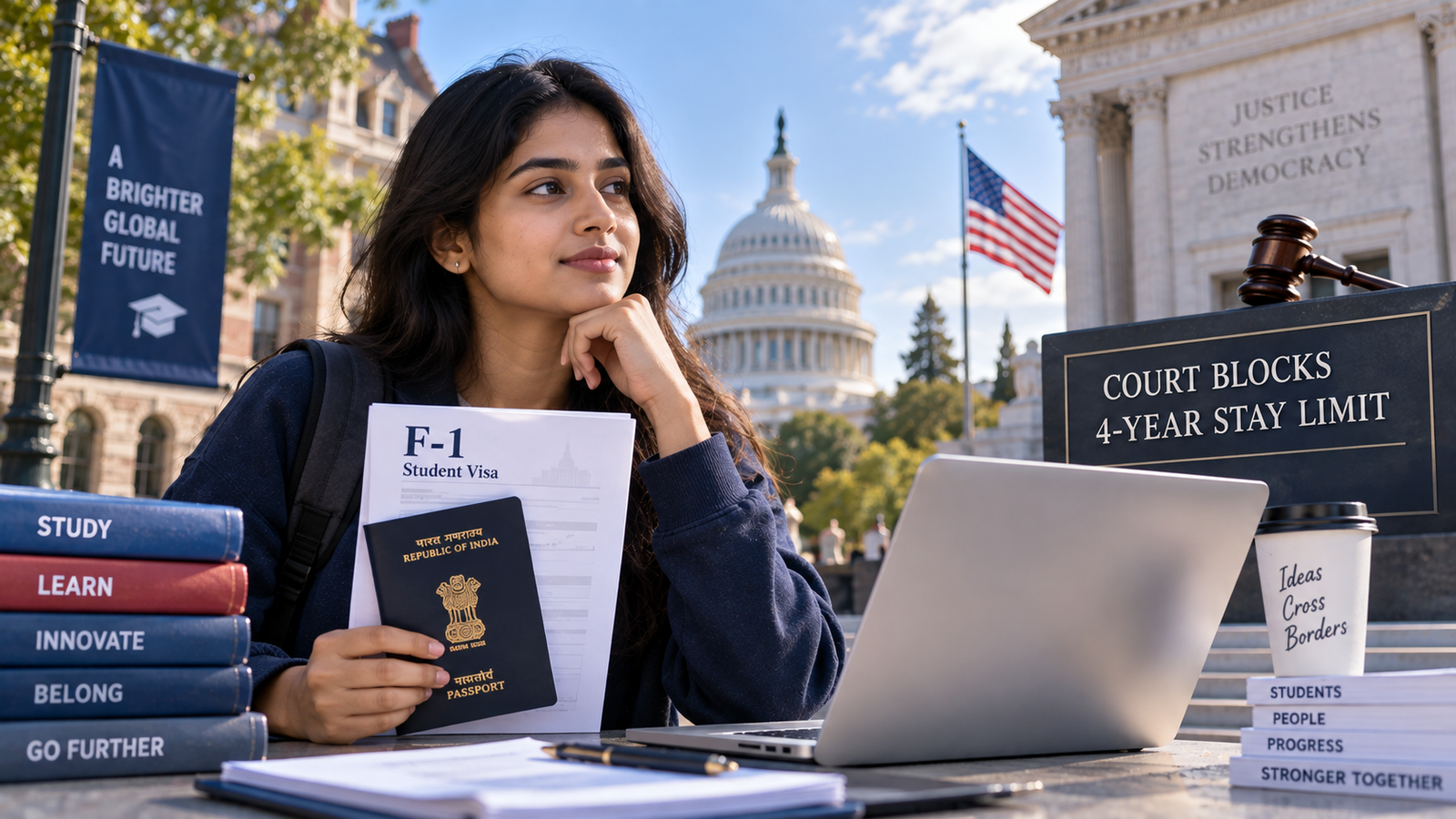
On September 14, 2026, one day before it was due to take effect, a federal judge blocked a Department of Homeland Security rule that would have ended "Duration of Status" (D/S) and capped admission for F-1 students and J-1 exchange visitors at four years. The rule had been scheduled to take effect September 15, 2026. U.S. District Judge F. Dennis Saylor IV issued a nationwide preliminary injunction, meaning the existing duration-of-status framework remains in place while the underlying legal challenge continues. For Indian students — the largest group of international students in the U.S. — this is significant, whether they are starting a four-year bachelor's degree, a two-year master's, a multi-year PhD, or currently on OPT or STEM OPT. This article explains exactly what happened, what the blocked rule would have done, and what it means going forward.
Quick Answer: Is the 4-Year F-1 Student Visa Limit in Effect?
No. A federal judge blocked the DHS rule on September 14, 2026 — one day before its scheduled September 15, 2026 effective date — so the four-year fixed admission limit is not currently being implemented. F-1 and J-1 students remain under the existing Duration of Status framework for now. The legal challenge is ongoing, so students should keep following official guidance from DHS, USCIS, SEVP/ICE, and their Designated School Official (DSO).
Immigration rules and court proceedings can change. This article is for general informational purposes and is not legal advice. Students with individual immigration concerns should consult their DSO or a qualified U.S. immigration attorney.
What Happened to the US 4-Year Student Visa Rule?
Date | Development |
|---|---|
August 28, 2025 | DHS and ICE publish the proposed rule to end Duration of Status |
July 17, 2026 | DHS publishes the final rule in the Federal Register, with an effective date of September 15, 2026 |
August 18, 2026 | Presidents' Alliance on Higher Education and Immigration, joined by NAFSA, AFT, and other groups, files suit against DHS in the U.S. District Court for the District of Massachusetts |
September 14, 2026 | Judge F. Dennis Saylor IV grants a nationwide preliminary injunction postponing the rule's effective date |
September 15, 2026 | Original scheduled effective date — the rule did not take effect |
Current status | Rule postponed under the Administrative Procedure Act (APA); litigation continues; next hearing set for October 2, 2026 |
What Did the 4-Year F-1 Rule Actually Propose?
This section explains what the blocked rule would have done if it had taken effect — not current law.
Under longstanding practice, F-1 students and J-1 exchange visitors were admitted for "Duration of Status" (D/S) — meaning they could remain in the U.S. as long as they maintained their status and made progress in their program, without a fixed expiration date on their I-94.
The blocked rule would have replaced D/S with a fixed admission period tied to the Form I-20 or DS-2019 program end date, capped at a maximum of four years, plus a 30-day grace period (reduced from the previous 60 days). Foreign media representatives (I nonimmigrants) would have been capped at 240 days. Anyone needing more time than their fixed admission date would have had to file for a formal extension of stay with USCIS, or leave the U.S. and re-enter to obtain a new admission period from CBP. The rule would also have restricted undergraduate students from changing majors or transferring schools before completing one year of study, and would generally have barred graduate students from changing majors, degree levels, or schools except in case-by-case "extenuating circumstances" approved by SEVP.
What Does "Duration of Status" Mean for F-1 Students?
D/S is the current admission framework: instead of a fixed end date, your I-94 shows "D/S," and you may remain in the U.S. as long as you maintain your F-1 status, stay enrolled, make normal academic progress, and only work with proper authorization.
Term | What It Means |
|---|---|
F-1 visa | The stamp in your passport allowing you to request entry to the U.S. as a student |
F-1 status | Your legal classification while inside the U.S. as a student |
I-20 | Certificate of Eligibility issued by your school, showing your program and end date |
I-94 | Your official arrival/departure record showing your authorized period of admission |
D/S | "Duration of Status" — admission tied to maintaining status, not a fixed date |
OPT | Optional Practical Training — temporary work authorization tied to your F-1 status and field of study |
STEM OPT | A 24-month extension of OPT for eligible STEM graduates working for an E-Verify employer |
Why Did the Court Block the Four-Year Rule?
FACT: The case is Presidents' Alliance on Higher Education and Immigration, et al. v. U.S. Department of Homeland Security, No. 1:26-cv-13799 (D. Mass.), filed August 18, 2026 by a coalition of higher-education groups, faculty and labor unions.
COURT ACTION: On September 14, 2026, Judge F. Dennis Saylor IV issued a Memorandum and Order, followed by a Preliminary Injunction Order, postponing the rule's effective date under Section 705 of the Administrative Procedure Act. The relief was made nationwide, not limited to the plaintiff organizations' members. The court found the plaintiffs likely to succeed on several APA claims — citing DHS's failure to adequately calculate costs, consider alternatives, respond to public comments, and rationally connect the rule to its stated goals of preventing fraud and enhancing national security. The court separately denied the plaintiffs' request for summary judgment/vacatur, without prejudice, meaning that part of the case remains open.
CLAIM: DHS has stated the rule was intended to improve oversight and reduce fraud; the plaintiffs argued DHS rushed the rulemaking and failed to follow required APA procedures. These remain contested positions in ongoing litigation, not settled facts.
ANALYSIS: The practical effect is that the rule did not take effect on September 15, 2026, and the prior D/S framework continues while the case proceeds — but the underlying legal dispute is not resolved.
What Does the Court Decision Mean for Indian Students?
Indian undergraduate students
Continue under the existing D/S framework. No fixed four-year admission date currently applies.
Indian master's students
Continue under D/S; the blocked rule's shorter grace period and stricter change-of-program limits do not currently apply.
Indian PhD students
Programs that run beyond four years are not currently subject to the blocked rule's four-year admission cap.
Indian students in STEM programs
STEM program length itself is unaffected; the blocked rule's fixed-period system, which would have added extension requirements, is not in effect.
Indian students on OPT
OPT continues to operate under existing rules; the blocked rule's interaction with fixed admission periods does not currently apply.
Indian students on STEM OPT
Same as above — current STEM OPT rules and timelines are unaffected by the injunction.
Indian students planning to start university in Fall 2026
Admission will follow the existing D/S framework, not the blocked fixed-period system.
Indian students planning to apply for Fall 2027
The framework in place at the time of a future entry will depend on how the litigation and any further DHS action unfold — this cannot be predicted with certainty.
Is There Still a Four-Year Limit on F-1 Students?
No — not as a currently enforced rule. The blocked rule's four-year fixed admission cap is not in force. The existing Duration-of-Status framework, which ties authorized stay to maintaining status rather than a fixed calendar date, remains the operative system.
Important
The court blocking the rule does not mean F-1 students can stay indefinitely. Students must continue maintaining lawful F-1 status and complying with applicable immigration and school requirements — the injunction pauses one specific rule; it does not remove any other F-1 obligation.
What About Students Studying Longer Than Four Years?
These are general examples, not individualized immigration advice.
A student entering a four-year bachelor's program continues under D/S, with status tied to maintaining enrollment and progress — not a fixed four-year admission cutoff.
A student who completes a bachelor's degree and begins a master's program continues to be governed by the current framework for that new program, under D/S.
A student beginning a PhD that may run five, six, or more years is not currently subject to the blocked rule's four-year fixed cap.
A student needing an extra semester follows existing I-20 program-extension procedures through their DSO, not the blocked rule's formal USCIS extension-of-stay process.
A student changing academic programs follows current SEVIS/DSO procedures; the blocked rule's tighter restrictions on changing majors or levels do not currently apply.
If the blocked rule had taken effect, each of these situations would instead have required a fixed admission date, and — where more time was needed — a formal extension-of-stay filing with USCIS or a re-entry through CBP. That is not the current requirement.
What About OPT and STEM OPT?
OPT and STEM OPT continue to operate under their existing eligibility rules, application windows, and timelines. The September 14 court decision paused the D/S-ending rule; it did not modify OPT or STEM OPT eligibility or create new work-authorization benefits. Students should not interpret the ruling as extending or altering their OPT/STEM OPT rights in any way — it simply means the fixed-admission-period system that would have interacted with post-completion training timelines is not currently in effect.
What Indian Students Should Do Now
Check your I-20 — confirm your program end date and major are accurate.
Check your I-94 — verify your current admission record at i94.cbp.dhs.gov.
Maintain F-1 status — continue full-time enrollment and authorized-employment compliance.
Stay in contact with your DSO — they are your primary source for school-specific guidance.
Track official DHS/ICE/SEVP updates — the rule remains in litigation and could change.
Do not assume the court ruling changes every F-1 requirement — it paused one specific rule.
Keep academic records updated — especially if you plan to change majors or programs.
Follow OPT/STEM OPT deadlines — these are unaffected by the injunction.
Be careful with international travel — re-entry requirements can shift if the legal landscape changes; check current guidance before travel.
Check official information before making major immigration decisions — rely on DHS, USCIS, SEVP, and your DSO rather than social media.
Planning to study in the USA? Stay updated with the latest US visa rules, immigration developments, and policy changes through IndiaWaleAbroad.
Does This Change F-1 Visa Validity?
No. A visa stamp's expiration date and your authorized period of stay are different concepts, and the injunction does not change either concept's underlying definitions.
Document/Status | Purpose | Why It Matters |
|---|---|---|
F-1 visa | Entry document (stamp/sticker in passport) | Lets you request entry to the U.S.; does not by itself define how long you may stay |
I-94 | Admission record | Shows your authorized period of stay, currently marked D/S for most F-1/J-1 admissions |
I-20 | Student status/program record | Issued by your school; anchors your SEVIS record and program dates |
SEVIS | Student immigration record | The database schools use to report and maintain your F-1 record |
What Happens If the Rule Is Eventually Implemented?
This is a hypothetical scenario, not a prediction of the outcome. If the rule is ultimately allowed to take effect at some future point, students could face fixed admission periods instead of D/S, extensions could become a more routine and necessary filing, long academic programs (like many PhDs) could require additional planning, and changes of education level or major could involve added procedural steps. Students would need to follow whatever final legal requirements are in force at that time. Further court proceedings — including the October 2, 2026 hearing — or subsequent government action could affect the rule's future status. It is not possible to say with certainty whether the rule will ultimately survive, be modified, or be struck down.
What Does This Mean for Indian Students Planning to Study in the USA in 2026–27?
Program duration, financial planning, and university choice remain personal decisions based on your academic and career goals, not on this specific litigation. That said, it's reasonable to factor in: choosing universities and programs based on your genuine academic fit; understanding that program length itself doesn't currently trigger extra immigration hurdles under D/S; maintaining F-1 status carefully regardless of which framework applies; staying alert to OPT/STEM OPT planning timelines; being thoughtful about international travel during any period of active litigation; and following your university's international student office and official government sources rather than informal channels. This article does not recommend for or against choosing the USA — that decision depends on your individual circumstances.
US Student Visa 2026: Current Rule vs Blocked 4-Year Rule
Issue | Existing/Current Framework | Blocked 2026 Rule |
|---|---|---|
Admission framework | Duration of Status (D/S) — tied to maintaining status | Fixed admission period, up to 4 years, shown as a specific date on I-94 |
F-1 stay | No fixed end date on I-94 while status is maintained | Fixed "admit until" date based on I-20/DS-2019 program end date |
Program longer than 4 years | No special four-year cap; continue under D/S | Would require formal USCIS extension of stay beyond 4 years |
Extensions | Program extensions handled by DSO/SEVIS in most cases | Extensions of stay would generally require formal USCIS filing |
Academic progression | Students may change majors/transfer per current SEVIS rules | Undergraduates limited before 1 year completed; graduate students largely barred except for SEVP-approved "extenuating circumstances" |
OPT | Existing OPT/STEM OPT rules apply, unaffected | Would interact with fixed admission periods but not change core OPT eligibility |
Travel/re-entry | Re-entry generally tied to maintaining D/S status | Re-entry would reset or interact with the fixed admission date |
Grace period | 60 days after program end (current) | Reduced to 30 days under the blocked rule |
Current status | In effect | Blocked (preliminary injunction, Sept 14, 2026) |
US Student Visa 2026 Timeline for Indian Students
August 28, 2025 — DHS/ICE publish proposed rule ending Duration of Status
July 17, 2026 — DHS publishes final rule in the Federal Register; effective date set for September 15, 2026
August 18, 2026 — Presidents' Alliance on Higher Education and Immigration, NAFSA, AFT, and other groups file suit in the U.S. District Court for the District of Massachusetts
September 14, 2026 — Judge F. Dennis Saylor IV grants a nationwide preliminary injunction postponing the rule
September 15, 2026 — Rule's original scheduled effective date passes with the rule not in force
Current status (as of publication) — D/S framework remains in place; litigation ongoing
October 2, 2026 — Next scheduled hearing in the case
10 Things Indian Students Should NOT Assume
"Every F-1 visa now expires after four years." False — the four-year cap is part of the blocked rule, not current policy.
"The court ruling gives unlimited stay." No — students must still maintain status under the existing D/S rules.
"Visa validity equals status." These are different concepts — see the comparison table above.
"A longer course automatically creates an immigration problem." Not under the current D/S framework.
"OPT is automatically extended." The ruling does not change OPT or STEM OPT eligibility or timelines.
"The court decision guarantees future policy." It's a preliminary injunction — the underlying case is still open.
"Students no longer need to follow their I-20." I-20 compliance remains essential regardless of this ruling.
"International travel is unaffected in every situation." Individual circumstances vary — check current guidance before travel.
"All students have identical immigration circumstances." Program type, visa category, and individual history all matter.
"Social media posts are enough to verify immigration rules." Always confirm with DHS, USCIS, SEVP, or your DSO.
Official Sources
Study in the States (DHS/SEVP): Duration of Status Rule Quick Facts
Forbes: Judge Blocks Immigration Rule Limiting Students to Four Years
Higher Ed Dive: 4-year visa cap for international students halted by federal judge
If you are comparing this development with our earlier coverage, read our guide on USA Student Visa Rules 2026: Fixed Stay Limit & What It Means for Indian Students. For H-1B-related 2026 filing changes, see New H-1B Form I-129 Mandatory in 2026 and H-1B FY 2027: No Second Lottery Announced. If you're also comparing study destinations, see Germany Overtakes USA, UK & Canada, Canada PGWP Crisis 2026, and Canada Bill C-12 Explained. On the UK side, see UK Immigration Rules October 2026: 7 Major Changes.
Indian Student Scenarios
Each of the following is a hypothetical example for educational purposes and is not individualized immigration advice.
Scenario 1: An Indian student beginning a four-year bachelor's degree in Fall 2026 continues under the existing D/S framework — no fixed four-year admission date currently applies to their I-94.
Scenario 2: An Indian student completing a two-year master's program follows current D/S rules; the blocked rule's shortened 30-day grace period does not currently apply, so the existing 60-day grace period remains in place.
Scenario 3: An Indian PhD student whose program is expected to run six years is not currently subject to any four-year admission cap or related extension-of-stay filing requirement.
Scenario 4: An Indian student moving from a bachelor's program to a master's program follows current SEVIS/DSO change-of-level procedures, not the blocked rule's more restrictive graduate-level change limits.
Scenario 5: An Indian graduate applying for OPT follows the existing OPT application process and timeline, unaffected by the September 14 injunction.
FAQs
1. Is the 4-year F-1 visa rule blocked?
Yes. A federal judge issued a nationwide preliminary injunction on September 14, 2026, postponing the rule one day before its scheduled effective date.
2. What happened on September 14, 2026?
U.S. District Judge F. Dennis Saylor IV granted a preliminary injunction in Presidents' Alliance on Higher Education and Immigration v. DHS, postponing the rule's effective date under the Administrative Procedure Act.
3. When was the rule supposed to take effect?
September 15, 2026.
4. Can F-1 students still use duration of status?
Yes. With the rule blocked, the existing D/S framework remains in place for now.
5. Does the ruling affect Indian students already in the USA?
It preserves their existing D/S status; it does not create any new requirement for them.
6. Does the ruling affect new F-1 applicants?
New applicants continue to be processed under the existing D/S framework, not the blocked fixed-period system.
7. Does it affect master's students?
No fixed four-year cap currently applies to master's students; they remain under D/S.
8. Does it affect PhD students?
PhD programs longer than four years are not currently subject to the blocked rule's cap.
9. Does it affect OPT?
No — OPT eligibility and timelines are unaffected by this ruling.
10. Does it affect STEM OPT?
No — STEM OPT rules remain as they were before the blocked rule.
11. Does the rule affect J-1 students?
The blocked rule would have applied to J-1 exchange visitors as well as F-1 students; since it is blocked, J-1 students also remain under existing rules for now.
12. Does the court ruling mean students can stay indefinitely?
No. Students must still maintain lawful F-1/J-1 status and meet all other current requirements.
13. Should Indian students change their study plans?
This article does not offer individualized advice; students should assess this with their DSO or an immigration attorney based on personal circumstances.
14. Should students contact their DSO?
Yes — DSOs are the primary source of school-specific, up-to-date guidance.
15. What happens next with the lawsuit?
The case continues, with a further hearing scheduled for October 2, 2026; the broader legal challenge to the rule remains unresolved.
16. Could the government appeal?
It's possible, but this article does not predict whether an appeal will occur or how it might be decided.
17. Does an F-1 visa last only four years?
No — an F-1 visa's stamp validity is separate from your authorized period of stay, which is currently governed by D/S, not a four-year cap.
18. Where can students check official updates?
DHS, USCIS, ICE/SEVP's Study in the States website, and your university's international student office.
Follow IndiaWaleAbroad for verified US immigration updates, student visa news, and practical guides for Indian students and professionals.

Comments
No approved comments yet. Be the first to comment.