
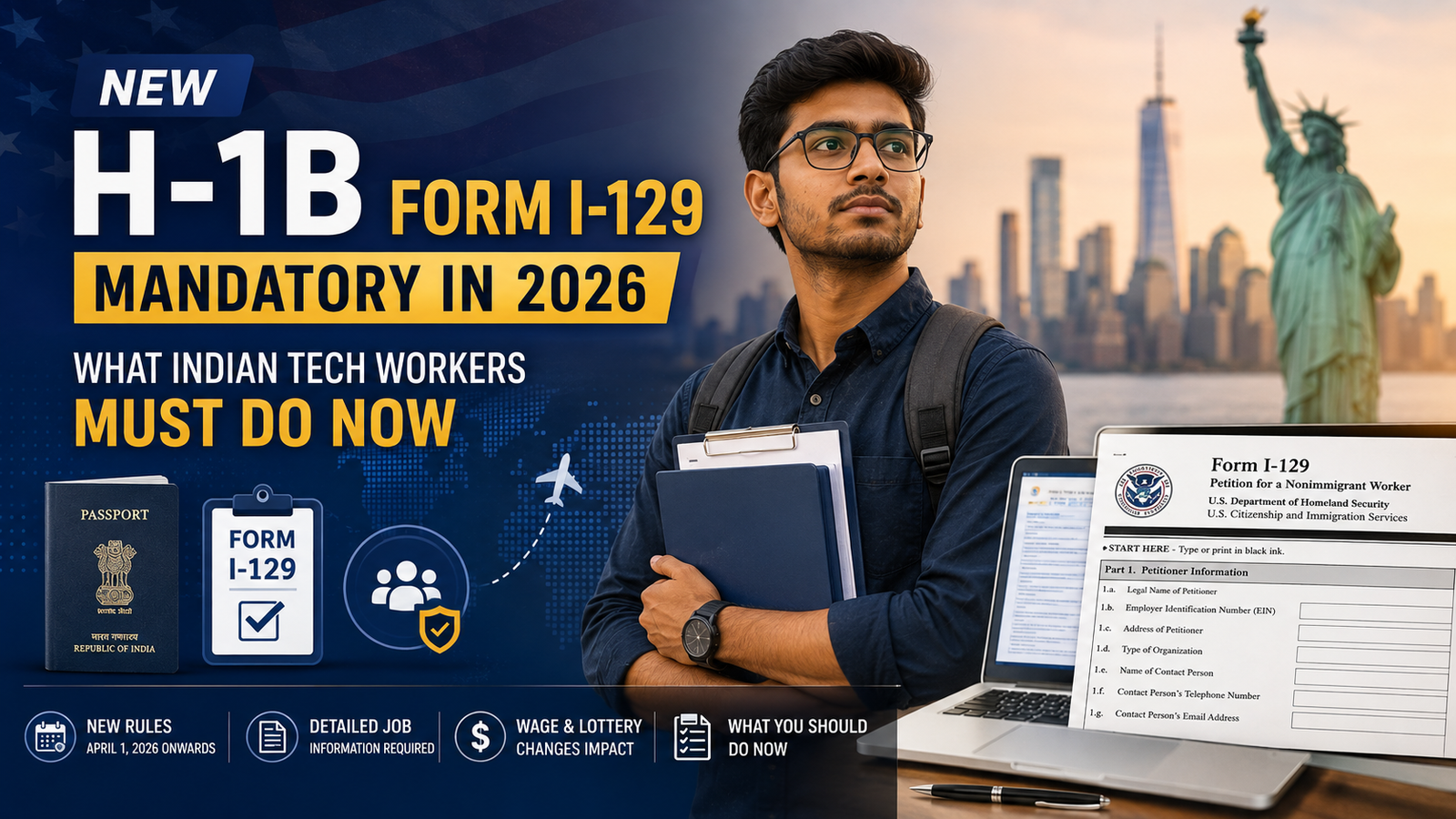
For Indian technology professionals, the H-1B visa remains one of the most important routes to work legally in the United States.
Software engineers, data scientists, cloud professionals, cybersecurity specialists, IT consultants, product managers and other highly skilled professionals have historically relied on the H-1B program to build careers in the American technology sector.
But the H-1B process has become increasingly detailed.
In 2026, employers filing H-1B petitions must use the revised Form I-129, Petition for a Nonimmigrant Worker. The revised form contains additional questions about the offered position, including information concerning the minimum education required, field of study, work experience and supervisory responsibilities. The new edition is particularly important because the FY 2027 H-1B process also introduced a wage-weighted selection system, making accurate job and wage information more significant than before.
For Indian professionals, the change matters even if you are not personally responsible for filing Form I-129.
Why?
Because your employer's petition needs to accurately describe the job you will perform, your qualifications, the offered compensation and other details supporting your H-1B classification.
And the numbers show just how important the Indian workforce is to the H-1B program.
According to USCIS's FY 2024 H-1B characteristics report, 71% of approved H-1B petitions were for beneficiaries whose country of birth was India. China was second at approximately 12%.
That makes changes to the H-1B filing process particularly relevant to Indian technology professionals.
Quick Summary: New H-1B Form I-129
Item | 2026 Update |
|---|---|
Form | Form I-129, Petition for a Nonimmigrant Worker |
Main Users | U.S. employers/petitioners |
H-1B Category | H-1B specialty occupation |
New Edition | February 27, 2026 |
Mandatory Use | Petitions received by USCIS on/after April 1, 2026 |
Major Change | More detailed job-position information |
Education Information | Minimum education requirement and field of study |
Experience Information | Required years of experience |
Supervisory Information | Whether the position supervises employees |
Relevance to Indian Workers | High, because India accounted for 71% of approved H-1B petitions in FY 2024 |
Key Authority | U.S. Citizenship and Immigration Services (USCIS) |
What Is Form I-129?
Form I-129 is the USCIS petition used by U.S. employers to request nonimmigrant worker classification for eligible foreign nationals.
For H-1B workers, the employer—not the employee—normally files the petition with USCIS.
The form is not exclusive to H-1B workers. USCIS uses Form I-129 for several temporary worker classifications, including H-1B, H-2A, H-2B, H-3, L-1, O-1, O-2, P, Q and R classifications.
For an Indian technology professional, this means an important distinction:
You do not normally file Form I-129 yourself. Your U.S. employer or authorized petitioner files it on your behalf.
However, the information you provide to your employer can directly affect the accuracy and strength of the petition.
What Changed in the New H-1B Form I-129?
The revised form asks employers for more detailed information about the position being offered.
Among the areas highlighted in reporting about the new form are:
Minimum educational requirement
Specific field or fields of study
Minimum years of experience
Special skills required
Whether the position involves supervision
Number of employees supervised, where applicable
These details are important because they help USCIS evaluate whether the position qualifies for H-1B classification and whether the beneficiary's background matches the requirements of the offered job.
Why Did USCIS Introduce More Detailed Questions?
The H-1B program is designed for specialty occupations.
That means the position generally requires specialized knowledge and a bachelor's degree or higher in a directly related specialty, or an equivalent qualification under the applicable rules.
USCIS has historically examined factors such as:
The nature of the job
The employer's business
The duties of the position
Educational requirements
The beneficiary's qualifications
Wage information
The relationship between the position and the beneficiary's education
The additional information in the revised I-129 gives USCIS more detail with which to assess the petition.
This is especially significant as the H-1B selection process has moved toward greater emphasis on wage levels.
The Biggest Change: More Transparency Around the Job
For Indian tech workers, one of the most important practical implications is that employers need to be precise about the actual job.
Consider two hypothetical positions:
Factor | Position A | Position B |
|---|---|---|
Job | Software Developer | Senior Software Developer |
Education | Bachelor's | Master's preferred |
Field | Computer Science | Computer Science |
Experience | 1 year | 5 years |
Responsibilities | Coding and testing | Architecture and team leadership |
Supervisory Role | No | Yes |
Salary | Lower | Higher |
The employer should not simply use a generic job description.
The information submitted in the petition should accurately reflect the position being offered.
This is particularly important for Indian professionals whose employment involves consulting arrangements, multiple work locations, client projects or complex job descriptions.
How Does the New Form Affect Indian IT Professionals?
The new form does not mean that every Indian H-1B worker has to complete a new personal application.
Instead, the biggest impact is on the employer's petition.
However, Indian workers should make sure their employer or immigration counsel has accurate information about:
1. Your Degree
Your degree should be accurately described.
For example:
B.Tech in Computer Science
B.E. in Information Technology
M.Tech in Computer Science
MCA
Bachelor's in Electrical Engineering
The relevance of the degree to the position is important.
2. Your Field of Study
The employer may need to provide information about the field of study required for the position.
A generic statement such as "technical degree" may not accurately describe a position that specifically requires computer science, information systems, data science or another specialized discipline.
3. Your Experience
The petition should accurately reflect the experience required for the position.
For example:
Requirement | Example |
|---|---|
Minimum Experience | 3 years |
Beneficiary Experience | 6 years |
Position | Software Engineer |
Specialty | Cloud Computing |
Education | Bachelor's degree in related field |
The employee should ensure that the information supplied to the employer is accurate and supported by documentation where necessary.
How the New I-129 Connects With the H-1B Wage System
The 2026 Form I-129 change is particularly important because the FY 2027 H-1B cap selection process introduced a wage-weighted approach.
Under the new process, wage information plays a more important role in selection than under the traditional purely random selection model.
This means employers need to pay close attention to:
Occupation
Work location
Offered wage
Wage level
Job requirements
LCA information
Position duties
The revised I-129's additional job information therefore becomes especially relevant.
H-1B Wage Levels Explained
H-1B wage data commonly uses four levels.
Wage Level | General Description |
|---|---|
Level I | Entry-level |
Level II | Qualified / experienced |
Level III | Experienced / competent |
Level IV | Highly experienced / advanced |
These levels are associated with the Department of Labor's prevailing wage framework.
The actual wage requirements depend on the occupation and geographic area.
An employer cannot simply choose an arbitrary salary because it wants to increase the probability of H-1B selection.
The wage information must be consistent with applicable Department of Labor requirements.
Why Salary Matters More Than Ever
For years, Indian technology workers have competed in a highly constrained H-1B system.
The number of registrations has been significantly higher than the number of available cap-subject visas.
USCIS introduced electronic H-1B registration in FY 2021 to simplify the cap-selection process. USCIS has also identified concerns about multiple registrations for the same beneficiary and efforts to prevent abuse of the registration system.
The 2026 environment adds another layer: wage information can matter to selection and petition preparation.
This means employers should carefully review the relationship between:
Job → Location → Wage → LCA → I-129 → Beneficiary qualifications
New I-129 vs Old I-129
Area | Older Process | 2026 Revised Form |
|---|---|---|
Employer information | Required | Required |
Beneficiary information | Required | Required |
Job title | Required | Required |
Salary | Required | Required |
Education details | Required | More detailed job requirement information |
Field of study | Relevant | More explicitly captured |
Experience | Relevant | More detailed |
Supervisory responsibilities | Relevant where applicable | More specifically addressed |
H-1B classification information | Required | Updated |
Compliance questions | Required | Updated |
Important Date: April 1, 2026
One of the most important dates for employers and H-1B applicants is:
April 1, 2026
The new Form I-129 became mandatory for petitions received by USCIS on or after this date.
USCIS guidance reported in March 2026 stated that the revised edition would be the required version for petitions postmarked on or after April 1, 2026.
Therefore, if an employer is preparing an H-1B petition now, it should not rely on an outdated version of Form I-129.
What Happens If an Employer Uses the Wrong Form?
Using an outdated form can create a serious filing problem.
USCIS has historically required applicants and petitioners to use the correct form edition when filing.
For H-1B employers, the safest approach is to:
Download the current Form I-129 directly from USCIS.
Check the edition date.
Review the current filing instructions.
Confirm the correct filing location.
Confirm current filing fees.
Review all required supplements.
Ensure signatures are included.
Confirm supporting documents are complete.
Do not rely solely on an old immigration checklist or a previously filed H-1B petition.
What Indian H-1B Workers Should Do Now
If you are an Indian technology worker currently in the U.S., selected in the H-1B process, changing employers, extending your H-1B, or preparing for an upcoming petition, you should take several practical steps.
Step 1: Ask Your Employer Which Form Edition Is Being Used
You do not need to personally file the form.
But you can ask your HR team or immigration attorney:
"Are we using the current 2026 Form I-129 edition for my H-1B petition?"
This simple check can prevent confusion.
Step 2: Review Your Job Description
Make sure the job description reflects your actual role.
For example, if you are a:
Software Engineer
Data Scientist
Cloud Architect
Cybersecurity Engineer
AI/ML Engineer
Database Administrator
Business Analyst
Product Manager
the petition should accurately describe the duties you will actually perform.
Step 3: Check Your Degree Information
Verify:
University name
Degree title
Graduation date
Major
Country of education
Credential evaluation, if applicable
Do not allow incorrect information to remain in an immigration filing.
Step 4: Keep Your Experience Documents Ready
Depending on the petition, useful documents may include:
Previous employment letters
Experience certificates
Resume
Payslips
Tax documents
Degree certificates
Transcripts
Your attorney will determine what evidence is appropriate.
Documents Indian Tech Workers Should Keep Ready
Document | Why It May Be Needed |
|---|---|
Passport | Identity and immigration history |
Current Visa | Immigration status |
I-94 | Current authorized stay |
Degree Certificate | Educational qualification |
Transcripts | Academic details |
Resume | Career history |
Experience Letters | Previous employment |
Offer Letter | Position and salary |
Job Description | Role requirements |
Payslips | Employment evidence |
Previous I-797 | H-1B approval history |
Previous I-129 | Petition history |
LCA | Labor condition information |
Not every case requires every document. The employer and immigration counsel should determine the appropriate evidence.
What Employers Need to Check
The new form makes employer-side preparation particularly important.
Before filing an H-1B petition, employers should review:
Position
Is the job genuinely available?
Are the duties clearly defined?
Does the position qualify as a specialty occupation?
Education
What degree is required?
What field of study is required?
Is the beneficiary's education related?
Experience
How much experience is actually required?
Does the beneficiary meet the requirement?
Wage
Does the offered salary comply with the LCA?
Is the wage information consistent across the petition?
Location
Where will the worker actually perform the work?
Are additional work locations involved?
Supporting Evidence
Are documents consistent?
Do the job duties match the evidence?
Are signatures and required forms complete?
H-1B Form I-129 and LCA: Why They Must Match
The Labor Condition Application (LCA) is an important part of the H-1B process.
Before filing most H-1B petitions, the employer must obtain a certified LCA from the U.S. Department of Labor.
The employer makes important attestations concerning wages and working conditions.
The U.S. Department of State's Foreign Affairs Manual explains that, before filing an H-1B petition with USCIS, the employer generally must file an LCA with the Department of Labor.
This means the information in the I-129 should be consistent with the LCA.
USCIS decisions have emphasized the importance of consistency between the petition and LCA, including the wage information.
H-1B Processing Times: How Long Can I-129 Take?
Processing time varies depending on the service center, case type and whether premium processing is used.
USCIS historical data for FY 2026 through May 31, 2026 showed a median processing time of approximately:
I-129 Processing Type | FY 2026 Median |
|---|---|
Premium Processing | 0.5 months |
Non-Premium Processing | 5.3 months |
These figures are historical medians and should not be treated as a guarantee for an individual case. USCIS processing times can change.
Premium Processing vs Regular Processing
Employers may have the option of using premium processing for eligible Form I-129 petitions by paying the applicable additional fee.
The advantage is faster USCIS action under the premium-processing service framework.
However, premium processing does not guarantee approval.
USCIS can still:
Issue a Request for Evidence (RFE)
Deny the petition
Request additional documentation
Take other permitted adjudicative action
Therefore, premium processing should not be confused with "guaranteed visa approval."
Does the New Form Mean Indian Workers Will Be Rejected?
No.
The existence of a revised Form I-129 does not mean that Indian H-1B applicants will automatically be denied.
The purpose is to collect updated information and administer the H-1B program under the applicable rules.
However, inaccurate information, inconsistent documentation, weak specialty-occupation evidence, wage problems or other eligibility issues can create problems.
Indian applicants should therefore focus on accuracy and consistency, rather than simply worrying about the existence of a new form.
Is This Change Only for New H-1B Applicants?
No.
The revised Form I-129 is relevant to eligible H-1B petitions filed under the applicable filing requirements, including situations such as:
New H-1B petitions
H-1B extensions
Change of employer
Amendments
Other eligible H-1B petition types
The exact filing requirements depend on the individual case.
What About H-1B Transfer Cases?
Indian workers already in the United States on H-1B status may change employers through an H-1B petition filed by the new employer.
The new employer must prepare the appropriate petition and supporting documentation.
The employee should provide accurate:
Immigration history
Employment history
Education information
Current status documents
Previous approval notices
A new employer should not simply copy an old petition without reviewing whether the current job and circumstances are different.
Common Mistakes Indian H-1B Applicants Should Avoid
1. Using an Old Job Description
Your current position may not match your previous H-1B role.
2. Incorrect Degree Information
A spelling or field-of-study error can create unnecessary complications.
3. Salary Mismatch
The salary on the petition should be consistent with the applicable LCA and supporting documentation.
4. Ignoring Work Location
Changes in work location can have immigration implications.
5. Relying on Old H-1B Advice
Immigration policies and forms change.
A petition prepared successfully several years ago may not be appropriate for a 2026 filing.
6. Waiting Until the Last Minute
Employers should allow sufficient time for:
Legal review
Document collection
LCA processing
Form preparation
Filing
USCIS receipt
New H-1B Form I-129: Indian Worker Checklist
Checklist Item | Done |
|---|---|
Confirm current I-129 edition | ☐ |
Verify passport information | ☐ |
Verify I-94 | ☐ |
Check degree details | ☐ |
Check field of study | ☐ |
Update resume | ☐ |
Verify employment history | ☐ |
Review job description | ☐ |
Verify offered salary | ☐ |
Confirm work location | ☐ |
Review LCA information | ☐ |
Check supporting documents | ☐ |
Confirm employer signatures | ☐ |
Confirm filing fee | ☐ |
Retain copy of submitted petition | ☐ |
What This Means for Indian IT Companies and Consultants
The change is not only relevant to employees.
Indian IT professionals frequently work through large technology companies, consulting firms, staffing companies and multinational employers.
For employers, accurate documentation becomes particularly important when workers:
Work at client locations
Have multiple work locations
Work remotely
Change projects
Change employers
Receive promotions
Change job duties
A generic petition that does not accurately reflect the real employment arrangement can create unnecessary immigration risk.
The Bigger Picture: H-1B Is Becoming More Data-Driven
The revised I-129 should be viewed as part of a broader evolution of the H-1B system.
The government increasingly collects detailed information about:
Employer
Position
Wage
Education
Experience
Work location
Beneficiary
Job requirements
The FY 2027 selection process's move toward wage-weighted selection further reinforces the importance of accurate wage and position information.
For Indian technology professionals, this means the H-1B process is becoming less about simply having a good resume and more about whether the entire petition tells a consistent and legally supportable story.
Why Indian Tech Workers Should Take This Seriously
India's dominance in the H-1B program makes these changes especially important.
USCIS reported that 71% of approved H-1B petitions in FY 2024 were for beneficiaries born in India.
That means changes to H-1B filing requirements can have a disproportionate impact on Indian technology professionals.
But the right response is not panic.
The right response is preparation.
If your employer is filing an H-1B petition, make sure your:
Education + Experience + Job Duties + Salary + Work Location + LCA + I-129
are all accurate and consistent.
Frequently Asked Questions
What is the new H-1B Form I-129?
It is the revised version of USCIS Form I-129 used by employers to file petitions for nonimmigrant workers, including H-1B workers.
When did the new Form I-129 become mandatory?
The revised form became mandatory for petitions received by USCIS on or after April 1, 2026.
Do Indian workers file Form I-129 themselves?
Generally, no. The U.S. employer or authorized petitioner files Form I-129.
Does the new I-129 affect H-1B transfers?
It can. Employers filing eligible H-1B petitions, including certain change-of-employer cases, must follow the applicable current Form I-129 requirements.
What information has become more detailed?
The revised process asks for additional information concerning the position, including minimum education, field of study, experience requirements and supervisory responsibilities where applicable.
Does the new form guarantee H-1B approval?
No. USCIS still reviews whether the petition meets all applicable eligibility requirements.
Does a higher salary guarantee H-1B selection?
No. Wage information is important under the new selection framework, but selection does not guarantee petition approval or visa issuance.
Can an employer use an old I-129?
For petitions subject to the new edition requirement, employers should use the current USCIS-approved form. Filing an outdated edition can result in rejection.
Is the H-1B process becoming harder for Indian workers?
The process has become more detailed and competitive. However, Indian professionals remain a major part of the H-1B program, accounting for 71% of approved H-1B petitions by beneficiary country of birth in FY 2024.
What should I do if my employer is filing my H-1B?
Provide accurate education, employment and immigration documents, review your job description for accuracy, and work with your employer's immigration counsel.
Final Takeaway
The new H-1B Form I-129 is an important 2026 development for Indian technology professionals, but it should not be misunderstood.
The employee does not normally file the form personally. Instead, the U.S. employer uses Form I-129 to petition USCIS for the worker.
What has changed is the level of detail employers must provide about the offered position.
With more information being collected about education requirements, field of study, experience, job duties, supervision and wages, accuracy is more important than ever.
For Indian tech workers, the best strategy is simple:
Keep your documents updated. Verify your job description. Make sure your degree and experience information is accurate. Ask your employer whether the current I-129 edition is being used. And always rely on current USCIS guidance rather than old H-1B advice.
The H-1B landscape is changing rapidly. Staying informed can make the difference between a smooth filing and an avoidable immigration problem.
Need Help Understanding US Immigration Changes?
At IndiaWaleAbroad, we publish the latest updates on:
H-1B visas
US work visas
Student visas
Immigration rule changes
Study abroad opportunities
Work opportunities abroad
Visa updates for Indian professionals
Follow IndiaWaleAbroad for regular immigration and study-abroad updates.
Disclaimer: This article is for general informational purposes and does not constitute legal advice. H-1B eligibility and filing requirements can depend on the individual facts of a case. Always verify current requirements with USCIS and, where appropriate, a qualified U.S. immigration attorney.
Official Sources
U.S. Citizenship and Immigration Services (USCIS) — Form I-129 and H-1B information.
USCIS H-1B Characteristics Report, FY 2024 — Data showing India-born beneficiaries accounted for 71% of approved H-1B petitions.
USCIS Historical Processing Times — FY 2026 I-129 processing data.
U.S. Department of State Foreign Affairs Manual — H-1B/LCA requirements.
IndiaWaleAbroad — Immigration and study-abroad updates for Indian students and professionals.



Comments
No approved comments yet. Be the first to comment.