

Renting your first home abroad is one of the most stressful, confusing, and expensive things you will do as an Indian living overseas. Nobody prepares you for it. Your university sends you a welcome email. Your employer sends you an onboarding pack. But nobody sits you down and explains that renting in most Western countries operates on an entirely different set of rules, expectations, documents, and cultural assumptions than anything you've experienced back home in India.
The result? Thousands of Indians every year overpay, get scammed, sign bad leases, lose security deposits unfairly, or spend their first weeks abroad sleeping on an air mattress because they didn't know where to start.
According to the Ministry of External Affairs, over 32 million Indians live outside India. A significant portion of them are renters — students, young professionals, newly arrived families — navigating foreign housing markets with little to no guidance. A 2023 survey by Housing.com found that Indians rank among the top five nationalities facing housing discrimination abroad, often due to unfamiliarity with local processes and documentation requirements.
This guide changes that. Whether you're heading to the UK, USA, Canada, Australia, UAE, or anywhere else — here is everything you need to know before you sign a single document.
How Renting Abroad Is Fundamentally Different From India
If you've rented in India before, you have a mental model that simply does not apply abroad. Here's what changes:
Factor | India | Abroad (Western Countries) |
|---|---|---|
Lease type | Mostly verbal or loose agreements | Legally binding written contracts, strictly enforced |
Deposit amount | 2–11 months rent (highly variable) | Typically 1–2 months, legally capped in many countries |
Credit history | Rarely checked | Almost always required |
References | Informal, relationship-based | Formal written references from past landlords/employers |
Rent negotiation | Common and expected | Less common; fixed rates in most markets |
Maintenance | Tenant often handles minor repairs | Usually landlord's legal responsibility |
Tenant rights | Weak legal protections, varies by state | Strong statutory rights in most countries |
Notice period | Informal, often immediate | Legally defined — 30 to 90 days typically |
Agent fees | Usually paid by landlord | Sometimes passed to tenant (varies by country) |
Understanding these differences before you start searching is not optional — it's the foundation of protecting yourself abroad.
Step 1: Understand What Documents You Will Need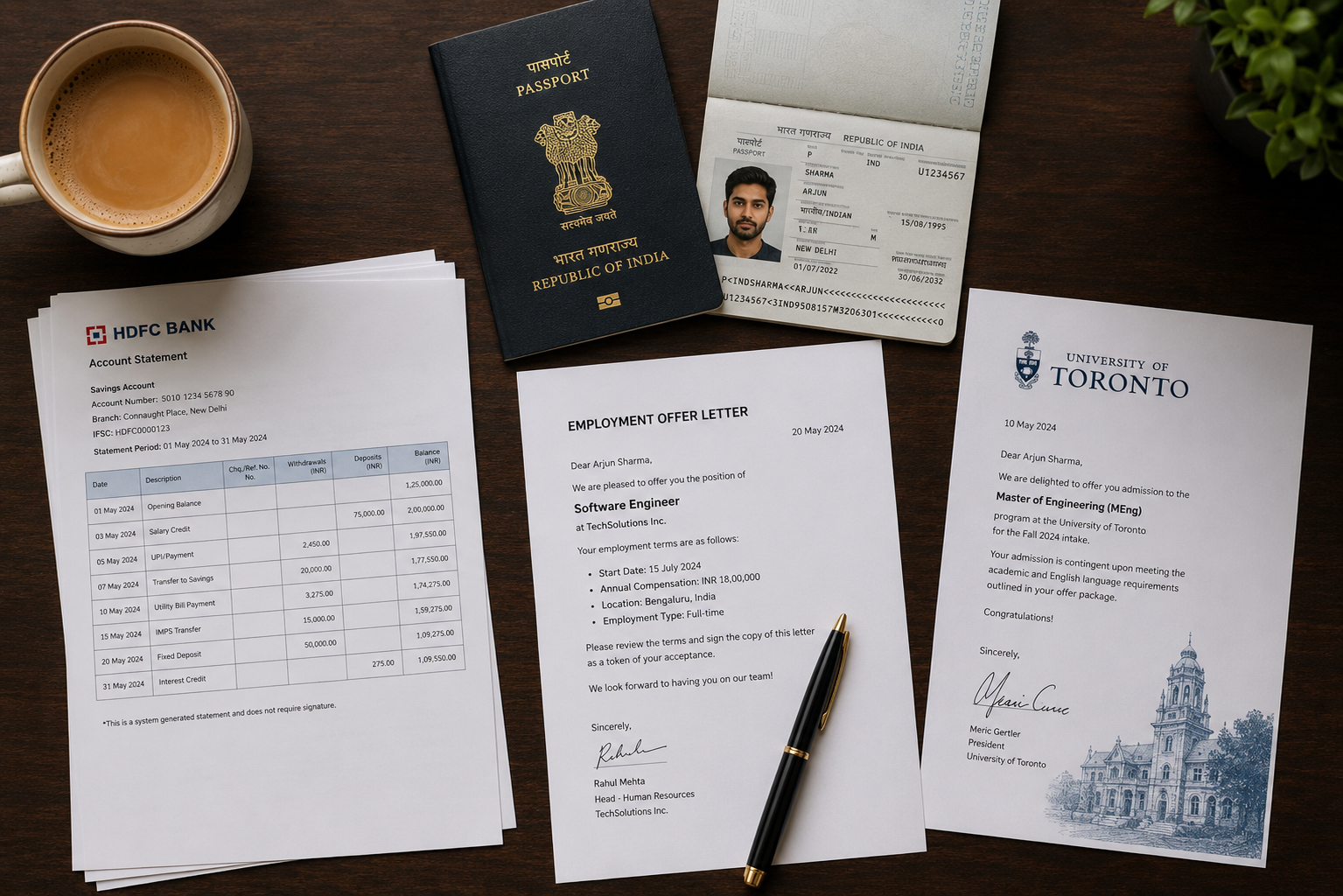
This is where most Indians get caught off guard. Foreign landlords and letting agents require documentation that Indians often don't have — especially when they've just arrived.
Standard documents required in most countries:
Passport (always)
Visa / Right to Rent documentation (legally required in UK, US, Canada, Australia)
Proof of income or employment contract (offer letter, pay slips, bank statements)
Credit report (major issue for new arrivals — more on this below)
Reference letters (from previous landlord or employer)
Bank statements (typically 3–6 months)
Student ID / University acceptance letter (for students)
The Indian-specific challenge: When you arrive in a new country, you have no local credit history, no local bank statements, and no local rental references. This is called the "newcomer gap" and it affects Indians disproportionately because Indian financial history does not transfer internationally.
How to bridge the gap:
Ask your employer to write a guarantor letter confirming your salary
Offer to pay 2–3 months rent upfront (legal in most countries and often accepted by landlords)
Use a rent guarantor service — companies like Guarantor Me (UK) or Leap Easy (US) act as your guarantor for a fee
Get a letter from your Indian bank confirming your savings balance
Apply for university-managed accommodation first while you build local history
Step 2: Know Your Budget — The Real Cost of Renting Abroad
Indians often budget for rent and forget everything else. Here is what renting abroad actually costs when you add it all up:
Cost Item | Typical Amount | Notes |
|---|---|---|
Monthly Rent | Varies widely by city | The baseline |
Security Deposit | 1–2 months rent | Refundable (if no damage) |
Holding Deposit | 1 week's rent (UK) | To reserve the property |
Agency/Admin Fees | £0–£500 / $0–$500 | Banned for tenants in UK; varies in US |
First Month Rent Upfront | 1 month | Standard everywhere |
Utility Setup | £100–£300 | Gas, electricity, internet connection |
Council Tax / Local Tax | Varies | UK: £100–£200/month; students exempt in UK |
Contents Insurance | £5–£20/month | Not mandatory but strongly recommended |
Furniture/Essentials | £300–£1,500 | If unfurnished — common in US, Canada |
Moving Costs | £50–£500 | Van rental or moving service |
Real example: In London, if you're renting a room at £1,200/month, your initial move-in cost before you've lived there a single day could be £3,500–£4,500 — nearly three months' rent in one hit. Plan for this.
Country-by-Country: What Indians Need to Know
🇬🇧 United Kingdom
The UK has one of the most tenant-protective rental markets in the world — but also one of the most competitive, particularly in London, Manchester, and Birmingham.
Key facts:
Landlords must check your Right to Rent before letting to you — this is a legal requirement under the Immigration Act 2014
Your deposit must be placed in a government-approved Tenancy Deposit Scheme (TDS) within 30 days — if it isn't, your landlord is breaking the law (tenancydepositscheme.com)
Letting agent fees for tenants are banned under the Tenant Fees Act 2019
Average rent in London: £2,200/month for a one-bed (Rightmove, 2024)
Average rent outside London: £900–£1,400/month for a one-bed
Best platforms: Rightmove | Zoopla | SpareRoom (for rooms) | OpenRent (direct from landlords, no agent fees)
Indian community tip: Cities like Leicester, Southall (London), Wolverhampton, and Bradford have large Indian communities and often more landlord flexibility for newcomers.
🇺🇸 United States
The US rental market is highly decentralised — rules vary dramatically by state and even city. There is no single national tenant protection law.
Key facts:
Credit score is everything in the US. Most landlords require a score of 620+ (FICO). As a new arrival, you'll have no score
Use services like Nova Credit — they translate your Indian credit history into a US-equivalent report, accepted by major landlords
Security deposits vary by state — typically 1–2 months, but can be higher
Renters insurance is not mandatory but frequently required by landlords — costs $10–$20/month
Average rent: $1,700/month nationally; $3,200+ in NYC and San Francisco (Zillow, 2024)
Leases are typically 12 months, with penalties for early termination
Best platforms: Zillow | Apartments.com | Craigslist (use with caution — scams exist) | Facebook Marketplace for rooms
Indian community tip: Cities like Fremont (CA), Edison (NJ), Sunnyvale (CA), and Schaumburg (IL) have large Indian populations and landlords familiar with Indian newcomers.
🇨🇦 Canada
Canada is experiencing a housing crisis — particularly in Toronto and Vancouver. Vacancy rates are at historic lows and competition is fierce.
Key facts:
Average rent in Toronto: CAD $2,500/month for a one-bed (CMHC, 2024)
Average rent in Vancouver: CAD $2,800/month for a one-bed
Average rent in smaller cities (Calgary, Ottawa, Halifax): CAD $1,400–$1,900/month
Landlord-tenant laws are provincial — Ontario, BC, and Alberta all have different rules
In Ontario, landlords cannot raise rent more than the government-set guideline rate (2.5% in 2024)
No credit history? Try Landlord Credit Bureau to start building one immediately
Best platforms: Rentals.ca | PadMapper | Kijiji | Zumper
Indian community tip: Brampton and Mississauga in Ontario have the largest Indian communities in Canada — landlords there are significantly more familiar with Indian newcomers and often more flexible.
🇦🇺 Australia
Australia's rental market is also under severe pressure, with vacancy rates in Sydney and Melbourne under 1% as of 2024.
Key facts:
Average rent in Sydney: AUD $3,200/month for a one-bed (Domain, 2024)
Average rent in Melbourne: AUD $2,400/month for a one-bed
Average rent in Brisbane, Adelaide, Perth: AUD $1,800–$2,200/month
Rental applications are highly competitive — you may apply for 10–20 properties before being accepted
Bonds (deposits) are capped at 4 weeks' rent and must be lodged with the state's bond authority
Rental laws are state-based — check your state's Fair Trading authority
Best platforms: Domain | Realestate.com.au | Flatmates.com.au (for rooms)
Indian community tip: Melbourne's western suburbs (Dandenong, Springvale) and Sydney's Parramatta and Harris Park areas have large Indian communities with welcoming landlord networks.
🇦🇪 UAE (Dubai & Abu Dhabi)
The UAE operates on an entirely different rental model from Western countries — and Indians are one of the largest renting populations there.
Key facts:
Rent is often paid via post-dated cheques — 1 to 4 cheques for the year upfront. This is standard practice
No formal credit check system — income proof and visa are the main requirements
Annual rent in Dubai: AED 50,000–120,000 for a one-bed depending on area (PropertyFinder, 2024)
All tenancy contracts must be registered with Ejari (Dubai) or Tawtheeq (Abu Dhabi) — this is legally required and protects you
Landlords cannot increase rent beyond the RERA Rental Calculator limits in Dubai — check yours at Dubai Land Department
No rent control in Abu Dhabi — increases are negotiated
Best platforms: Bayut | Dubizzle | PropertyFinder
The Rental Scam Playbook — And How to Avoid It
Indians abroad are disproportionately targeted by rental scams. A 2023 report by Action Fraud UK found that rental fraud cost victims an average of £1,500 per incident, with international students among the highest-risk groups.
Common scams targeting Indians:
1. The Phantom Listing A property is advertised at below-market rent with beautiful photos. The "landlord" claims to be abroad and asks you to transfer a deposit before viewing. You transfer the money. The property doesn't exist. Rule: Never pay anything before physically viewing a property.
2. The Bait-and-Switch You're shown one property, sign for it, and are then told that property is "no longer available" but a worse one at the same price is. Your deposit has already been taken. Rule: Ensure your contract specifically describes the exact property you viewed.
3. The Unlicensed Landlord In countries like the UK, landlords renting HMOs (Houses in Multiple Occupation) require a licence. Renting from an unlicensed landlord means you have no legal protection. Rule: Ask for the landlord's licence number. Verify it with the local council.
4. The Deposit Trap A landlord invents damage or cleanliness issues at the end of your tenancy to withhold your deposit. Rule: Take timestamped photos of every room, wall, appliance, and fixture on the day you move in. Email them to the landlord immediately.
5. The Fake Agent Someone poses as a letting agent with a professional-looking website. They collect fees and disappear. Rule: In the UK, verify agents on ARLA Propertymark. In the US, check state real estate licensing boards.
Reading a Lease: What to Check Before You Sign
A lease is a legal contract. Many Indians sign it without reading it fully — sometimes because it's 20 pages long, sometimes because they're desperate, and sometimes because they don't know what to look for.
Non-negotiables to check:
✅ Exact address and description of the property you are renting
✅ Rent amount, due date, and acceptable payment methods
✅ Lease duration and what happens at the end (auto-renewal? Notice required?)
✅ Notice period required from both sides to end the tenancy
✅ Deposit amount and conditions for its return
✅ Who is responsible for repairs — landlord vs tenant responsibilities
✅ Rules on subletting — can you take a flatmate?
✅ Pet policy (if relevant)
✅ Guest policy — some leases restrict how long guests can stay
✅ Rent increase clause — can rent be raised mid-lease? By how much?
✅ Early termination clause — what is the penalty if you need to leave early?
✅ What utilities are included (if any)
If anything is unclear, ask. If the landlord resists clarification on any clause, treat that as a red flag.
Your Tenant Rights — Across Key Countries
Right | UK | USA | Canada | Australia | UAE |
|---|---|---|---|---|---|
Written lease required | ✅ | Varies by state | ✅ | ✅ | ✅ (Ejari) |
Deposit protection | ✅ Legal scheme | Varies | ✅ | ✅ Bond authority | ❌ |
Repairs landlord's responsibility | ✅ | ✅ | ✅ | ✅ | Partially |
Eviction notice required | ✅ Min. 2 months | Varies (3–30 days) | ✅ 60 days | ✅ 90 days | ✅ 12 months |
Rent increase limits | ✅ Once/year | Varies | ✅ Provincial caps | Varies by state | Dubai: RERA cap |
Right to quiet enjoyment | ✅ | ✅ | ✅ | ✅ | Limited |
Know your rights. Landlords abroad often assume you don't.
Smart Tips Specifically for Indians Renting Abroad
1. Join Indian community Facebook groups before you arrive Groups like "Indians in London," "Desis in Toronto," or "Indians in Melbourne" are goldmines for housing leads, landlord recommendations, and scam warnings. Real people share real experiences.
2. University accommodation first, private renting second If you're a student, take university housing for your first semester even if it's more expensive. Use that time to find the right private rental without desperation.
3. Always negotiate Even in markets where it's less common, there is often room to negotiate — a lower deposit in exchange for upfront rent, or inclusion of internet/utilities. The worst they can say is no.
4. Understand the difference between furnished and unfurnished In the UK and Australia, most rentals are unfurnished but include white goods (fridge, washing machine). In the US and Canada, unfurnished often means absolutely nothing — no appliances, no fixtures, nothing. Budget accordingly.
5. Check the broadband situation before signing This sounds minor. It is not. In many older UK buildings, getting fibre broadband installed takes 4–6 weeks and requires landlord permission. For Indians used to fast, affordable Jio broadband — this is a genuine shock.
6. Build your credit score from Day 1 Open a bank account immediately. Use a credit card for small purchases and pay it off monthly. Register on the electoral roll if eligible (UK). Use apps like Experian Boost (US/UK) to add utility and subscription payments to your credit record.
Useful Resources by Country
Country | Tenant Support | Official Resource |
|---|---|---|
UK | Shelter England | |
UK | Citizens Advice | |
USA | HUD Tenant Rights | |
Canada | CMHC Housing Help | |
Australia | Tenants Victoria | |
Australia | NSW Fair Trading | |
UAE | Dubai Land Department | |
UAE | RERA Rental Calculator |
Frequently Asked Questions
Q: Can an Indian with no credit history rent abroad? Yes — but it requires preparation. Offer upfront rent, use a guarantor service, or provide strong proof of income. Building local credit from Day 1 is essential for future rentals.
Q: Is it legal for a landlord abroad to refuse to rent to me because I'm Indian? In the UK, US, Canada, and Australia — yes, this is illegal under discrimination laws. In the UK, the Equality Act 2010 prohibits racial discrimination in housing. In the US, the Fair Housing Act applies. If you experience discrimination, report it to the relevant authority.
Q: Should I use a letting agent or rent directly from a landlord? Both have pros and cons. Agents offer more formal processes and legal protection but charge fees in some markets. Direct landlords are often more flexible but carry more risk. Use verified platforms either way.
Q: Can I break a lease early if I need to move? Most leases allow early termination with a penalty — typically 1–2 months rent or forfeiture of deposit. Some have a break clause allowing exit after a set period (usually 6 months in the UK). Check your lease before signing.
Q: What if my landlord refuses to return my deposit? In the UK, escalate to the Tenancy Deposit Scheme for free dispute resolution. In the US, file a complaint with your state's housing authority. In Australia, contact your state's Fair Trading office. Always have photographic evidence from move-in day.
Final Thoughts
Renting abroad as an Indian is not impossible — millions of Indians do it successfully every year. But it requires preparation that nobody tells you about in advance. Know your documents. Know your budget (the real one). Know your rights. Read the lease. Take the photos. Build your credit from Day 1.
The rental market abroad doesn't care that you're new. But you can show up prepared — and that changes everything.
IndiaWale Abroad exists precisely for moments like this — to give you the knowledge that the system assumes you already have. Bookmark this page. Share it with every Indian you know who's about to move abroad. It might save them thousands.
Have a renting abroad experience — good, bad, or ugly? Share it in the comments. Your story could be exactly what another Indian needs to read before they sign.



Comments
No approved comments yet. Be the first to comment.