

If you have been watching your Comprehensive Ranking System (CRS) score and waiting for a general Express Entry draw to drop to your level — you may be waiting a very long time.
Canada's Express Entry system has fundamentally changed. General all-program draws are no longer the primary mechanism for most candidates. The system that Indians spent years studying and preparing for in 2022 and 2023 looks almost nothing like the one operating in 2026. New draw categories have replaced the open pool. Arranged employment points were eliminated entirely. And the pool itself — sitting at nearly 239,000 profiles as of late May 2026 — is more crowded than ever.
But here is what the headlines miss: the opportunity has not disappeared. It has just moved. For Indians who understand how the 2026 system actually works — which categories are drawing, which CRS ranges are realistic, and which strategies are producing actual Invitations to Apply — this is still a very achievable path to Canada PR.
This guide gives you the complete, current picture: the latest draw data, the category-by-category breakdown, the strategies that work in 2026, and the mistakes that are quietly killing Indian profiles before they even get a chance.
238,847
Profiles in the Express Entry pool as of May 2026
72,007
ITAs issued by IRCC in 2026 through May (27 draws)
379–419
French-language draw CRS range in 2026
514–547
CEC general draw CRS range in 2026
The New Reality: Why 2026 Express Entry Is Not the System You Studied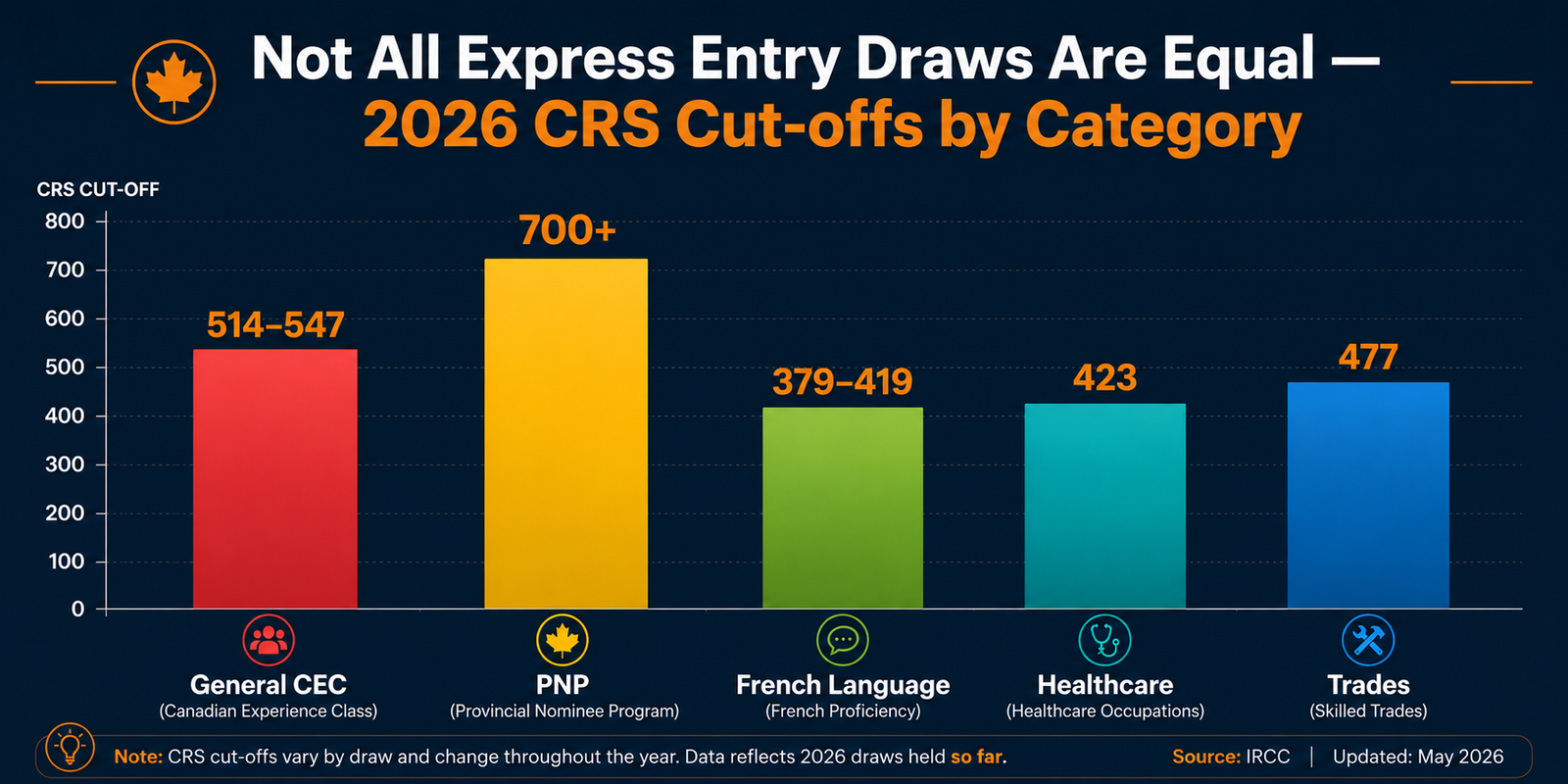
The original promise of Express Entry — submit a profile, rank by CRS, highest scores get invited — still technically exists. But the practice has moved far from this simple model.
[Insert Content Image 1 here — CRS cut-offs by draw category bar chart]
Here is what has actually happened to Express Entry since 2023:
General all-program draws have essentially stopped. In 2025, IRCC issued zero general invitations to Federal Skilled Worker (FSW) candidates outside Canada. Every ITA went through Canadian Experience Class (CEC), Provincial Nominee Programs (PNPs), or category-based selections. If you are outside Canada applying as a skilled worker — you need a category or a PNP nomination.
Category-based draws are now the dominant mechanism. In 2026, IRCC added five new occupational categories in February alone — Senior Managers, Researchers, Transport Workers, Skilled Military Recruits, and Physicians. There are now ten active categories pulling from the Express Entry pool. Five new categories were launched in February 2026 alone.
Arranged employment points were removed in March 2025. The 50-point and 200-point bonuses that a valid LMIA job offer used to add to your CRS score are completely gone. A job offer still helps with program eligibility and PNP nominations — but it no longer moves your CRS number directly.
The STEM category has been dormant for over 25 months. If your plan was to qualify through the STEM category draw, you need an alternative strategy now.
Canadian work experience minimums went up. Several priority categories raised the minimum qualifying work experience from 6 months to 12 months. If you have less than a year of Canadian work experience, check whether this affects your category eligibility.
The bottom line for Indian applicants: Your CRS score matters less than whether you qualify for a category draw. A candidate with CRS 450 in a healthcare or trades occupation can receive an ITA before a general CEC draw ever reaches that score. The question is no longer "what is my CRS score?" — it is "which draw category can I qualify for?"
2026 CRS Cut-Offs by Draw Type — The Complete Picture
Understanding exactly which cut-offs apply to which draw type is the single most important piece of information for any Indian Express Entry candidate in 2026. Here is the current data:
Draw Type | 2026 CRS Range | Volume per Draw | Who Qualifies | Key Requirement |
|---|---|---|---|---|
Canadian Experience Class (CEC) | 514–547 | 3,500–5,000 | Candidates with 1+ year Canadian work exp | Must be in Canada with qualifying NOC work history |
French Language Proficiency | 379–419 | 4,000–6,000 | Any program (FSW, CEC, FSTP) | NCLC 7+ in all four skills (speaking, listening, reading, writing) |
Healthcare Occupations | ~423 | Varies | Specific NOC healthcare codes | Occupation in approved healthcare NOC list |
Trades Occupations | ~477 | Varies | Skilled trades NOC codes | Qualifying trades occupation + 12 months experience |
Provincial Nominee Program (PNP) | 700+ | Varies | Any program with provincial nomination | Provincial nomination (adds 600 CRS automatically) |
Education Occupations | Similar to healthcare range | Varies | Teachers, ECE, education support | Qualifying education NOC code |
General All-Program | Very high / rare | Rare in 2026 | Any program | Top-ranked profiles in pool |
💡 What this table tells you: The difference between a French draw cut-off (379) and a CEC draw cut-off (547) is 168 points. That is the value of qualifying for a category. An Indian candidate with CRS 430 and strong enough French language scores qualifies for every French draw. The same candidate without French qualifications is more than 100 points below a CEC draw floor.
The New 2026 Categories — Added February 18, 2026
Five new category-based draws were formally announced by IRCC in February 2026, expanding the total number of active categories to ten:
Senior Managers (NOC Major Group 00)
Researchers (academic and industrial research roles)
Transport Workers (pilots, transportation infrastructure roles)
Skilled Military Recruits
Physicians (quietly added December 8, 2025 — now formally part of the 2026 framework)
⚠ The Agriculture category is gone: The Agriculture and Agri-food category was retired for 2026. If your previous strategy relied on qualifying through agriculture occupations, that route is closed and you need to reassess your approach entirely.
The 8 CRS Strategies That Are Actually Working in 2026
These are not theoretical suggestions. These are the specific levers that are producing point gains and actual ITAs for Express Entry candidates in 2026, updated for the post-March 2025 environment.
[Insert Content Image 2 here — CRS boost toolkit graphic]
STRATEGY 1 +600 CRS points
Get a Provincial Nomination — The Single Biggest Lever
A provincial or territorial nomination through an Enhanced PNP stream adds a flat 600 CRS points to your Express Entry profile. This single move lifts virtually any profile above 700 — clearing every draw type in 2026. With 91,500 PNP spots available in 2026, this is no longer a backup plan. For the majority of Indians currently sitting in the 400–500 CRS range, PNP nomination is the primary pathway to an ITA.
Top PNP streams for Indians in 2026: Ontario Immigrant Nominee Program (OINP) — Tech Draw; British Columbia PNP — Tech Pilot; Alberta Advantage Immigration Program; Saskatchewan Immigrant Nominee Program (SINP)
Key insight: Each province runs its own draws independently of IRCC. Express Entry PNP streams draw from the same federal pool but with provincial criteria. Monitoring multiple provincial draws simultaneously is essential.
Important: PNP streams have their own eligibility requirements — occupation, salary, connection to the province, or existing job offer. Meeting the CRS threshold is necessary but not sufficient.
Province | Key Stream for Indians | What They Prioritise |
|---|---|---|
Ontario (OINP) | Tech Draw, Human Capital Priorities | IT, engineering, finance roles; profiles already in pool |
British Columbia | Tech Pilot, Skills Immigration | Tech sector, healthcare, skilled trades |
Alberta | Alberta Advantage Immigration Program (AAIP) | Engineering, IT, healthcare, oil & gas adjacent |
Saskatchewan | SINP — Express Entry | Skilled workers with job offer or in-demand occupation |
Nova Scotia | Nova Scotia Nominee Program | Healthcare, education — smaller but active draws |
STRATEGY 2 +25 to +70 CRS points
Add French Language Skills — The Most Underused Strategy for Indians
French language proficiency is the highest-impact CRS strategy available to Indian candidates who are currently outside Canada and do not have Canadian work experience. Here is why it is so powerful in 2026:
Direct CRS points: NCLC 7 across all four skills (speaking, listening, reading, writing) adds 25–50 CRS points directly. NCLC 9 adds 50–70 points.
Category draw eligibility: French language proficiency at NCLC 7 qualifies you for French category draws — which have been running at CRS 379–419 in 2026. These are among the lowest cut-offs in the entire Express Entry system.
Canada's target: Canada has a federal target to admit 9% French-speaking permanent residents outside Quebec in 2026, rising to 10.5% in 2027. IRCC will continue to prioritise French draws to meet this target.
Test to take: TEF Canada or TCF Canada (for FSW/CEC eligibility)
✅ Real-world example for Indian candidates: An Indian software engineer with CRS 430 and no Canadian experience currently cannot qualify for a CEC draw (floor: 514) or a general draw. The same candidate adds NCLC 7 French → CRS rises to approximately 480 → qualifies for every French language draw in 2026. Six months of French study and one exam can be the difference between years of waiting and an ITA within months.
STRATEGY 3 +40 to +74 CRS points
Retake Your Language Test — The Fastest Wins Are Here
Language proficiency — specifically your first official language (English) score — is the single largest variable you can directly control in your CRS calculation. The difference between CLB 8 and CLB 10 can be worth 40–74 points depending on whether you have a spouse on your application.
IELTS Score | CLB Level | Approx CRS Impact vs CLB 8 (single) |
|---|---|---|
6.0 per band | CLB 8 | Baseline |
7.0 per band | CLB 9 | +26 to +38 points |
8.0 per band | CLB 10 | +40 to +60 points |
8.5–9.0 per band | CLB 10+ | Maximum points — up to +74 with skill transferability |
Many Indian candidates sitting with CLB 8 or 9 scores took their IELTS years ago. Retaking and improving by even one band across multiple skills can produce a significant point gain at minimal cost. This is the fastest, cheapest CRS boost available before pursuing more complex strategies.
STRATEGY 4 +15 to +30 CRS points
Check Your Canadian Study Bonus — If You Studied in Canada
If you completed a post-secondary degree or diploma in Canada, you may be leaving CRS points on the table if this is not correctly claimed or documented in your profile:
1-year Canadian post-secondary credential → +15 CRS points
2+ year Canadian post-secondary credential, or a Master's or PhD from a Canadian institution → +30 CRS points
This also significantly boosts your Skill Transferability score when combined with strong language results. For recent Indian graduates from Canadian universities — correctly structuring your profile around your Canadian credential is essential and often underdone.
STRATEGY 5 +15 CRS points
Sibling in Canada — A Free 15 Points Many Indians Miss
If you have a brother or sister who is a Canadian citizen or permanent resident, and they are 18 or older, you are entitled to 15 additional CRS points simply by declaring this on your Express Entry profile. This is one of the most overlooked point sources in the entire system.
Requirements: The sibling must be a Canadian citizen or PR. Both you and your sibling must be at least 18 years old. You must be the applicant (not your spouse) who has the qualifying sibling.
💡 Note on proposed reforms: IRCC has proposed removing sibling bonus points as part of a broader 2026 reform package. The proposal is not yet implemented — these points remain valid in the current system. But if you qualify, claim them now and do not wait for the reform timeline to crystallise.
STRATEGY 6 +25 to +50 CRS points
Maximise Skill Transferability — The Bonus Most Profiles Ignore
Skill Transferability factors add up to 100 points to your CRS score based on combinations of your core attributes. Many profiles leave 20–50 points here by not structuring their experience correctly. The key combinations are:
Education + Language: A post-secondary degree + CLB 9+ English = up to 50 transferability points
Foreign Work Experience + Language: 3+ years foreign experience + CLB 9+ = up to 25 points
Foreign Work Experience + Canadian Education: 3+ years foreign exp + Canadian degree = up to 25 points
Canadian Work Experience + Education: 1+ year Canadian exp + post-secondary = up to 25 points
Crucially, both elements in each combination must meet their respective thresholds to earn the bonus. If your language score is at CLB 8, improving it to CLB 9 does not just earn direct language points — it can unlock an entire skill transferability combination that was previously inaccessible.
STRATEGY 7 Category eligibility
Check Your NOC Code Against Active 2026 Categories — You May Already Qualify
The ten active Express Entry categories in 2026 are pulling candidates with far lower CRS scores than CEC or general draws. Before pursuing any of the score-boosting strategies above, check whether your NOC occupation code already qualifies you for one of these categories:
Category | Typical CRS Cut-off 2026 | Key Occupations for Indians |
|---|---|---|
French Language Proficiency | 379–419 | Any occupation — just need NCLC 7 |
Healthcare Occupations | ~423 | Nurses, pharmacists, physiotherapists, medical lab techs |
Education Occupations | ~420–450 | Teachers, early childhood educators, special ed support |
Trades Occupations | ~477 | Electricians, plumbers, welders, construction supervisors |
Transport Occupations | TBC (new 2026) | Transport infrastructure, logistics, aviation |
Researchers | TBC (new 2026) | Academic researchers, industrial R&D |
Senior Managers | TBC (new 2026) | NOC 00 — C-suite and senior management |
Physicians | TBC | Medical doctors with qualifying Canadian experience |
Note: Category-based draws require 12 months of qualifying experience in the relevant occupation (updated from 6 months in 2025). Verify your NOC code mapping carefully — a misclassified occupation is a common and costly mistake.
STRATEGY 8 +15 to +30 CRS points
Add Post-Secondary Education — If a Second Degree Makes Strategic Sense
For Indian candidates who are a few years away from their target CRS score and have no other fast levers available, completing an additional Canadian credential — specifically a 1-year or 2-year graduate certificate from a Canadian college — can add 15–30 CRS points directly, plus unlock Canadian study bonus points, Skill Transferability bonuses, and potentially Canadian work experience through a post-graduation work permit (PGWP).
This is a longer-term strategy (12–24 months) but one that builds multiple CRS advantages simultaneously. It is most relevant for Indian candidates who:
Have a bachelor's degree but no master's
Are considering Canadian study anyway for career development
Have a CRS score in the 430–480 range with no other fast levers
Want to transition from FSW eligibility to CEC eligibility (Canadian work exp via PGWP)
The CRS Cheatsheet for Indian Applicants — What Your Score Actually Means in 2026
📊 CRS Score Interpretation Guide — 2026
Your CRS Range | Current Situation | Recommended Strategy |
|---|---|---|
700+ | PNP nomination in place — ITA is coming | Ensure application is complete and ready to submit within 60 days of ITA |
550–699 | Competitive for CEC draws. Apply PNPs proactively. | Monitor CEC draws closely. Apply to all eligible provincial PNP streams simultaneously. |
500–549 | Near CEC draw threshold. Gap is closeable. | Retake IELTS. Check French language. Apply to province-specific PNPs. Check NOC for category eligibility. |
450–499 | Too low for CEC. Strategy shift required. | French proficiency draw (fastest route if NCLC 7 achievable). PNP nomination. Category draw eligibility check. |
400–449 | Currently outside all draw ranges except French. | French language is your primary lever. PNP is your primary route. Multiple simultaneous strategies needed. |
Below 400 | Significant profile improvement needed. | Major intervention required: language retest, French, PNP, or reconsider alternative pathways (other countries). |
What Has Changed Since March 2025 — The Arranged Employment Update
One of the most significant rule changes in Express Entry history happened quietly on March 25, 2025 — and many Indian applicants (and some consultants) are still acting as though it did not happen.
What changed: IRCC removed all CRS points for arranged employment. This means:
The 50 CRS points previously earned by a valid LMIA-supported job offer (TEER 0–3) — gone
The 200 CRS points previously earned by a senior manager NOC 00 LMIA job offer — gone
A job offer still supports program eligibility for FSW and FST streams
A job offer can still support a PNP nomination, which indirectly adds 600 CRS points — but the direct path no longer exists
⚠ Scam warning: Unscrupulous agents are still offering to "get you an LMIA for CRS points" — often at significant cost. This is either a scam or dangerously out-of-date advice. LMIA job offers no longer add any points to your CRS score. Do not pay for one for this purpose.
The 2026 Express Entry Reform Proposal — What May Change
IRCC has proposed the biggest structural overhaul of Express Entry since its 2015 launch. These are proposals — not yet implemented — but Indian applicants need to be aware of what may be coming:
Proposed Change | Current Rule | Proposed Rule | Impact on Indian Profiles |
|---|---|---|---|
Merge three programs into one | FSW, CEC, FSTP are separate streams | Single unified Express Entry program | Simplification — may change eligibility thresholds |
Remove spousal points | Spouse attributes add up to 40 CRS points | No points for spousal education/language | Couples relying on spousal language strength may lose 20–40 points |
Remove French proficiency bonus | French adds 25–70 direct CRS points | French points replaced by category draw access only | French investment still worthwhile for category draws — but direct CRS math changes |
Remove sibling-in-Canada bonus | +15 CRS for sibling who is citizen/PR | Removed | 15-point loss for qualifying Indian applicants |
Remove Canadian study bonus | +15 or +30 for Canadian education | Removed | Indian graduates from Canadian institutions lose this direct bonus |
New: high-wage occupation bonus | Does not exist | Points for working in a high-wage occupation | Could benefit Indian IT and finance professionals in Canada with above-median wages |
What this means for your strategy: The proposed reforms are not yet law. But if you have sibling-in-Canada points or are benefiting from spousal language/education points — the message is clear: do not delay your profile submission assuming these will still exist in 12 months. The current system is more generous to family ties than the proposed one. Act while the current rules apply.
5 Mistakes Indian Applicants Are Making in 2026 Express Entry
Waiting for a general draw that may not come: Many Indian FSW candidates outside Canada are still submitting profiles and passively waiting. In 2025, there were zero general FSW draws for candidates outside Canada. If your strategy is "wait for the general draw to drop to my score" — you need a new strategy today.
Not monitoring PNP draws: Provincial nominee draws happen independently of federal Express Entry draws and are not widely covered in mainstream immigration news. Many Indian applicants receive an OINP or BC PNP notification they were not expecting — because they set up the profile correctly and waited. Others miss their window because they were only watching federal draw announcements.
Ignoring French language completely: "I am not going to Quebec" is not a reason to ignore French. French language draws apply to candidates settling anywhere outside Quebec. An Indian engineer in Brampton or Calgary who speaks French at CLB 7 can access draws at CRS 379. The same candidate without French is waiting for CEC draws at 514+.
Incorrect NOC code — the silent disqualifier: Your National Occupation Classification (NOC) code determines your program eligibility, category draw eligibility, and how your work experience is assessed. A wrong NOC code — choosing the one with the better-sounding title rather than the one that actually matches your duties — is one of the most common and most damaging errors in Express Entry applications. Your NOC must be supported by your actual job duties, not just your job title.
Old CRS calculators and outdated advice: The March 2025 arranged employment removal, the February 2026 new categories, and the ongoing reform proposals mean that any CRS calculator or advice from before mid-2025 is potentially misleading. Use IRCC's official calculator and verify any consultant advice against the current IRCC ministerial instructions.
Your 2026 Express Entry Action Plan — By Profile Type
Your Situation | Priority Action | Timeline |
|---|---|---|
Indian IT professional, CRS 430–490, outside Canada | Study French to NCLC 7. Apply to BC PNP Tech Pilot and OINP simultaneously. Check if your NOC qualifies for any 2026 category. | French: 6–9 months. PNP: ongoing monitoring. |
Indian nurse or pharmacist, any CRS | Check Healthcare category eligibility immediately. Update NOC code. 12 months qualifying experience required. | Healthcare draws are running now — act immediately. |
Indian with 1+ year Canadian work exp, CRS 510–545 | Monitor CEC draws — you are within range. Apply to province-specific PNPs to get the 600-point boost as a safety net. | CEC draws are bi-weekly. Check after every draw. |
Indian recent Canadian graduate | Get PGWP. Begin Canadian work experience clock. Use CEC pathway once you hit 12 months. Claim Canadian education bonus in profile. | 12–18 months to CEC eligibility. |
Indian trades worker (electrician, plumber, welder) | Trades category draw is running at CRS 477. Ensure FSTP eligibility. Get trade certification recognised by Canadian authority. | First 2026 trades draw ran April 2 — more expected. |
Indian researcher or senior academic | New Researchers category added February 2026. First draws expected in 2026. Prepare profile and document research credentials thoroughly. | Prepare now — draws likely in H2 2026. |
Indian with family member (sibling) in Canada | Claim the +15 sibling bonus immediately. It may be removed under proposed reforms. This free 15 points could move your profile into a category draw threshold. | Update profile now — do not delay. |
Not Sure Which Express Entry Strategy Fits Your Profile?
IndiaWale Abroad connects you with verified Canadian immigration consultants (RCICs) who specialise in Express Entry profile strategy for Indian applicants — and with Indians already living in Canada who can give you honest, unfiltered guidance on the PNP process, provincial life, and what nobody tells you before you arrive. No generic advice. Real strategy.
Find Your Canada Immigration Expert →
More Guides to Help You Plan Your Canada Move
👉 Canada's new work visa rule 2026 — what open work permit holders must know
👉 How to get a job abroad from India in 2026 — complete step-by-step strategy
👉 Countries Getting Easier for Indians in 2026 — if Canada is taking too long
Official IRCC Resources
Frequently Asked Questions
What is a good CRS score for Canada PR in 2026?
It depends entirely on the draw type you are targeting. For CEC (Canadian Experience Class) general draws, you need 514–547. For French language draws, as low as 379–419 qualifies. For PNP draws, 700+ (because the 600-point nomination boost takes virtually everyone above the threshold). For healthcare and trades categories, roughly 420–480. There is no single "good" score — your strategy determines what score you need to target.
Do LMIA job offers still add CRS points in 2026?
No. IRCC removed all arranged employment CRS points on March 25, 2025. The 50-point and 200-point bonuses that LMIA job offers used to provide are completely gone. A job offer can still help with program eligibility for FSW/FSTP applicants, and can support a PNP application — but it no longer adds any direct CRS points. Be very cautious of any consultant or service offering to "boost your CRS with an LMIA" — this is either misinformation or fraud.
Can Indians outside Canada use Express Entry in 2026?
Yes — but the pathway is much narrower than it was before 2023. Federal Skilled Worker (FSW) candidates outside Canada are technically eligible, but IRCC ran zero general FSW draws in 2025 and the trend continues into 2026. Realistically, Indians outside Canada need one of three things: (1) French language proficiency at NCLC 7+ to qualify for French category draws; (2) An occupation on the healthcare, trades, or other active category list; or (3) A provincial nomination through a PNP stream that does not require Canadian work experience. Passively submitting an FSW profile and waiting for a general draw is not a viable 2026 strategy.
How long does it take to learn French to CLB 7 for Express Entry?
For an English-speaking Indian professional with no prior French exposure, reaching NCLC 7 (roughly B2 level) in all four skills typically takes 6–12 months of focused study. Online platforms like Alliance Française, Duolingo (for basics), and dedicated TEF Canada preparation courses are widely used. The TEF Canada exam is accepted by IRCC for Express Entry. NCLC 7 is conversational French — not native fluency. For candidates who already have some European language exposure, the timeline can be shorter. The investment of 6–9 months of evening study can open category draws at CRS 379, making it one of the highest-return strategies in the entire system.
How do I know which PNP streams I qualify for?
Each province publishes its own eligibility criteria on its immigration website. The key variables are: your NOC code (occupation), whether you have a job offer in that province, your salary level, whether you have previous ties to the province (study, work, family), and your English/French language scores. The major PNP streams with Express Entry alignment for Indians are Ontario's OINP Tech Draw, BC PNP Tech Pilot, Alberta AAIP, and Saskatchewan SINP. You must create an Express Entry profile first — provincial PNP streams then draw from the federal pool. Checking all provinces simultaneously (rather than one at a time) is important because draw timing varies and you may qualify for multiple streams.
What is the STEM category and why has it not drawn in 25+ months?
The STEM (Science, Technology, Engineering, Mathematics) category was one of the original category-based draws introduced in 2023. It targeted software engineers, IT professionals, data scientists, and related occupations. However, it has been dormant since late 2023 — IRCC has not issued a single STEM draw in over 25 months. The most likely reason is that IRCC is satisfying tech talent demand through the CEC, French language, and the new Researchers category instead. Indian IT professionals who qualified under STEM should not count on a STEM draw in the near term and should identify alternative categories or strategies.
How often do Express Entry draws happen and how do I stay updated?
IRCC holds draws roughly every two weeks, though the schedule is not fixed. Category draws can happen outside this regular cadence. The most reliable way to stay updated is: (1) bookmark IRCC's official draw results page at canada.ca; (2) set up email alerts via immigration news services; (3) follow IRCC's official social media announcements. The CRS cut-off is only known after each draw is completed — it cannot be reliably predicted in advance, though patterns from recent draws give reasonable guidance for expectations.



Comments
No approved comments yet. Be the first to comment.